

Not Honeysuckle, Not Impatiens: The Easy-To-Grow Flower Hummingbirds Love
We may receive a commission on purchases made from links.
When gardeners picture flowers that attract hummingbirds, honeysuckle and impatiens often come to mind first. After all, they look beautiful and are easy to grow. But what if you want something different? Something that is not so common but still simple to grow and irresistible to hummingbirds. Meet Mexican giant hyssop (Agastache mexicana 'Sangria'). It is a herbaceous perennial native to the southwestern United States and northern Mexico and is known for its impressive heat and drought tolerance. It grows quickly as well, sending up vivid pink and purple tubular blooms from early summer through mid-fall.
Those flowers do more than draw hummingbirds and other pollinators. They also make an excellent option for cut flower gardens. Better still? The plant is usually pest-free, and deer generally leave it alone. Its foliage adds charm, too, with dark green, elliptical leaves that carry a fresh lemon scent. In size, Mexican giant hyssop reaches around 2 to 3 feet tall and 1 to 3 feet wide, with flower spikes stretching another foot above the leafy growth. You will need to be patient, though! The plant can take about 2 to 5 years to reach full height.
As for its use, you can tuck it into many garden spaces, from containers and borders to mass plantings and cottage gardens. The only thing that might limit its use is its hardiness. Mexican giant hyssop grows in USDA Hardiness Zones 7 through 10. In colder areas, you will need to grow it as an annual. Or you can grow other perennials that hummingbirds love.
Growing Mexican giant hyssop to attract hummingbirds
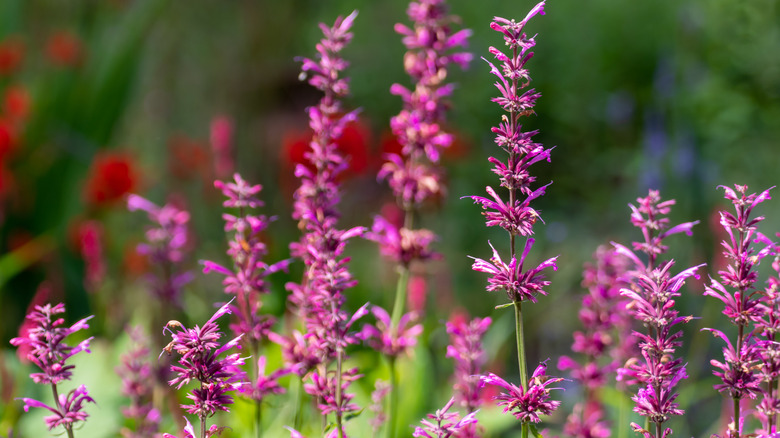
If your goal is to attract hummingbirds with Mexican giant hyssop, plant it in groups rather than setting single plants here and there. Hummingbirds and other pollinators notice clusters or groups of flowers more easily than isolated plants scattered across a garden. Grouping also makes foraging easy for them, so they stay longer in the garden as well. However, you should not crowd several Mexican giant hyssop plants carelessly in your garden. You must space them right! Without enough room, airflow drops between the plants, and that can raise the risk of fungal trouble in plants, especially in damp or tightly packed garden beds.
This is especially important because Mexican giant hyssop can be prone to powdery mildew – a fungal disease that creates a white or gray powdery layer on leaves, stems, and other plant parts, hurting both their appearance and health. So, make sure when growing Mexican giant hyssop, you space the plants at least 2 feet apart. As for the soil, make sure it is well-drained and moist. Avoid poorly drained ground, since soggy conditions can cause root or crown rot in Mexican giant hyssop.
It is also important to note here that while Mexican giant hyssop is not very picky about soil pH, it does best in slightly alkaline soil. So, if you can, test the pH of your garden soil with a home-based soil testing kit like Luster Leaf's Rapitest Soil Test Kit and make adjustments accordingly. For sunlight, full sun and part shade can both work, and you can start Mexican giant hyssop from either seed or division as well. The seeds, however, may be a little hard to find.