

What To Do If You Find Bright Orange Fungus Growing On Your Trees
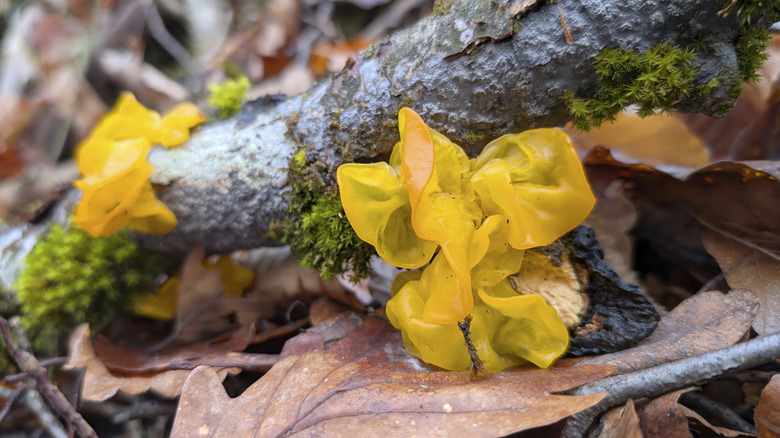
You're out walking through your garden after a heavy rainstorm. Suddenly, you spot it: a bright, gelatinous, neon-orange blob clinging to the bark of your beloved maple tree. It looks like an alien lifeform or a giant piece of gummy candy a kid left behind. Naturally, your first instinct might be to panic and wonder what exactly you need to do about it. Fortunately, we have good news: You can breathe a sigh of relief. This colorful growth is almost certainly a type of jelly fungus commonly known as witch's butter (aka Tremella mesenterica).
Despite the somewhat eerie name and striking appearance, witch's butter mushrooms are entirely harmless to the living parts of your trees. They're also one of many common mushrooms that can grow on trees in your yard. This yellow-to-orange fungus bursts into a brain-like shape and expands in wetter months. Alternatively, it shrinks, dulls, and tends to blend in with tree bark when dry, only to plump back up again (like a sponge) when the rain returns.
Witch's butter is an edible fungus, but you should still be cautious and learn how to tell edible mushrooms apart from poisonous ones before digging in. Otherwise, the most important thing to know is that it feeds exclusively on other harmless fungi and decaying wood. It's not damaging healthy, living plant tissue. So, if you see this brilliant orange fungus clinging to a branch, know that it's not killing your tree. Instead, it's simply doing its natural job of breaking down wood that has already died.
How to assess tree health after spotting witch's butter
You know this brightly colored visitor isn't a threat now, but you still need to figure out what to do about it. Since witch's butter only grows on dead or decaying wood, it means that a specific branch or section of your tree is no longer alive. If the orange fungus is only on a single broken or decaying limb, your best course of action is some standard tree maintenance. Just as you would trim away a dead or damaged branch without fungus on it, you could do the same here. By pruning away any decaying wood, you'll both help beautify your tree and remove the food source for the fungus.
If you discover witch's butter growing on your tree's central trunk or major limbs, it could indicate a bigger issue with its health and structural integrity. In this case, your best bet is to contact a certified arborist who can come over and evaluate the tree's status and whether it poses a safety hazard to your property.
Finally, if you spot this vibrant jelly fungus growing somewhere in your yard like on an old stump or in a brush pile, remember that it isn't dangerous. You don't need to do anything about it. In fact, feel free to leave the witch's butter be and enjoy the pop of natural color. It'll continue its beneficial work of decomposing organic matter and enriching your soil. Now, if you see a fairy ring in your yard, that might be a more serious matter altogether.