

11 Trends That Will Make Your Patio Look Outdated In 2026
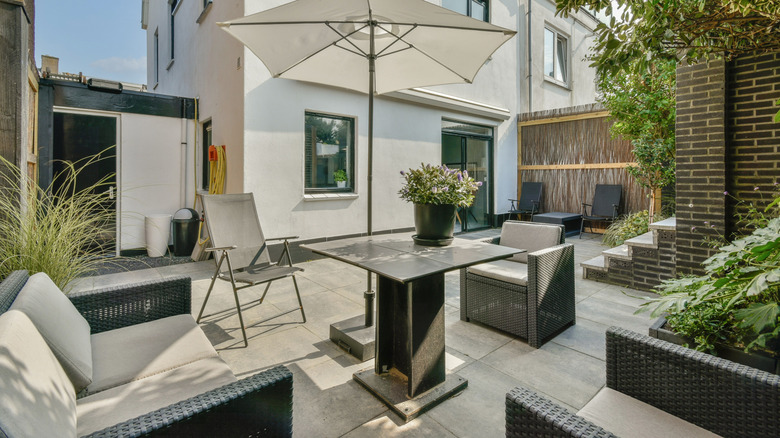
Are you after ideas to make your patio feel more like a living room? Or do you need to level up your deck for a summer full of parties? Perhaps you're ready to start work on your new patio but are unsure whether all those trendy patio ideas of yesteryear remain "en vogue" for 2026. Whatever your plans for your patio, this guide is here to help.
Below, we explore different patio trends which have lost their shine among design-minded homemakers. Some have well and truly lost their balance on the tightrope between modernly "cool" and stylistically stale and cold. Other, more prescriptive ideas are leaving a hungry hole in the hearts of creatives who crave a little more freedom of expression when layering their outdoor spaces. Some lack the flexibility required for modern, post-COVID-19-pandemic living, and others, despite placing little demand on the wallet, stand testament to the saying that when you buy cheap, you buy twice.
Matching outdoor furniture lacks personality and interest
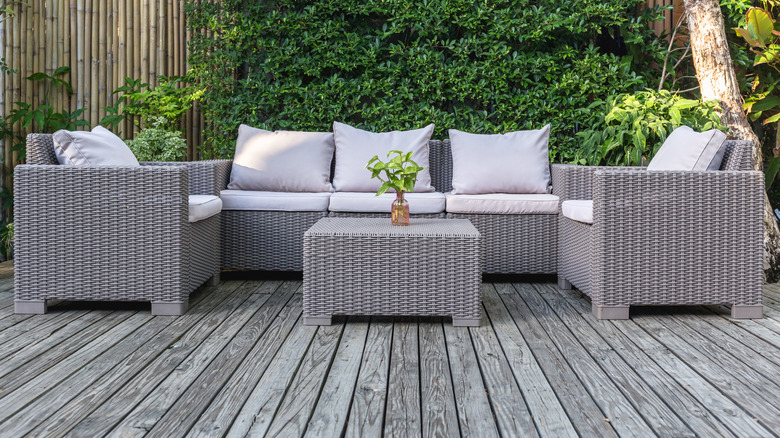
Regardless of how pretty they look in the showroom, matching furniture sets — including tables, chairs, chests, and all — are losing their luster in the world of patio design. This can be tricky to understand. After all, those cleverly laid out displays of outdoor furniture at Costco look great! The problem is, once they are hauled out of the showroom and plonked onto your patio, they can quickly lose the personality and interest that set them apart from the other sets on display. Matching sets of indoor furniture have long been relegated as outmoded, and now, the same is starting to become true of outdoor sets.
It is also important to understand how lifestyle shifts are changing outdoor furniture trends in 2026. More of us than ever are trying to extend the feeling of living room luxury into our gardens. And like it is indoors, the goal is to lace patio furnishings with personality and character. Intentionally pairing different furniture styles and materials goes a long way here, as does teaming up different colors across the soft furnishings. Many homeowners and designers are also favoring more curved forms and organic materials, which often glare in contrast against the clean, sterile lines of matching furniture sets.
Oversized, hardscape fire pits lack the flexibility for modern, social living
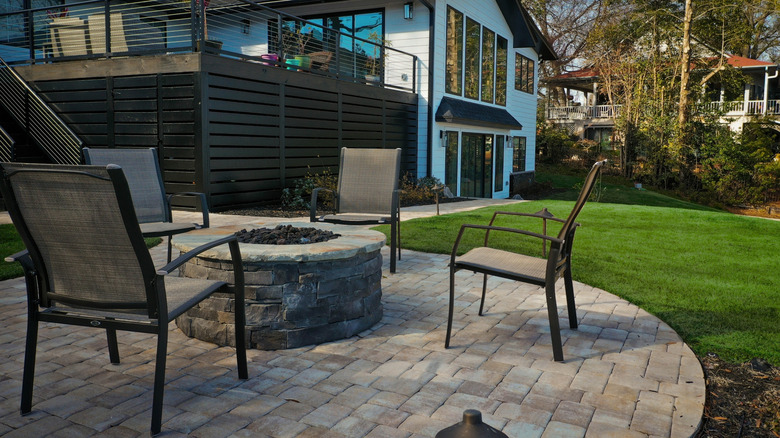
Not long ago, homeowners around North America were clamoring to find creative DIY fire pit ideas. The goal was simple: To extend those summer evening soirées after sunset, with toasted marshmallows and the warm shivers that run through us whenever we hear the crackle of flames. Now, we are not saying that humans have suddenly evolved beyond the enjoyment of a roaring fire. Far from it. But the wider demands we now place on our patios have. In short, homeowners require flexibility from their outdoor spaces, and over-imposing fire pits are starting to feel a bit passé.
"We are seeing some movement away from over-built fire pits," landscaping expert Dawn De Feo shared with Homes & Gardens, explaining that homeowners are leaning more towards simpler designs that don't dominate the exterior living area. And if you are limited on space — which, let's face it, many of us are — a hardscape fire pit may not be the best choice over, say, comfortable furnishings. The problem with hardscape fire pits is that once they are installed, that is it. There is no popping them in the shed to make room, and if you happen to run out of wood logs, they are of little use to you, anyway.
You might be better off shopping for high-quality smokeless fire pits. Being smokeless, these are excellent for gatherings, since they are less likely to fog the windward side of your party. Crucially, they are also portable, meaning that if you need to make room for more guests, you can.
Gray remains cool, and that's precisely the problem
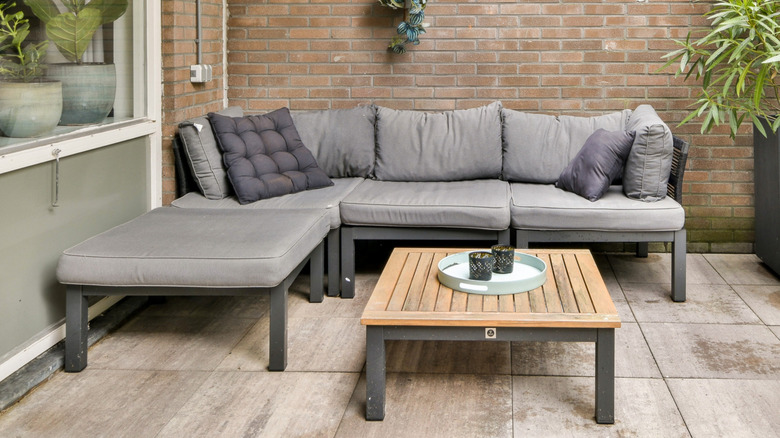
If you are hoping to avoid falling foul of outdated trends, then a safe bet, indoors and out, is to avoid one of the many shades of cool gray. Not only is it one of the most strongly outdated flooring trends for 2026, but gray has rather lost its shine in just about every corner of the home. First, let's explore why it was once considered so "hot." Gray is neutral, which makes it a reliable foundation on which to layer color. But the totalitarian gray takeover of the last few years saturated design to the point where, today, it feels massively overdone. In 2026, gray is very out of touch with the warmth most homeowners want to imbue their homes with.
Outdoor spaces were the final stronghold of gray-on-gray — but now, after years of patios being a predictable wash of gray (in both furniture and finishes), warm tones are returning. Sandy colors, earthy greens, woody browns, and more are all worth considering. If you are trying to achieve a greater sense of outdoor immersion, then the key is to find hues that harmonize and complement those of your yard.
Cheap patio furniture doesn't look stylish, or meet the demands of modern homeowners
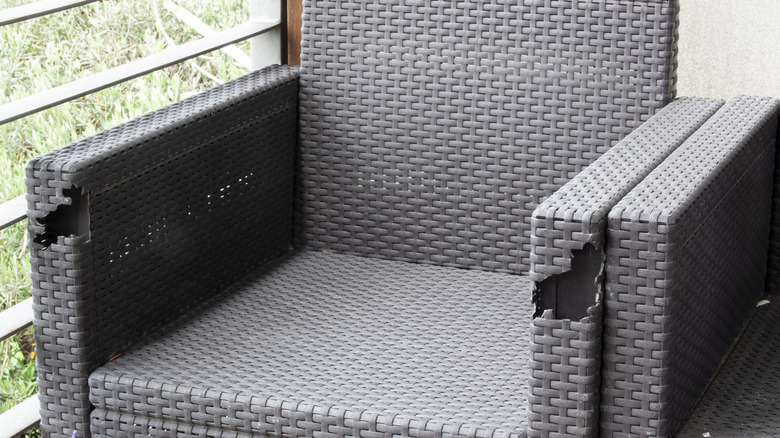
You don't have to choose top-dollar outdoor sets to stay on trend. But very budget-friendly patio furniture sets are less likely to be durable than those made with premium materials. Nothing looks sadder, and less stylish, than an overtly cheap set of patio furniture that's starting to show its age. Most people want to get more mileage from their outdoor sets than just a season or two, especially if they're being put to ongoing use.
More people are working from home and seeing the benefit of a comfortable place to set up shop when the sun's shining. What's more, when the COVID-19 pandemic confined us to our homes, many realized how much potential our patios have to enrich at-home lifestyles. With the cost of living making it hard to justify luxuries like restaurants and vacations, it's only natural that homeowners would want to make their spaces at home more comfortable.
Besides looking shabby fast, cheap outdoor furniture is typically less comfortable than premium furniture. Additionally, while some cheaper furniture is weather-resistant, it often is not weather-proof, meaning it needs constant upkeep in order to last. If you plan to enjoy lots of time on your patio, then cheap furniture may fly directly in the face of that. While you do not have to spend a fortune, it pays in the long run to spend wisely. Visit a store in person and assess how comfortable sets are before buying. It is also worth considering the material. High-quality resin wicker, for example, stands up better against UV and rainfall than its natural counterpart. Teak is another good, weather-resistant choice, while powdered aluminum is popular for its lightweight build and corrosion resistance.
String lights have been overdone and can clutter up sightlines
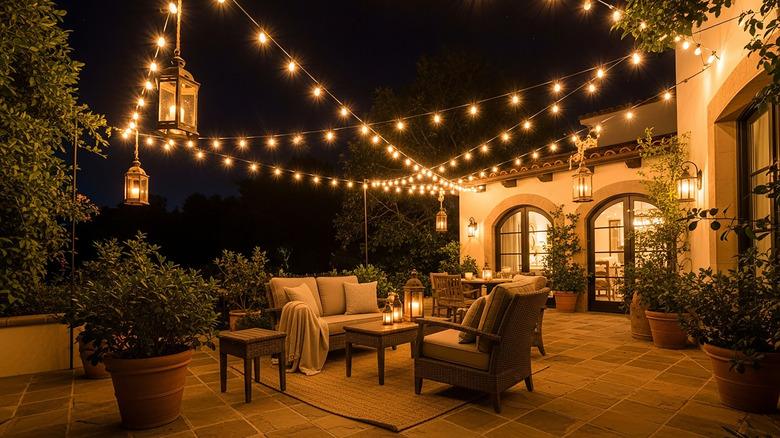
String lights, especially solar-powered ones, offer a useful way to illuminate your outdoor space without the hassle of hardwiring. They are widely used on patios to imbue the space with a feeling of after-dark coziness, but they have rather been done to death. The problem is that, if used in excess, string lights can visually "clutter" outdoor spaces, rather than enhance them. This is especially true when they are used in large quantities to effectively "ceiling" an area with light. "String lights were once the staple of all backyards, bringing a sense of charm and whimsy," plant expert Lydia Beaumont told Homes & Gardens. "However the trend has now been overused and has become very visually noisy."
So, what should you do instead? Well, in the first instance, we would suggest removing the thousand-yard string of fairy lights from your Amazon basket. Instead of defaulting to miles of string lights, augment with more subtle solutions. Spotlights can be installed on your walls and fences, for example, and used to shine either up or down the structure. You can also use uplights on nearby trees, to highlight these beautiful natural features even after dark. And if you need practical lighting that helps you see where you are going, try path lights.
Giant, single-level decks make it hard to zone your space effectively
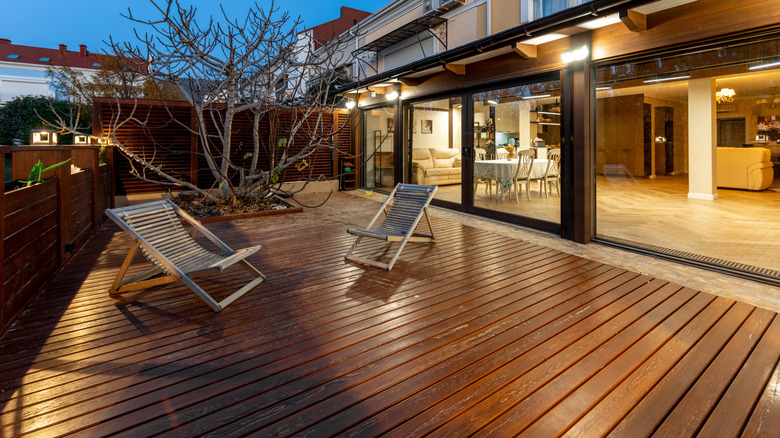
One of the biggest mistakes you can make when designing your deck is just planning out one big expanse of planks, without any thought to how each area will be used. That means not considering where, for example, you will have your grill and cooking station, and where you'll have your dining furniture. This is known as "zoning," which effectively means splitting a space into different zones — each tailored to the different activities you plan to do in the space, like cooking and eating. And the reason single-level decks are on the way out in 2026 is because they make it tricky to "zone" the space in a way that feels natural and uncluttered. "Instead of one massive deck with additions like a fire pit feature and an overbuilt kitchen, designers are breaking decks into flexible zones with dedicated spaces for fire, grill, dining, and lounging," decking expert Dave Kile told Homes & Gardens.
If you're embarking on a new deck build this year, keep the tiered approach in mind. Yes, tiered decks can be more complicated to install, but they can give outdoor areas a well designed feel. If you already have a large, flat expanse of deck, and are struggling with zoning it, consider using things like outdoor area rugs and lighting to demarcate the different areas.
Luxury outdoor kitchens that lean more showy than practical feel out of touch
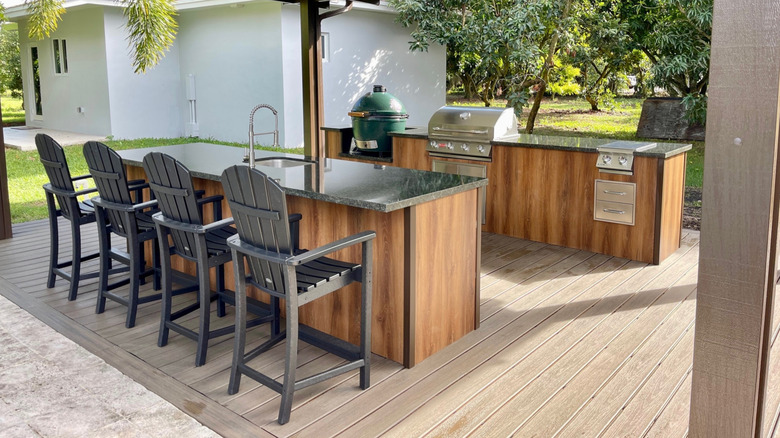
On the face of it, an outdoor kitchen with all the bells and whistles seems like a no-brainer, if you can afford one. But the cost of an outdoor kitchen might not be worth it, especially if you're installing one just because it's been an up market trend for the past few years. The current trend in outdoor kitchens leans towards practicality, instead of just fancy finishes. "The biggest outdoor kitchen trend for 2026 is the shift from aesthetics-first to function-first," stated VP of Design at RTA Outdoor Living, James King, to Livingetc. As these function-forward designs become more prevalent, an overtly showy outdoor kitchen, that's mainly built to impress, is likely to look a bit out of touch.
To design a practical outdoor kitchen, it's important to be honest with yourself. If you do not tend to spend much time cooking outdoors now with your current setup, will you realistically start devoting more time to it just because you have lots of nifty appliances? We recently spoke exclusively to Nate Fox, lead designer at Foxterra Design, who gave House Digest some exclusive insights into things professional landscapers wish you knew. On the subject of things like expensive outdoor kitchens, he said that "forgetting your actual lifestyle can leave you with a stunning outdoor space full of features that never get fully utilized." Instead, landscape designers are recommending that homeowners pare back their outdoor kitchen plans for 2026. Even something as simple as a decent grill, storage, and a countertop can go a long way. It will cost much less than a full-blown kitchen, freeing up your budget to get creative with other important patio elements like furniture and lighting.
Unnaturally planted borders and containers don't align with current garden trends
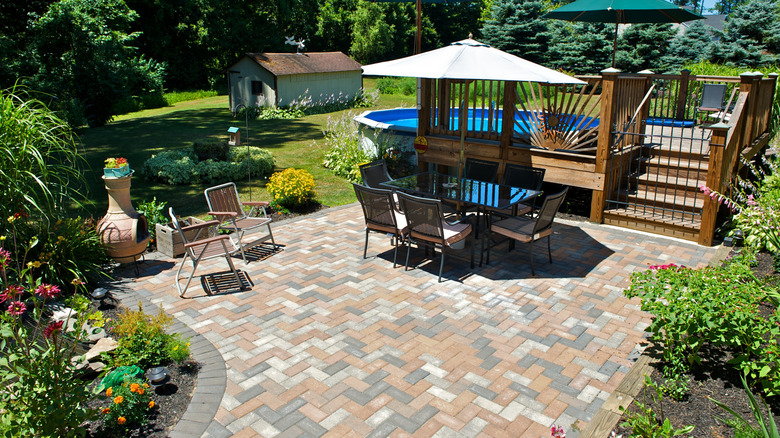
If you're only now dipping your toes into patio container gardening, there's a long list of potential options. It's confusing, and it is easy to get it wrong by shoe-horning the wrong plants into the pots and borders around your patio. Generally speaking, the best choices depend on what you are trying to achieve. If, like many homeowners in 2026, you want to feel immersed in nature — that is, an environment that feels natural to your area — then sticking to native plants is a sure bet. Gone are the days when most homeowners solely wanted yards of bare beds dotted with neat rows of petunias. Now, natural plantings, cottage gardens, and even prairie-style gardens are taking over the zeitgeist.
So how do you achieve this? It's easy to choose plants with the sole intention of filling gaps and adding some color. But randomly filling borders with plants that happen to be in bloom at the garden center can create a chaotic mix of species that aren't going to thrive or look cohesive. Instead, spend some time researching the plants that are native to your area, and which will therefore grow best in your garden. Native plants have a greater chance of establishing properly and maturing. They'll also be looked upon more favorably by local pollinators and birds who'll recognize them more readily, and whose presence, in turn, will reinforce the "wild" feeling of your patio.
Man caves and she-sheds get in the way when you want to come together
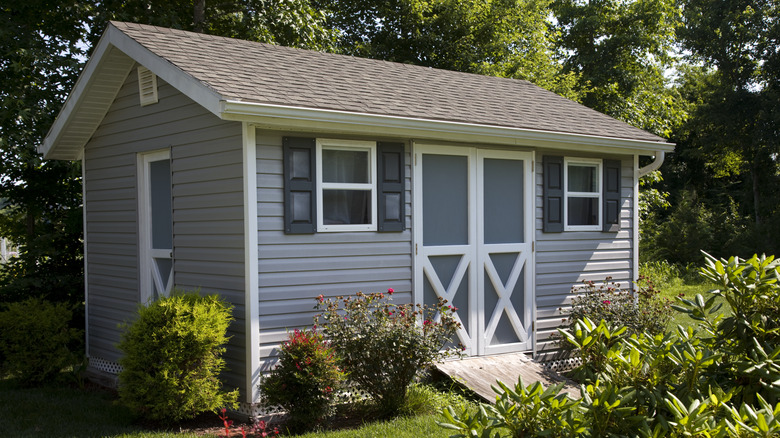
Think about it, when last did you actually hear someone talking about building a man cave or she-shed? However, yards are still dotted with these structures. Although it was more than half a decade ago, the effects of the COVID-19 pandemic are still being felt in the world of garden and patio design. When we were told that we had to stay at home, the demand for miniature "escapes" within the boundaries of our abodes skyrocketed. For many, man caves and she-sheds provided an answer. They offered sanctuaries in which to work, pursue hobbies, and even just escape the madding noise of a household with nowhere else to be. Today, with the world having long since opened back up, these structures are declining in popularity, fast.
The need for she-sheds and man caves was "understandable at the time, but now it's time for the return of the backyard party," interior designer Nicole Alexander told Homes & Gardens. Instead of solitary structures which are designed for shutting yourself away, consider incorporating a social structure instead. Things like bars, comfortable seating, thoughtful lighting, and, if possible, a canopy overhead can all contribute to a convivial atmosphere.
Minimalist, clean-lined hardscapes feel devoid of the life that homeowners crave
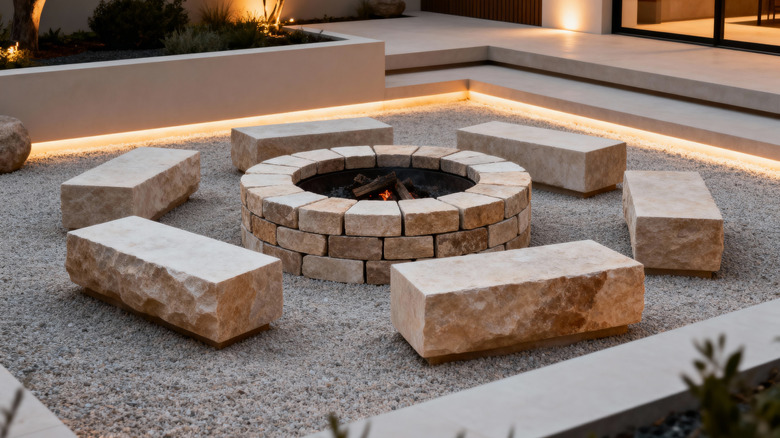
By now, we know that opting for all-gray with your furniture is likely to leave your patio feeling cold and dated. We also know that hardscape fire pits are losing popularity thanks to the lack of flexibility they bring to the party. Another trend that's dropping off in 2026 for similar reasons is the creation of starkly minimalist, clean-lined hardscapes. They were popular, until very recently, for lending gardens a "clutter-free" feel and for requiring very little maintenance, but the tide is turning. "One of the big outdated backyard trends for 2026 that's worth putting behind us is the hardscape-focused, starkly minimalist landscape that has tended to dominate," garden designer Michele Chambliss told Homes & Gardens.
The problem with this approach to landscaping in 2026 is that it feels out of touch with the growing desire for natural immersion — and the move towards more whimsical outdoor spaces. Smooth concrete slabs and crisp, perfectly hewn stone benches are perhaps the antithesis of the natural world, which is, by its very nature, disorganized. A truly natural environment should feel almost wild — full of life and inviting. Minimalist hardscapes, on the other hand, can feel lifeless and stark. Their permanence can dominate an outdoor space, especially in the winter when garden growth dies back. Like permanent fire pits, they are also utterly inflexible, and once they are installed, there is no chance of them evolving with you and the way you use your garden.
White rendered, Mediterranean-inspired courtyards have proven problematic to maintain
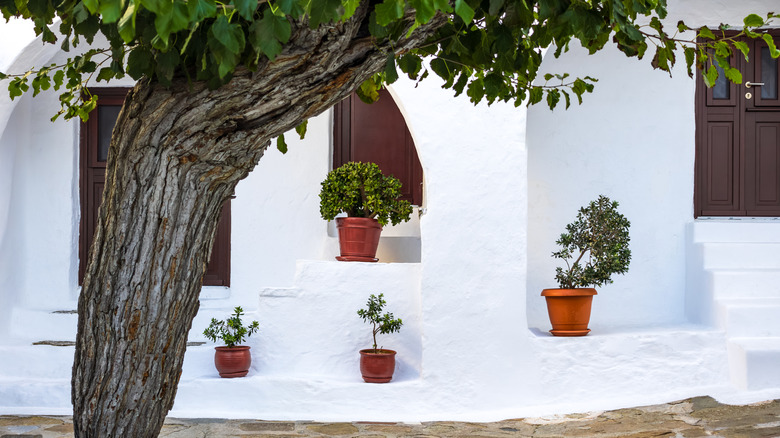
Have you ever wondered whether those white, sun-soaked courtyards from the pictures of your last Greek holiday would suit your patio? If so, you are not the only one. Imbuing this timeless Mediterranean look has been popular since the 2010s, giving homeowners the vibes of a vacation without the need to fly long-haul. Unfortunately, the trend is losing its popularity, particularly among those who live in cooler, damper climes. In these conditions, the whitewashed Mediterranean aesthetic is a little harder to maintain than a lot of homeowners expect. Algae inevitably builds up and clings to those pristine walls, requiring constant cleaning. It can lead to staining, which in turn requires deeper cleaning and, in some cases, repainting to restore walls and surfaces to their original appearance.
Of course, if you live in a desert climate, then you are unlikely to experience any of these problems. But if your winters are wet and gloomy, then you may be better off sticking with warmer, earthy hues. Not only will these help to "hide" any minor algal stains and the general grime that builds up in wet weather, but they are also very much on-trend and promise to play nice with the rest of your garden.