

How To Tell If Your Stove Is Induction Or Not

With just a glance, most homeowners can easily tell the difference between electric and gas stovetops. However, if you're trying to figure out whether your stove has an induction cooktop or an electric ceramic glass-top, it's definitely trickier. Induction and ceramic glass-top stoves look very similar, with both having a smooth surface with rings indicating where to place your pan. When it comes to how they actually heat and perform, though, there are stark differences between the two. Price is usually a dead giveaway because induction stoves are so expensive. If you're trying to determine whether your current stove is induction, though, turning it on without any cookware and observing how it reacts is the easiest way.
When you turn on an electric ceramic glass-top stove, the rings begin to glow or turn red, and the burner area immediately becomes hot. On the other hand, an induction stovetop doesn't emit any glow when its burner is turned on. It usually stays cool to the touch without a pan on it, too, though some induction cooktops can become slightly warm. However, if you place a pan on the cooktop, turn on the burner, and the cookware heats up almost immediately, that's another indication you have an induction stove.
Here's how an induction stove works
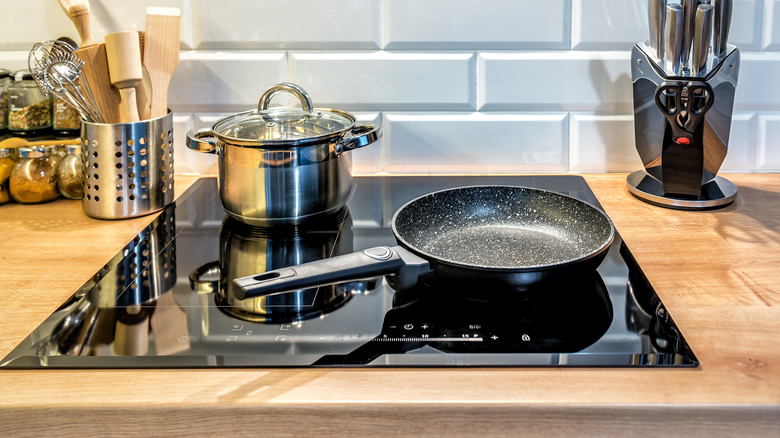
An induction stovetop doesn't rely on an electric or gas-powered heating element because it heats the cookware directly. Beneath an induction stove's smooth cooktop, there is a copper coil. When you turn on the stove, a current moves through the coil, creating an electromagnetic field. The current then passes through to the cookware sitting on the burner, heating it rather than the surface beneath it.
Using this process to heat cookware offers many benefits, which is why induction stoves are predicted to be 2026's big kitchen trend. Since an induction cooktop heats the pans directly, it eliminates the need to heat the burner itself. As a result, it heats up — and cools down — much more quickly than traditional electric and gas stovetops.
Induction stoves aren't as prone to heat loss, either, making them more efficient than standard cooktops. They score a 90 percent energy efficiency, while electric stoves sit at 74 percent and gas at 40 percent (per Rewiring America). That means an induction stove can boil water up to 50 percent faster than a traditional electric or gas model, allowing you to use less energy to cook your favorite meals. Additionally, like an electric ceramic glass-top stove, an induction cooktop is extremely easy to clean. Its smooth surface allows you to wipe away messes, and because the cooktop itself never gets too hot, you don't have to deal with burnt-on messes.
How to work out whether your cookware can be used on an induction stove

Unfortunately, there is a downside to induction cooking: It's not necessarily safe to use any type of pan on an induction stove. To be compatible with an induction cooktop, your cookware must be made from a magnetic material. Induction burners can't sense non-magnetic pots and pans, so the cookware won't receive the electromagnetic current needed to heat it. The good news is that many common cookware materials are magnetic. This includes high-quality stainless steel, carbon steel, cast iron, and enameled cast-iron. However, most copper, glass, and aluminum pots and pans aren't magnetic, so they shouldn't be used on an induction stovetop.
It's important to remember that some cookware features layers of different materials, though. That means that even pots made with non-magnetic core materials can be induction-compatible if they have a magnetic base. Most induction-compatible cookware is marked on the bottom with a coiled spring symbol to help you quickly identify the appropriate pots and pans. If you're unsure whether a pot or pan is induction-compatible, the easiest way to test it is to hold a refrigerator magnet against its bottom. If the magnet sticks to the cookware, it's compatible. If it doesn't stick, it won't work on an induction stove.