

The Common Watering Mistake You're Making With Your Peace Lily
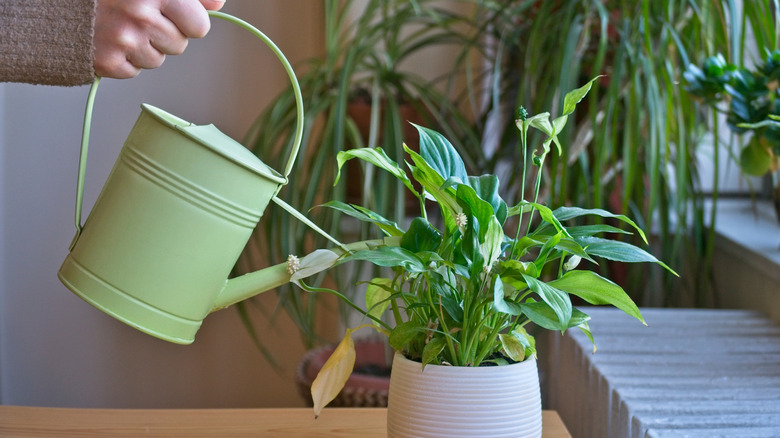
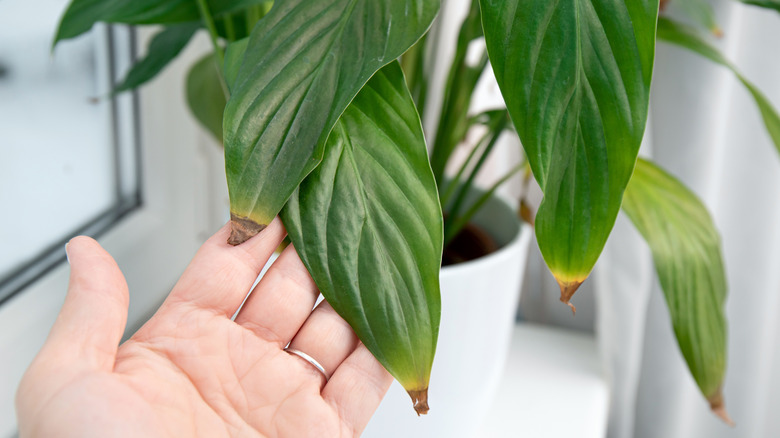
If you're looking for one of the easiest houseplants that anyone can keep alive, look no further than the peace lily (Spathiphyllum spp.). It's an absolutely gorgeous plant with bright green leaves and pure white flowers, adding sophistication to your room's aesthetic. And like all houseplants, it can give a boost to mood and productivity. So when you notice the leaf tips turning brown, you might spiral into a panic, wondering what you did wrong. But don't worry — we've got you covered. One of the most common reasons is that you're simply using the wrong type of water.
When it comes to watering, it's not always how often you should be watering a peace lily for a healthier houseplant that matters. Sometimes, it's just as important to consider what type of water you're using. Most people fill their watering cans at the tap, and for many houseplants, that's absolutely fine. But some indoor plants, like peace lilies, are more sensitive to things that can be lurking in tap water. Municipal water sources are often treated with minerals and chemicals like fluoride and chlorine. When you regularly water a peace lily with chemically treated water, those substances can build up in the soil and begin to affect the plant negatively, hence the brown-tipped leaves.
Water your peace lily correctly to avoid brown leaves
From one green thumb to another, we have plenty of hacks to help your peace lilies flourish as an indoor houseplant, starting with using the right type of water. It's best to use distilled or filtered water, which can be purchased at any local grocery store. Another great water source, which comes without a price tag, is rain or even melted snow. You can set a bucket outside to collect rainwater that you then use to water your peace lily. If you don't want to pay for distilled water and there isn't enough rainfall in your area, you can fill a can with tap water and let it sit for a day or so, which allows chlorine to dissipate.
If you notice brown tips on the leaves of your peace lily, don't worry; it's not a total loss. You'll want to start by flushing the pot to get rid of any buildup that's affecting the plant. Do this by running clean, distilled water — two to three times the volume of the pot — through the pot. You can cut off the brown portion of the leaves with sharp shears, following the form of the leaf to maintain its natural shape. And moving forward, water the plant with only the preferred types of water — rainwater, distilled, or tap water that has been sitting long enough for chlorine to no longer be an issue.