

Why The Stacking Turf Method Will Elevate Your Compost Game
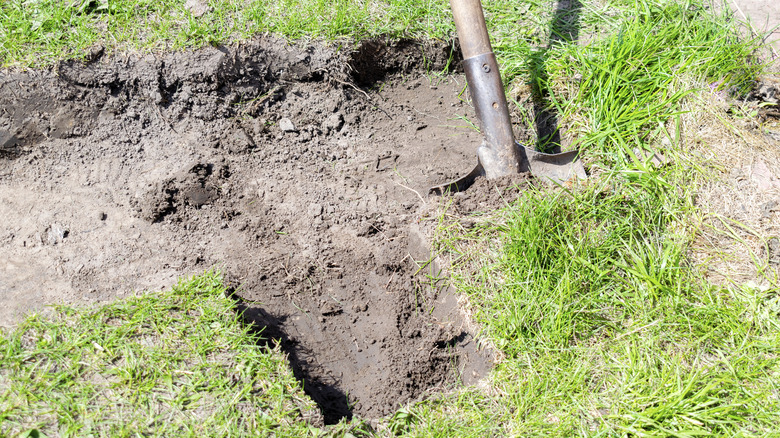
Don't you find tasks especially satisfying when you can kill two birds with one stone? That's what happens when you use the stacking turf method to make awesome compost. The method, also known as composting sod or making loam stacks, is just what it sounds like — stacking pieces of turfgrass or sod and allowing them to decompose into rich, loamy compost. Thus, the method provides a valuable way to deal with turfgrass that perhaps you dug out to start a new garden bed — and gain quality compost in the process.
While we found no specific scientific studies backing up this method, it has been used for at least a century. The "Gardener's Chronicle of America" discussed stacking sod in the early 20th century, and a publication ("Formulation of John Innes Composts") about the composition of a UK brand of compost dating back to the 1930s discusses an early formulation that involved "stacking grass turf to produce loams with a high organic matter." Not clear about what loam is? It's soil made from all three types of soil particles: clay, sand, and silt.
The method is effective for the same reason recommendations to add grass clipping to compost piles or make grass clipping "tea" to nourish your plants are effective — nitrogen and other nutrients in the grass are indirect food for bacteria. You'll need stamina to deal with turfgrass and patience to endure a long decomposition process, but the payoff will be quality compost at no cost. Let's learn how to do it.
Turn your unwanted turfgrass into quality, loamy compost

Identify a spot in your yard to create your stacks; a partially sunny spot will help the decomposition process. You're probably considering this method because you already have turfgrass that you've removed — but if not, dig out your turfgrass, using the hack that'll make digging out grass so much easier — a flat-blade shovel. Start stacking your pieces of turfgrass, with grass facing down to help it decompose. Fit the pieces in the bottom row of your stacks snugly together. Stacks can be about 3 to 4 feet tall.
The decomposition process will need moisture, so give stacks a good watering after all stacking is complete. Apply the same advice gardeners are given not to overwater any other kind of compost. You'll want to block out sunlight so the grass is not encouraged to grow, so cover the stacks with a black tarp or plastic sheeting, weighing it down if needed.
Your compost may be ready after a full garden season, but if you're in a position to leave it longer, do so to make sure all fibrous root material has decomposed. If you come up with more turfgrass to compost, it's better to start new stacks than add to the existing stacks since it will be difficult to access the older compost when it's ready. Once your loamy compost is ready, you may want to know the key differences between loam and topsoil, so you're making the best use of your loam.