

If You Live In These States, You're Most Likely To Find Black Widow Spiders

Black widow spiders strike fear into the hearts of many people. You've probably heard that the small black spiders with the distinctive red hourglass under their midsection can kill you with one bite. While it's true that their bites can be fatal, deaths are extremely rare. Even if you are bitten by a black widow, you're likely to recover completely within a day or two with treatment. However, because there is the potential for serious harm and even death, it's one of the spiders you absolutely do not want to find in your garden or yard. If you know where to find them, you can take measures to avoid them whenever possible.
If you live anywhere in the U.S. other than Alaska, there are black widows in your state. They're one of the most common types of spiders you'll see in your home. But they're not distributed equally. Some states have many more than others. Black widows favor climates that are warm, dry, and have diverse ecosystems. As a result, you'll find the largest populations in states such as Texas, Florida, Georgia, California, and Arizona. There are several different species of black widows. The southern black widow spider is most common throughout the southeastern U.S. Northern black widow spiders differ from their southern relatives because their abdominal markings are either red spots or broken hourglasses. They're found throughout the northeastern U.S. states. Western black widows prefer a drier climate, so they're primarily in the western U.S. states. These spiders have the same type of hourglass marking as southern black widows.
Black widow habitats in different states
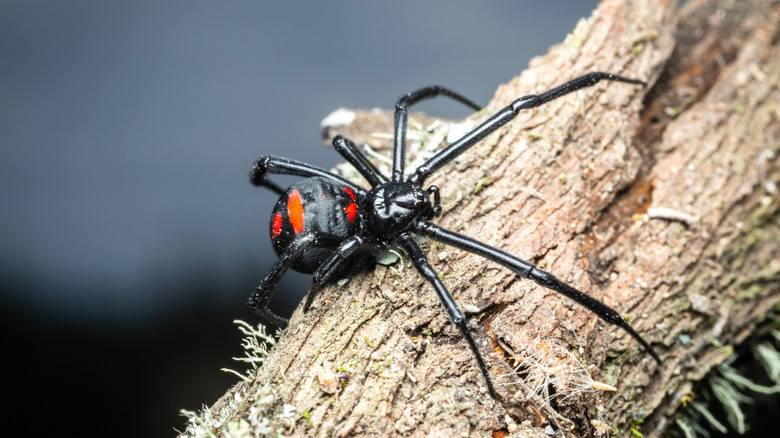
Southern black widow spiders often hide out in dark areas such as under stones, in wood piles, in holes left by small rodents, and in corners of sheds and garages. Northern black widow spiders are found in similar places to southern ones. They like natural shelters like hollow stumps, wood piles, and rock piles. They'll also hide out in quiet buildings that don't have a lot of foot traffic, such as abandoned sheds and attics. Western black widow spiders have become adapted to city life and can typically be found in places where there are lots of other insects for them to feed on. Insects send off chemical trails that the spiders follow to habitats such as waste disposal sites and garages.
Black widows are usually nonaggressive and will only bite if they have no other option. They'd rather run away and save their venom for their next meal. That being said, the best way to avoid contact with black widow spiders in your home or garden is to clean up areas where they may be tempted to hide. To keep spiders away from your home, eliminate piles of debris around your house and make it a habit to regularly sweep, vacuum, and dust in rooms and buildings that aren't used regularly, such as attics and tool sheds.