

The Countertop That'll Help You Make Your Kitchen Work Best For Your Needs
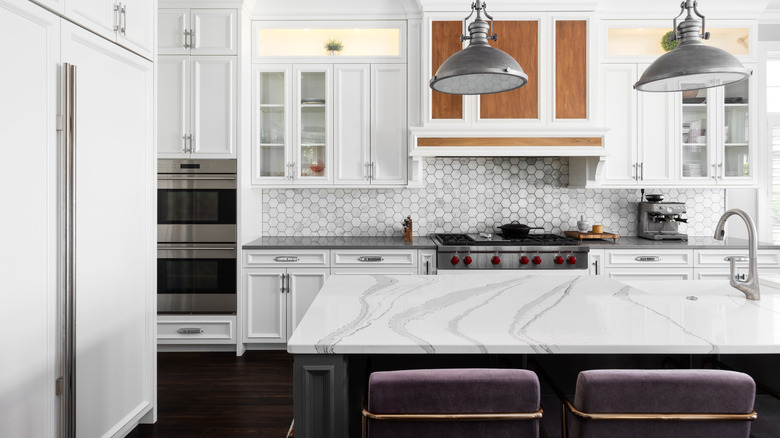
A countertop that works for your kitchen should not only look appealing in your design scheme but also provide enhanced functionality, whether that looks like ease of maintenance or increased durability. This year, the new countertop trend is all about making a statement, and we're seeing this played out with the mixing and matching of materials to achieve surfaces that add visual and textural variety. Interior designer Laura Fox spoke to Homes and Gardens, saying, "I am seeing more mixed materials, maybe wood and stone, or natural stone on an island and quartz on the perimeter." Designers and homeowners are changing up the single-tone countertop layout for a blend of materials, often creating contrast between center islands and surrounding surfaces. However, this concept can be implemented on peninsulas, in galley kitchens, or as a way to differentiate a wet bar or butler's pantry from the main kitchen for more separation.
Beyond aesthetics, one of the most appealing facets of this trend is that various materials on countertops allow you to have designated zones. For example, you might install a granite or quartz countertop around your stovetop, where heat-resistance and durability are a must. Or, for those seeking a good material for center island prep work, add a wow-factor with marble or concrete. If you love butcher block counters, you can now utilize this on an island and avoid covering the sink area — a place commonly known for residual moisture that could warp wood.
Mix and match countertop materials to boost aesthetics and functionality
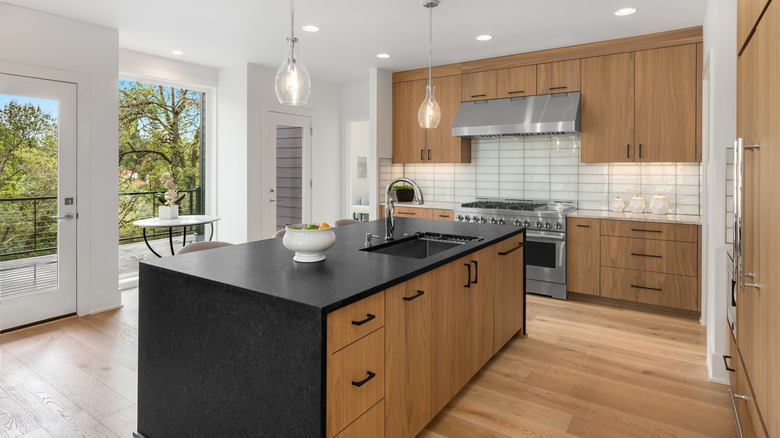
Before you begin choosing your countertop materials, you'll want to consider how two-tone countertops will impact your design. Adding a second countertop material will create a focal point in your kitchen. The center island is a natural candidate for this addition, but you could opt to create a focal point in a kitchen nook, on a wet bar, or in a transitional space between the kitchen and dining areas. When choosing materials, a go-to choice is to have one flashier piece, like deeply veined marble, and one calmer material like quartzite. The showier piece should be placed in the area that has become the focal point, such as the center island, where it will grab attention. You might also play around with texture, such as using a polished quartz alongside a rustic butcher block for a tactile approach to your design. Wood countertops alongside natural stone also invite more warmth into your space.
Another consideration is the function of your space. Heavy prep spaces, areas around the sink or stove, or places that will see a lot of action during mealtime could benefit from more durable and low-maintenance materials rather than aesthetic ones. For example, if your kitchen island is a high-traffic area, you could add a durable dark granite that hides staining. Around the perimeter, a softer stone like a pale-veined marble or soapstone could be good for adding visual contrast while remaining practical.
Pros and cons of using mixed materials on your kitchen surfaces
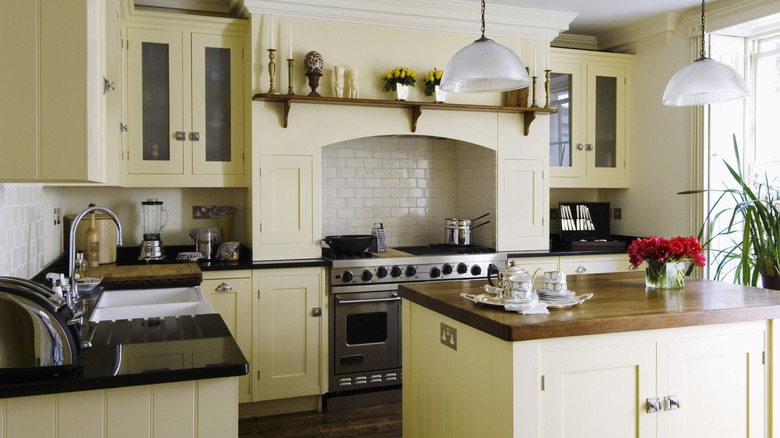
Before jumping onto the two-tone countertop trend, there are a few considerations. For instance, if you've already found the most durable countertop material for the best price, you may want to stick with it throughout your kitchen. Another consideration is how much it will cost to update your countertops depending on the material. While adding a show-stopping marble center island sounds luxurious, the price of this stone can range from $50 to $150 per square foot, compared to lower-cost alternatives like granite, which run $40 to $100 per square foot. Price could be a pro or con depending on your situation. For example, if you long for real marble but can only afford a few square feet, using it on one small surface can create visual impact for less money. A similar situation arises with using a colorful countertop. You may love a bright green lava stone, but not enough to commit to an entire kitchen's worth.
You should also consider whether this trend will still be a fad in the future. Every few years, there is an outdated countertop trend or two that will make you want to replace yours ASAP. While mixing and matching materials is popular now, it could become an eyesore long-term (on the other hand, if only one material becomes outdated, it's less you have to replace). Further, this addition is not ideal for every kitchen. Small kitchens may appear unfinished with two-tone countertops. And since the most common utilization of this trend is via the central island, kitchens lacking one may not pack the same aesthetic punch.