

3 Beautiful Holiday Flowers That Are Perfect For Christmas
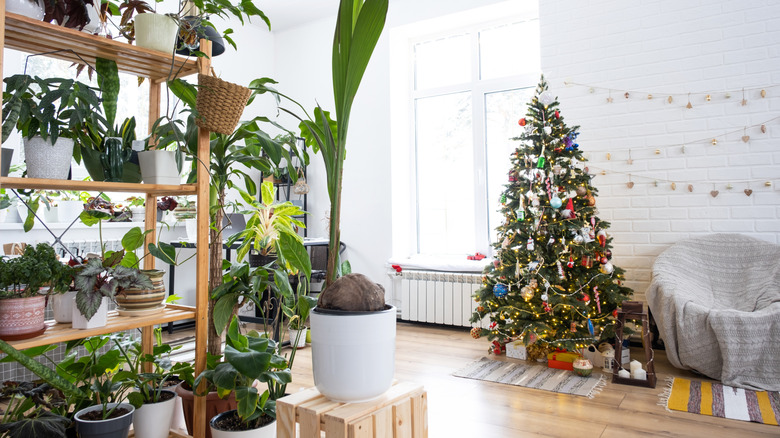
Your outside garden may be dormant for the winter, but that doesn't mean your indoor garden has to be devoid of life. In fact, many types of flowers grow beautifully indoors during the winter, and some of them are the perfect holiday flowers for Christmas decorations. Many winter houseplants can thrive in conditions with lower light, water, and temperature requirements than summer-blooming plants. The ones that make the most impact at your holiday gatherings are the plants that bring the colors of the season indoors to warm up the space.
Red is a color that represents love and passion, but it can also represent warmth and coziness. That's why plants like poinsettias, Christmas cacti, and Thanksgiving cacti are commonly used as holiday flowers that brighten up your festive decor. These three beautiful holiday flowers can be grown to bloom with the brightest flowers at the right time for your holiday gatherings. Plus, the deep red and green colors work perfectly to tie a holiday theme together.
Welcome the holidays just in time with Christmas and Thanksgiving Cacti
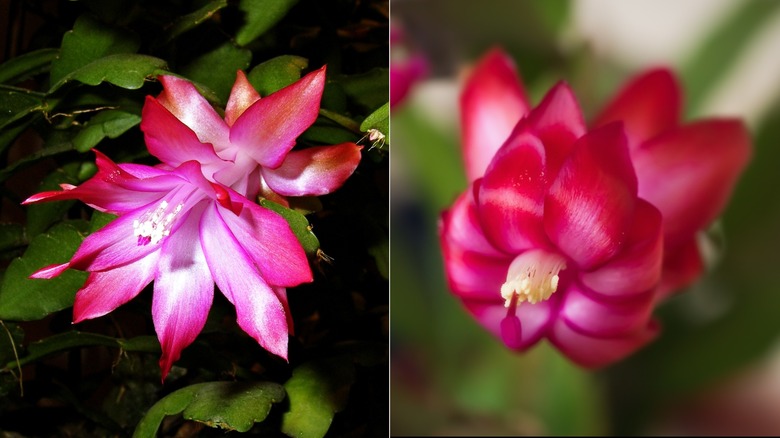
The Christmas cactus (Schlumbergera bridgesii) and the Thanksgiving cactus (Schlumbergera truncata) are both part of the Schlumbergera genus. These are just a few types of holiday cactus you should know about that are aptly named for the festive flowers that bloom in time with common holidays. Though they are commonly confused for being the same plant, they have a few distinct differences. They both bloom based on day length and temperature conditions. They do best in partial shade conditions with bright, indirect light and temperatures between 55 and 65 degrees Fahrenheit. In addition, they need at least 13 hours of darkness each night for several weeks to begin blooming.
The Christmas cactus features smooth, rounded leaves with scalloped edges that bloom just in time for Christmas and the New Year. They are known to flower in late winter between January and February, but if you start planning early enough, you can alter the growing conditions to promote earlier blooming. Experts at the Chicago Botanical Gardens claim that you can even get them to bloom as early as Thanksgiving!
On the other hand, the Thanksgiving cactus produces more pointed leaves with claw-shaped segments. They are known for blooming earlier in the season, usually in November. They can be red, purple, orange, pink, or white. On occasion, they can also rebloom in February.
Invite the Christmas spirit in with a time-honored classic: Poinsettia
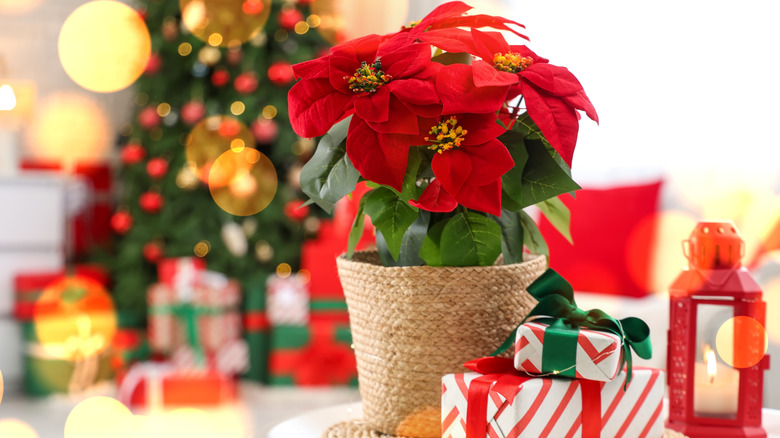
Poinsettias (Euphorbia pulcherrima) are one of those houseplants that will spice up your holiday decor. They are such a popular holiday plant that they are often known as the Christmas Flower. Though commonly grown as houseplants, poinsettias are actually semi-evergreen shrubs. They have been used as an indoor decoration for the holidays for generations, which has led them to become the number one selling potted plant in the United States and Canada, according to the University of Illinois. At the top of large and velvety leaf bracts, the poinsettia produces tiny yellow flowers. The leaves directly below the flowers come in many colors (usually deep red). These larger leaves rest on dark green foliage, making it look like a large, colorful flower that lasts all winter.
Poinsettias do best when grown in partial sun with bright, indirect sunlight. They like temperatures between 65 and 70 degrees Fahrenheit, and they don't tolerate temperatures below 50 degrees Fahrenheit. You will want to water your poinsettia any time the soil feels dry at the top, but make sure the water drains completely. You won't want the pot to sit in water for any length of time. After the holiday season is over, you can maintain poinsettias with regular pruning and monitoring growing conditions for each season.