

The Easy Way To Propagate A Bay Leaf Plant For An Endless Harvest

Bay leaf, also known as bay laurel (Laurus nobilis), is a popular aromatic, culinary herb. It is used in everything from stews to soups to some types of teas, and you can even use bay leaves to repel cockroaches naturally. So wouldn't it be great if you could propagate it yourself? It would be far better than paying premium prices for those small packets at the store. Well, the good news is that bay laurel thrives in small spaces and containers, which makes it perfect for home propagation projects.
This is where stem cuttings can help. With stem cuttings, you don't have to worry about slow and poor germination rates as you do with seeds. Also, cuttings provide the same flavor and aroma as parent plants, unlike propagating with seeds. But you can't just take a cutting, put it in the ground, and expect an endless harvest. There are some careful considerations to be made first when propagating the bay leaf plant with cuttings.
First of all, use semi-hard wood cuttings for the best results. These are sturdy enough to snap clean yet still flexible enough to bend and work with efficiently. Also, try to collect your cuttings in summer after the flush of growth. Just keep in mind that even if you do everything right, bay laurel is slow to take root and grow, so you might need to wait a while before you can harvest it.
Place bay leaf stem cuttings in rooting mix
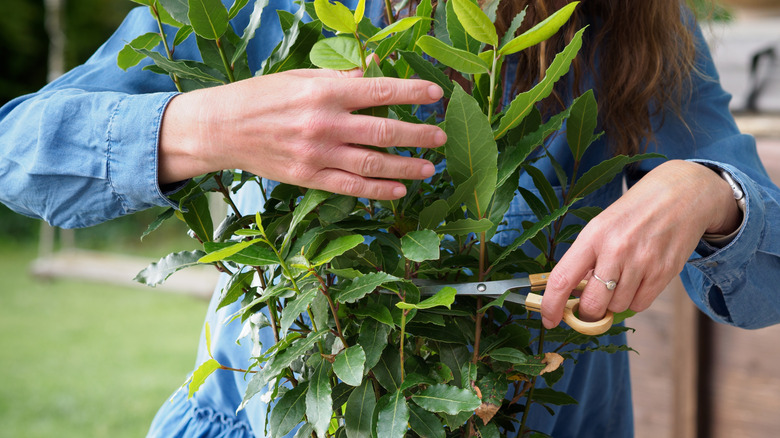
Start with a healthy plant, and cut about 4 to 6 inches from the tips of suitable stems. Gently snap the semi-hard wood shoots while making sure that the "heel" of older wood remains intact. This will help increase rooting success. Once done, strip away leaves from the lower half of each cutting to reduce water loss. This will also give you a bare stem section that can be inserted into a rooting mix. For the rooting mix, use a free-draining medium. Don't use heavy garden soils, as they compact and saturate easily.
Next, fill your propagation trays with the rooting mix, and moisten the medium so it is evenly damp. But don't let it get soggy or oversaturated. Then start inserting the cuttings into it. It would also help if you could dip the cuttings into a powdered or quick-dip liquid rooting hormone. This can significantly increase rooting percentage, root number, and root length.
Once inserted, move the cuttings to a protected and humid environment to prevent desiccation. You can cover your cuttings with plastic wrap to form a miniature greenhouse that traps moisture. This is just one of the smart ways to use plastic wrap for gardens and plants in your home. In a few weeks, you will see a knob form at the cut before roots appear on the cuttings. Once the roots appear and are about an inch long, you can move the cuttings to a rich potting mix for further growth. Enjoy their harvest, and try other clever ways to use bay leaves around your home.