

Fascia Need Replaced? Here's How Much That'll Cost You

Owning a home is an exciting mix of responsibility, pride, and frustration at the many sneaky costs associated with homeownership, such as taxes, maintenance, insurance, and the occasional repair. Roof problems are a common fear among property owners, as the overall cost can be drastic. But most people don't know to worry about roof-adjacent parts, such as the fascia, which can rack up average repair costs ranging from $600 to $6,000, depending on several factors.
The fascia on a house is a support board extending along the edge of your roof, butting up against the overhanging shingles. This simple piece serves several crucial protective functions. Along with providing structural support for the bottom of your shingles and the soffits, it also keeps pests and the elements from your home's attic and interior. This board also serves as an anchor for gutter systems. Homes that have gutters in place typically do not have visible fascia.
Fascia replacement pricing varies by the amount of material that needs replacing, the type of material, and whether you're DIYing or hiring expert help. Where you live and your local regulations may affect your decision making for roof repairs, including requiring permits, licenses, and materials used. Minor fascia repairs can usually be done for under a grand — around $300 to $700 — while full replacement can extend into the thousands, anywhere from $2,500 to $6,000.
Materials, size, and labor impact fascia replacement cost

Estimating fascia replacement costs requires a combination of several things. First, how much material are you replacing? Small repairs are cheaper than having to redo the whole thing, but if there's damage across multiple parts, a full replacement can save you money rather than having to do multiple repairs over time. Fascia pricing is typically done by the linear foot, and the length of fascia will vary based on your home's design. You can expect to pay between $1 and $20 a foot, depending on material.
You have several choices of fascia materials, with wood being the most affordable at $1 to $3 per linear foot. Aluminum, which has the longest lifespan, also has the highest price point at $8 to $20 a linear foot. Vinyl, which runs $5 to $9 a foot and PVC materials, about $3 to $7, are a good middle ground of affordability and durability. The material you choose will also affect your overall cost due to labor charges.
DIYing fascia replacement can potentially save money in labor, which usually charges around $75 to $120 an hour, or by the repair size, roughly $6 to $20 per linear foot. But inexperienced DIYs can lead to higher repair costs if you make mistakes. These prices do not typically include the cost of removing old or damaged fascia, replacement to any other damaged areas, or disposal and clean-up.
Local laws and your home design may also factor in
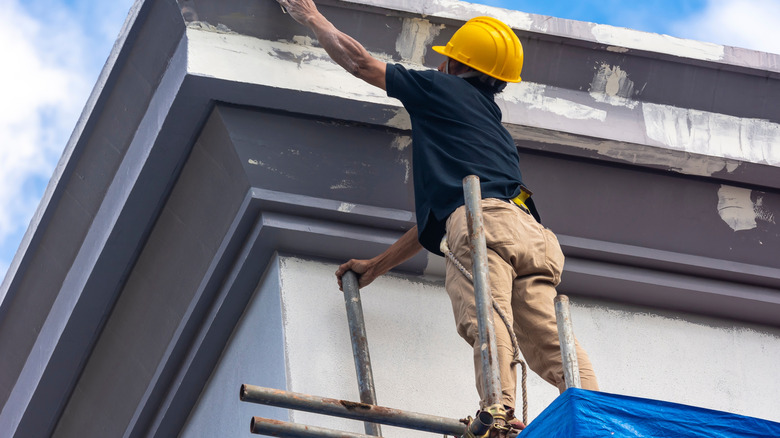
There are a few outliers that can also impact the overall cost of fascia replacement. One of the biggest differences is location. Where you live can have a drastic impact on your final price. Both labor and materials can have different price points depending on your area. Your local government might also have different restrictions, which could require you to pay for permits.
Another overlooked price factor is the final aesthetic post-repair. Many houses have gutters that hide the fascia, so it isn't as important how the area looks, since the drainage system will hide it. However, DIY installing or hiring a professional to replace gutters is a separate expense. Other houses may prefer to use the fascia as a visual statement, which could require painting, staining, or otherwise decorating. These visually appealing updates can come with their own price tag, depending on labor and materials.
The final surprising factor that can change your total cost is the design of your home. Single-level homes with a simple roofline will be cheaper to repair than homes with odd angles, higher roofs, and complicated eaves. Not only can these areas be more challenging to DIY, but professionals may charge a increased rate due to the higher difficulty of accessing tall rooflines.