

How To Water Bromeliads Correctly For Festive Holiday Blooms
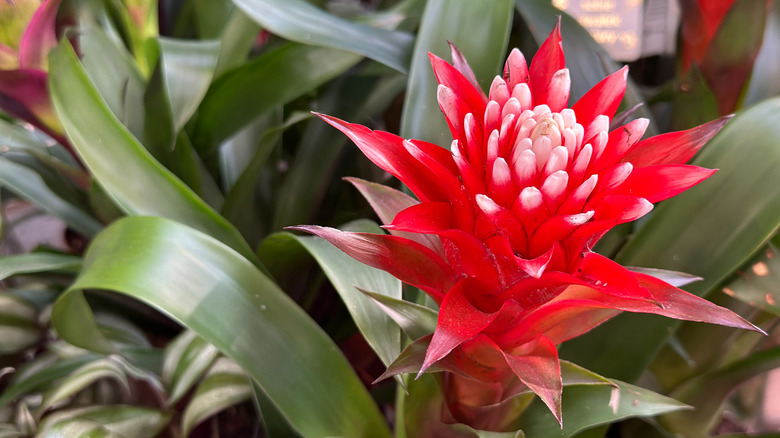
Just because winter rolls around doesn't mean you can't continue to enjoy stunning plants around your home. Bromeliads (Bromeliaceae) are a family of brightly colored tropical plants that make for excellent houseplants. There are likely over 3700 species including some edible varieties such as the pineapple. Varieties such as the matchstick bromeliad (Aechmea gamosepala) and hybrid cultivars like Aechmea 'Del Mar' offer festive, winter-blooming flower displays indoors. Most varieties will only bloom once but with ample pups sprouting from mother plants, you can encourage your new plants to flower. While this is a diverse group of plants, there are some universal best practices to keep in order to help this gorgeous houseplant bloom. Proper watering is a crucial aspect of correctly growing and caring for bromeliad.
Since many bromeliads are adapted to harsh conditions where water is harder to come by, they serve as a fairly drought-resistant houseplant. With that in mind, bromeliads often require a different watering schedule than typical houseplants, especially in winter when growth slows. Rather than following fixed intervals, water them when the potting mix has mostly dried — but not gone bone-dry — as soggy soil can quickly lead to root rot. To ensure proper moisture levels, always use a porous, fast-draining potting mix, such as an orchid or bark-based blend amended with perlite.
Caring for your bromeliads over the winter
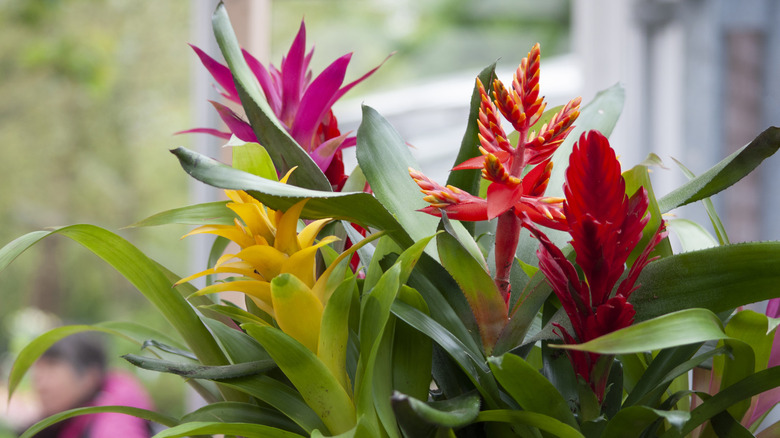
Bromeliads are an extremely diverse group of plants. About half of them are epiphytes meaning they use their roots to cling to trees and rocks rather uptake water. They instead use stemless rosettes to collect water and nutrients. Some large cultivars can hold up to two gallons of water in their leaf reservoirs in their natural habitats.
If your plant has a "tank" in the center of its rosette, be sure to fill it up with filtered water or rainwater on the same schedule as other bromeliads. Just be sure you flush and refill the "tank" every once a week or so to prevent bacterial growth and mineral salt build-up. Bromeliads also prefer 50 to 75 percent humidity. You can increase the humidity around your plant by misting them once to twice a week. Misting (along with periodic soaking by submerging in a bowl or sink) is the best way to keep air plant bromeliads moist. Once your watering routine is on track, it's also vital to situate your plant in a spot it can receive bright, indirect light,even in the winter. With all this in mind, your bromeliad should thrive and offer a festive holiday bloom!