

That 'Dust' On Your Succulents? Here's What It Really Is
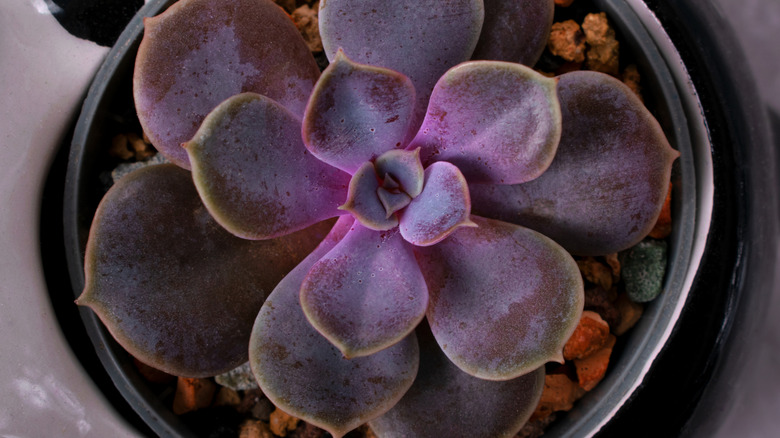
As you care for succulents inside your house, do you notice a white or bluish-gray coating on your succulent plants that looks like dust? It probably looks like something you should be cleaning off the leaves. The coating may even provoke concern that the plant has a disease, such as powdery mildew. You may be surprised to learn, however, that rather than a dirty and undesirable aspect of your succulent, this substance on the leaves is actually vital for the plant's health.
The seeming dust on your succulents is really a waxy material called "farina," or its more scientific name, "epicuticular wax." Virtually all plants have epicuticular wax; it is more pronounced on succulents and other plants, like staghorn ferns. Farina serves several important functions for your succulents and most plants. You'll notice water beading up on the leaf surface, as farina helps keep moisture in the leaves. As water beads roll off leaves, succulents gain protection from fungal diseases.
The coating also serves as a natural sunscreen for plants and reflects sunlight so the succulent doesn't take up too much heat. This epicuticular wax makes an inhospitable environment for insect pests and their egg-laying, as well as pathogens like bacteria. Succulents on which farina looks especially pronounced include members of the Echeveria, Pachyphytum, and Kalanchoe genera, as well as the hybrid genera Sedeveria and Graptoveria.
Farina, the waxy substance on succulent leaves, benefits your plants
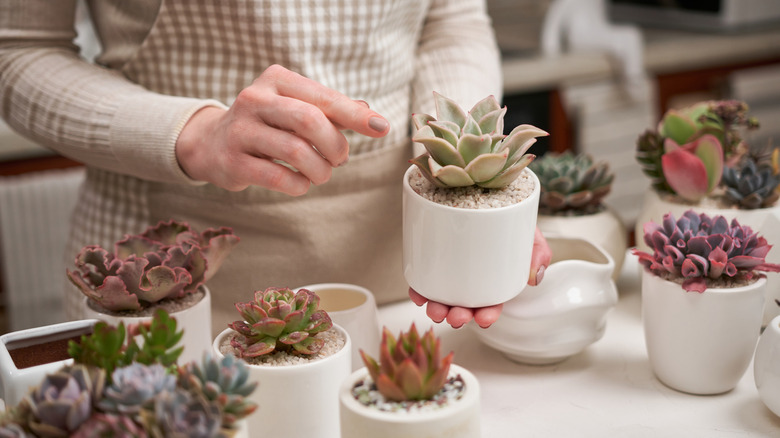
You may be tempted to wipe off the farina coating to improve the succulent's appearance, but avoid doing so for the sake of the plant's health. It's true that succulents will gather dust on top of the farina, but you can learn how to clean dusty succulent leaves by gently blowing on them or with tools such as a soft makeup brush that won't harm the farina. What happens if you accidentally wipe off the farina? It will return on some species, but it takes a long time and may return in a degraded form.
Your farina-coated plant probably doesn't have a disease or pest issue, but you'll want to make sure. You may want to use a jeweler's loupe to look closely at the leaves. You can eliminate powdery mildew if the substance doesn't appear fuzzy, appears all at once instead of gradually, and is distributed evenly on the succulent. If you fail to see signs that mealybugs are damaging your plants – a substance resembling cotton-like threads combined with droppings, which look like black specks – you can rule them out. If you see no pale yellow or brown eggs, nor feel a sticky honeydew residue, and leaves don't wither, whiteflies are not the culprits. The substance on your plants is probably farina, which some succulent fans feel adds to their beauty; collectors even strive for attractive, undisturbed farina.