

Why You May Want To Reconsider Using De-Icing Salt On Your Deck
We may receive a commission on purchases made from links.
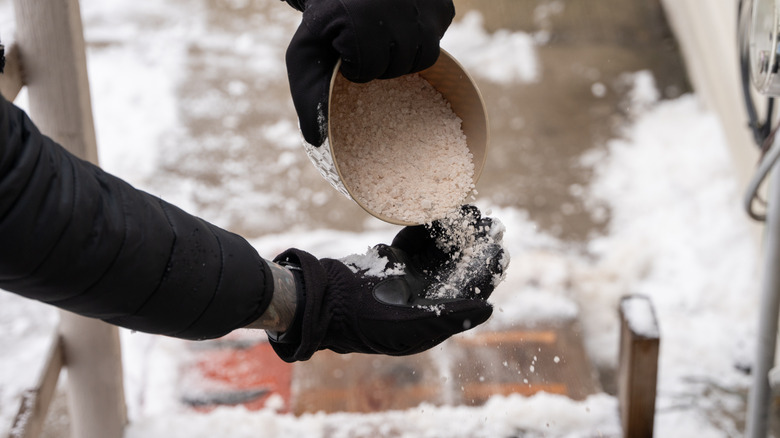
The winter season brings lots of snow and ice in many parts of the world. As a homeowner, you often have to get outside to shovel sidewalks, driveways, and decks to keep paths clear, removing the snow and ice so you can walk safely. It's crucial to winterize your deck based on its material to protect it. However, you may often reach for a bag of de-icing salt to melt the snow and ice and minimize shoveling. Sodium chloride, or rock salt, is the most common de-icing salt, capable of lowering water's freezing temperature substantially so that it liquifies easily even on the coldest winter days. While the salt can be effective on driveways and sidewalks, your deck is made from a different surface, and unfortunately, using it here may be doing more harm than good, since it can damage your deck's protective coatings, cause erosion, and even stain it.
Using regular de-icing rock salt can end up wearing down, warping, and cracking decks (particularly those with more wood in them) and compromising their strength, which can later lead to more repairs and maintenance. If there is anything metal on your deck, such as hardware or screws holding boards together, they can become corroded from the salt. If your deck is made of composite or wood material, there is a safer type of salt you can use to de-ice it during winter. Look for a magnesium or calcium chloride salt, such as Snow Joe Snow & Ice Melter, as a better alternative, since these types of salts are going to be more forgiving to your deck's surface. They are also safer if you have pets, since rock salt can dry out and even injure your pet's sensitive paws.
What you can do instead of using de-icing salt on your deck in the winter
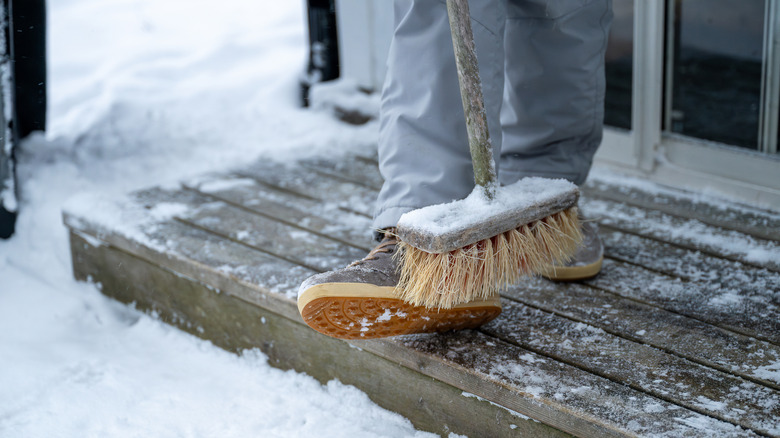
Whatever method you choose for de-icing, it's best to research products and check labels to determine which will work best for your deck's surface to ensure that they are safe. For instance, calcium chloride is much safer when used around any plants or if you have any pets. The magnesium chloride de-icers, although less harmful than rock salt, are not good for animals. Anything containing salt in it should be rinsed away immediately once melting occurs, so that you don't damage your deck or cause rust on the hardware. You should also avoid any colored or dyed melts, since there's a possibility they could stain your deck. You can also reduce the potential for any damage from your ice melt application by sealing your wood deck before winter.
To prepare in advance and protect your deck, you can lay down a thin layer of your safe de-icer on your deck before a winter storm arrives. This step also helps prevent ice from sticking and becoming difficult to remove. If you are only getting a light snow, you can still spread some of your de-icer on the deck right away to help ensure that as more snow falls, it doesn't accumulate as much. Finally, if temperatures are dropping rapidly, it's a good idea, even if there isn't much snowfall, to put some of the de-icer down to keep your deck from getting any icy spots.