

Are Ryobi's Power Inverters Worth Buying?
We may receive a commission on purchases made from links.
Ryobi's power inverters let you use your Ryobi batteries to power devices that require electricity. So if you're on a job site without a power source, Ryobi's inverter can run your electric drills, saws, and other tools. And if the power goes out in your home, Ryobi's inverter can power your home appliances and devices, as well. Is it worth buying? Or is this another Ryobi product that you should avoid? If you already own several Ryobi 18-volt batteries, it might be worth considering purchasing Ryobi's companion power inverter. If not, there are other power stations out there that can provide more power, last longer, and cost less.
Ryobi's base-model battery inverter power station,sold for around $650, comes with only a single 18-volt battery. This may be fine for light work, but it only generates 450 watts and can run for 108 watt-hours. By comparison, a 10-inch miter saw requires 1,000 watts of power, while an electric drill requires 600 watts. The inverter power station can accommodate a total of eight 18-volt batteries. The batteries need to be of the same brand and voltage, so don't even consider using a power tool battery adapter to run other brands' batteries in Ryobi's inverter. With eight batteries, though, the inverter will provide a maximum of 1,800 watts, capable of running a full-size refrigerator for 11.5 hours.
If you already own multiple 18-volt Ryobi batteries, that amount of power for roughly $650 can be a bargain. If not, you can purchase the power inverter with four batteries for around $850. An additional four-pack of batteries will run you around $300. This means a full power station will cost around $1,150. At that price, it's worth doing some comparison shopping.
Comparing Ryobi's power inverter to the competition
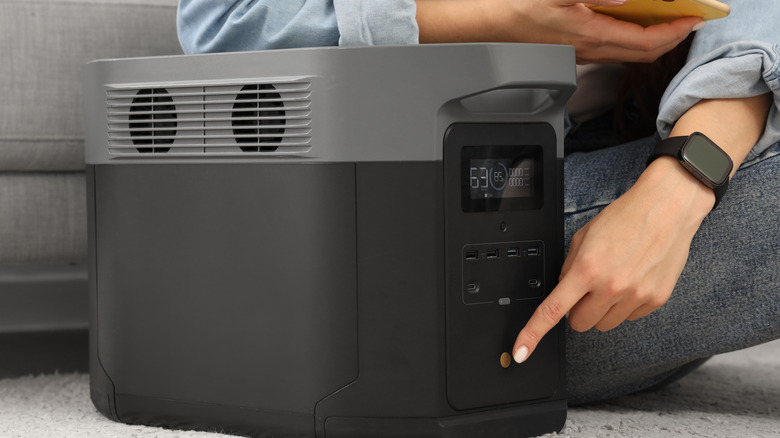
A minimum of $650 is a lot to spend on running a few relatively lightweight plug-in power tools. For the $1,150 pricetag, it might be tempting to use Ryobi's power inverter to keep your entire home running during a power outage. A portable power source for running heavy-duty tools and a whole-home battery backup are two very different use cases, though. In each case, Ryobi's competitors offer better value.
If you only need a lightweight power source to recharge your cordless drill's battery, a Jackery Portable Power Station can provide 300 watts of power for a total of 288 watt-hours. This has less power than Ryobi's base model, but you can buy it for around $300. If you need more than that (but not enough to power your whole home), a Bluetti Elite Power Station, for around $800, can provide 2,600 watts for a whopping 3,900 watt-hours. That's far more than the 1,800 watts and 432 watt-hours that Ryobi's comparably priced 8-battery inverter power station can provide.
With eight batteries, Ryobi's power inverter can certainly make a power outage less miserable by keeping your refrigerator going, but not much more than that. A refrigerator can require 700 watts of power to run. Try to run your 2,100-watt electric stove or your 1,200-watt window air conditioner as well, and you've already maxed out your Ryobi power inverter. To run your entire home, an EcoFlow Portable Power Station can cost you around $2,300. This pricetag might seem high, but it provides you with 4,000 watts of power for far longer: 8,096 watt-hours, making Ryobi's power station look like weak tea. Whatever your use case, unless you already have a bunch of 18-volt Ryobi batteries that you're not using, it's worth shopping around.