

Epsom Salt Vs Vinegar: This DIY Laundry Additive Made Our Clothes Soft, Bright, And Odor-Free
We may receive a commission on purchases made from links.
When it comes to household chores, one task is never-ending at my house: the laundry. We're disciplined about doing the dishes after every meal, the floors get a quick vacuum most days, and I'm still obsessed with my Tineco (the robot maid you didn't know you needed.) But no matter how steadily my trusty old Whirlpool washing machine runs, there's always another load of laundry waiting for me in the wings ... er, in a pile on the floor if I'm being totally honest. Among the joys of middle age is figuring out that magic formula of detergent, water temperature, and add-ins that promises to leave my scratchy linens and dirty clothes looking and smelling like new. There's no end to the best laundry hacks out there, but I frequently stand in the detergent aisle wondering which products actually work and which are just another overhyped internet myth I'm about to dump all over my clothes. Enter two hacks that are each supposed to eliminate odors from laundry: vinegar and Epsom salt.
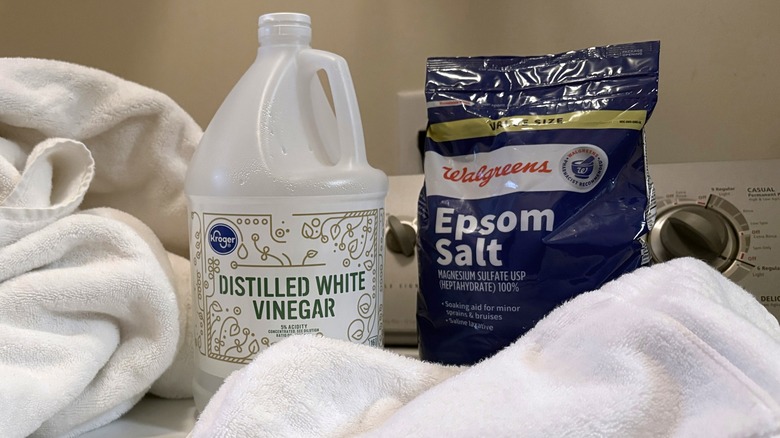
Natural ingredients always seem like they're less likely to leave bleached out spots or weird odors on my sheets or shirts. Vinegar's affordability appeals to me, plus that weirdly astringent smell practically whispers, "Of course I make things cleaner." Admittedly, I measure with my heart straight from a giant bottle whenever I wash my stinky whites. My giant bag of Epsom salt, meanwhile, lives in a bathroom cupboard just waiting to be called on for its gentle scrubbing power when our sinks or tubs get grimy. Even though I always have these staples on hand, I've never put them head-to-head in a laundry showdown. So this week, I ran a simple test to see which one delivers best on softness, brightness, and smell.
Two loads, one method
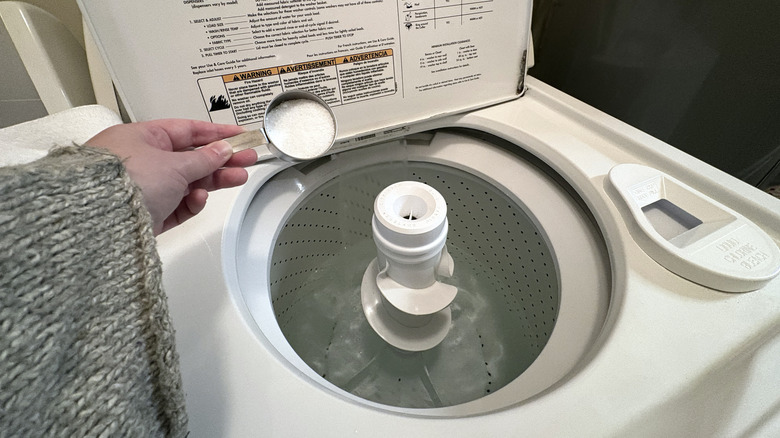
One of the ways I simplify my laundry routine is by using the same settings every time. I approached both of my ingredient tests the same way, running super loads with cold water on a regular cycle. I've been finding great deals on Arm & Hammer Free and Clear Laundry Detergent, and since everyone in my house has sensitive skin, I always run an extra rinse cycle. My dryer stays on low to reduce energy costs at home, and I use three handmade wool dryer balls instead of scented dryer sheets. Usually, I add a few drops of essential oils before tossing them in, but since one of my main priorities was to see how well Epsom salt and vinegar worked to deodorize my dirty laundry, I skipped adding any scent for both tests.
To ensure each natural ingredient got a fair shake, I used the exact same amount of laundry detergent for each load. Conveniently, I had two white queen-sized duvet covers and two full-sized white bath towels waiting to be washed, so each load had one of each. Instead of just winging the amounts, after some internet sleuthing, I decided a ½ cup was the right amount for both of these boosters. For both loads, I allowed the washing machine to fill halfway before adding the detergent and natural ingredients at the same time. Then, I allowed the machine to finish filling before adding my laundry. I realize the correct order to load your laundry is up for debate, but this is how my mama always does it and, well, I don't make the rules.
What I wondered (and expected)
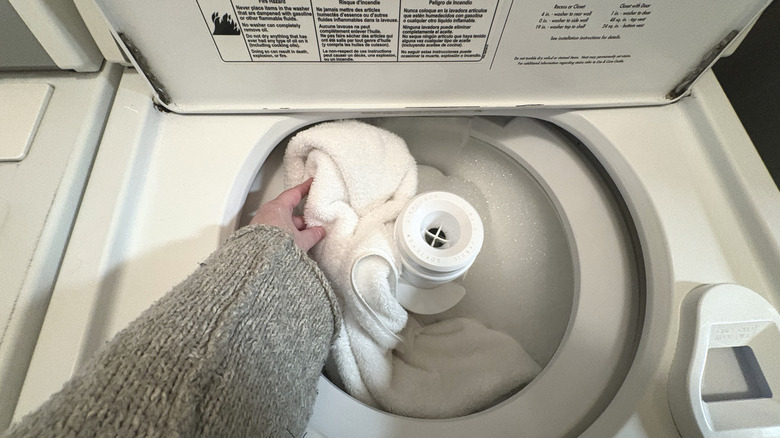
I started with both questions and assumptions about this experiment. Vinegar has been a part of my laundry routine for a long time. Meanwhile, although I can make a gritty sink scrub with the best of them, I had to research how to use Epsom salt in the laundry room. Was I supposed to just throw it right into the washing machine, did I need to dissolve it first, or should I mix it into my detergent? The internet was divided on whether it was even effective, let alone the best way to use it.
The more I dug, the clearer it became that comparing these two natural ingredients was going to be anything but straightforward. There's no real way to equate liquid vinegar and crystalline Epsom salt. Vinegar relies on acetic acid, while the magnesium sulfate in Epsom salt helps to resoften even your scratchiest towels. The science behind this went deeper than my single O-Chem class brain could really comprehend, but I gathered that even though magnesium is a mineral that technically hardens water, it's often recommended online as a DIY fabric softener because it binds to soap residue.
Part of the fun in testing internet hacks is seeing whether my gut instincts are right or whether I've been underestimating something that's been tucked in a cupboard all along. Still, I couldn't shake the suspicion that Epsom salt belongs in the bathroom, while I confidently expected vinegar to deliver the odor removal and brighter finish I frequently rely on.
The results are in
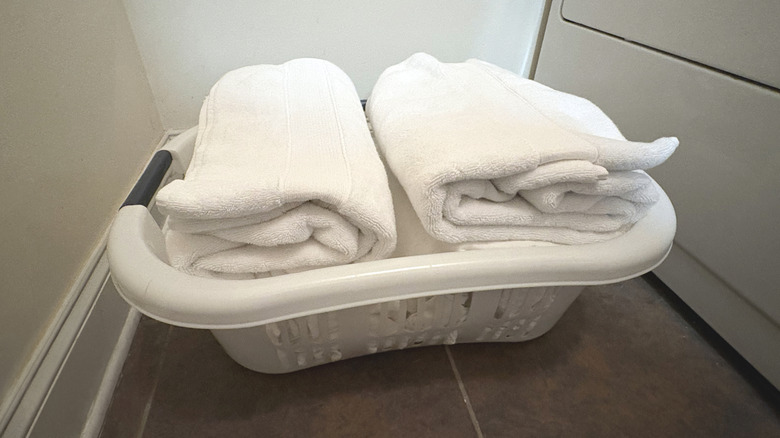
After washing, drying, and folding both loads of laundry, the differences were easy to spot. The vinegar load came out of the washer with that faintly sharp smell that always reassures me things are clean, and once everything was dry, the smell disappeared completely. What remained were immaculately white, soft, freshly scented linens. My duvet cover had just the right texture, and the towel felt soft and fluffy without any of that filmy feeling that liquid fabric softeners often leave behind.
The Epsom salt load wasn't terrible, but I'm not sold either. The laundry smelled reasonably fresh, but both the duvet and towel felt slightly stiff, almost like they needed one more rinse cycle prior to drying. The towel edges in particular had a crunchy stiffness that made me second-guess all those DIY fabric softener claims I kept finding online. I couldn't tell a difference in terms of brightness between the two methods, and when I solicited a second opinion from a family member, he couldn't either.
In terms of both ease and cost, vinegar wins by a mile. It dissolves instantly, and a gallon of the Kroger-brand white vinegar I always have on hand costs just over $4. Meanwhile, the Epsom salt was a bit messier to handle, and a 6-pound Walgreens-brand bag costs closer to $8. Although I didn't experience any of the corrosion or mineral buildup some sources warn about, the results weren't impressive enough to risk trying again. Vinegar delivered a fresh scent, brighter finish, and softer texture with zero fuss, cementing its place as one of my go-to laundry boosters.