

Why Your Evergreen Conifers Are Losing Needles (And When To Worry)

Many homeowners plant beautiful and fast-growing conifers to add privacy to their yards. Assuming they're evergreen, they believe the privacy screen would hold its green hue year-round. So, when they notice their evergreen conifers losing needles in the fall, they might be concerned about disease or site problems. Fortunately, it's usually nothing to worry about; your conifers are undergoing seasonal needle drop, a natural phenomenon that occurs around fall.
Also known as fall needle drop, it occurs when conifers kick into defensive mode. During autumn, when their resource stockpile is dwindling, they release their older needles. Since old growth is located in the tree's interior, it receives limited sunlight. Plus, these leaves are often dusty and wounded from experiencing the direct ire of natural elements. These factors impair their ability to photosynthesize, causing conifers to shed them and instead focus their limited resources on new growth. Since newer needles are already out on the tips in all their green glory, conifers are treated as evergreens without them actually being so. However, if you notice this trend in seasons other than fall and if it's more pronounced around the newer growth or specific sections, you may have reasons to be concerned. But how do you differentiate the two?
Conifers naturally drop their needles in the fall
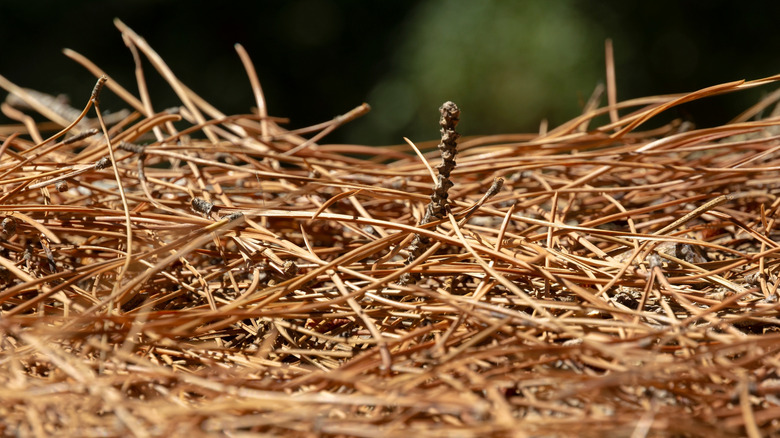
The biggest tell that your conifer is undergoing seasonal needle drop is that it occurs in the fall. It starts gradually, with the old needles turning yellow, then reddish-brown in tandem with the weather growing chilly, while branch tips remain a healthy green. However, if your conifers experience extended dry or hot spells, they may show browning a bit sooner (during the late summer months) due to diminished resources.
Another thing to bear in mind is that seasonal needle loss isn't equally conspicuous for all conifer species. For instance, Eastern white pines show the biggest drop, as they cast off their second-year growth. In contrast, spruces won't shed their leaves until they're at least five years old, making the event far less dramatic. All in all, you'll find this more evident in the case of pines, fir, and spruce. Or, in dawn redwood, larch, and bald cypress, though they're deciduous conifers, not evergreen. That's why knowing which specific conifer variety you have in your yard is useful for identifying this natural growth-loss cycle. Regardless, you don't have to worry about this seasonal loss; conifers will recover on their own, provided their growth conditions are met and they receive optimal care.
Times when needle drop signals disease or stress
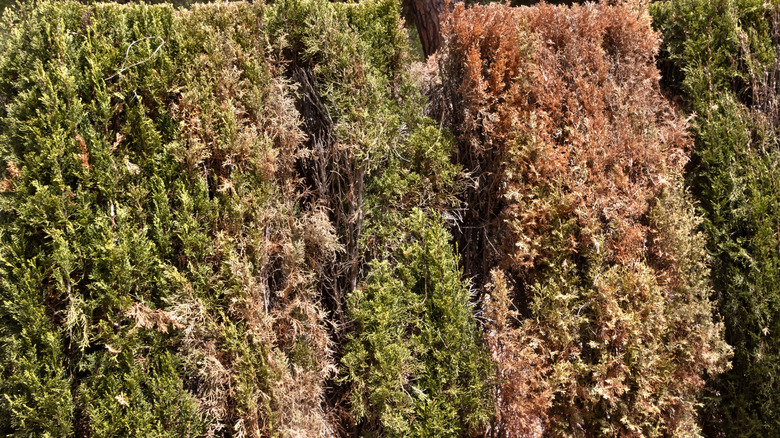
If you notice the needles on your conifer trees and shrubs turning brown during the growing season, say spring or summer, or in isolated patches, it may indicate disease or environmental stress. Although symptoms vary across species and microorganisms at play, a diseased conifer would show signs of stress in outermost (new) needles, not in the interior. Left unchecked, entire branches may die off, leaving the lower canopy thin and sparse. Rhizosphaera needle cast is the partial exception. It begins on older needles but works from the lower branches upward. Either way, diseases progress rapidly and may be accompanied by galls, cankers, resin overflow, and stunting.
You may notice a similar trend if your conifers are in unfavorable conditions. Poor drainage, alkalinity, and soil compaction are usually the biggest issues, as they interfere with the trees' ability to access essential nutrients, forcing them to discard their needles for sustenance. That being said, trees standing in an open site and exposed to biting cold or winter rains may also show discoloration during winter or early spring. They can't withstand the stress and nutrient leaching for long — red cedars are particularly notorious for this. But they recover and green up once the desired conditions are restored. Given that, it's best to monitor your trees throughout the year before making any diagnosis. But if you believe the tree poses a safety hazard, contact your local extension service with photographs or consult a licensed arborist for a detailed diagnosis.