

Keep Your Walkways Snow And Ice-Free With A Less Corrosive Solution

We may receive a commission on purchases made from links.
Snow is lovely to look at, but one place you certainly don't want to see it is on your driveway and walkways; and when winter comes, many of us will go to great lengths to keep those areas snow and ice-free. Rock salt — and even table salt! — is a very effective snow and ice remover and deterrent, but using salt as a deicer has a lot of downsides. Not only is salt harmful to the environment by contaminating water supplies and injuring plants, it's also very corrosive — meaning it can do some serious damage to concrete sidewalks and anything metal, like your car. If you're looking for ways to eliminate snow and ice without suffering the abrasive consequences, incorporating beet juice is a less corrosive solution that can keep walkways clear.
First, it's important to note that this isn't a totally salt-free solution, and consequently isn't totally corrosion-proof, either. People aren't pouring straight-up beet juice on walkways and roads and calling it a day; in fact, beet juice won't work on its own and needs salt to be used as a deicer. Instead, cities and states have been using beet juice as an ingredient in salt mixtures to help minimize the corrosive harm that salt can do. By supplementing some of the salt with beet juice, they are using less salt, which means less corrosion. Plus, the beet juice actually boosts the efficacy of the salt by lowering the temperature at which it can melt snow and ice.
How beet juice works against snow and ice
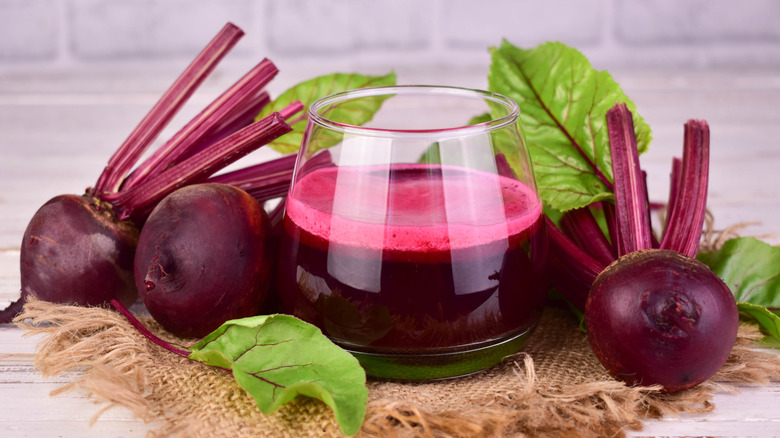
While this may seem like a quirky ice solution, it actually isn't an uncommon way to combat ice on a mass scale, with Time reporting in 2014 that about 175 municipal agencies were using a beet-infused product for deicing. In addition to diluting the amount of salt in deicing mixtures, beet juice also means less corrosion on roads because the sticky beet juice keeps the salt on the road where it belongs instead of allowing it to scatter everywhere, which means less of the salt mixture gets wasted and needs to be applied.
In fact, Tim Byrne, maintenance operations and fleet services manager for Lincoln Transportation and Utilities in Nebraska, told The Weather Channel that using a combination of beet juice and salt has helped the city considerably reduce their salt use, and that beet juice is the special ingredient that makes the mixture less corrosive. "The incorporation of that organic by-product serves as a natural corrosion inhibitor," Byrne explained. "By incorporating that into our solutions, [it] makes a brine that is 75% less corrosive than salt itself."
You can buy commercial beet juice solutions, like Beet Blast or Organic Melt, to reap these less corrosive benefits on your own walkways, too. And if you're worried about beet juice dying your driveways and walkways (beet juice has long been used as a natural dye and stain, after all!), don't worry; these are non-staining solutions. You can also try MELT Beet-It, which is combined with less corrosive CMA (calcium magnesium acetate) for a salt-free option.