

4 Ways To Propagate A Fruit Tree For An Endless Supply Of Delicious Produce
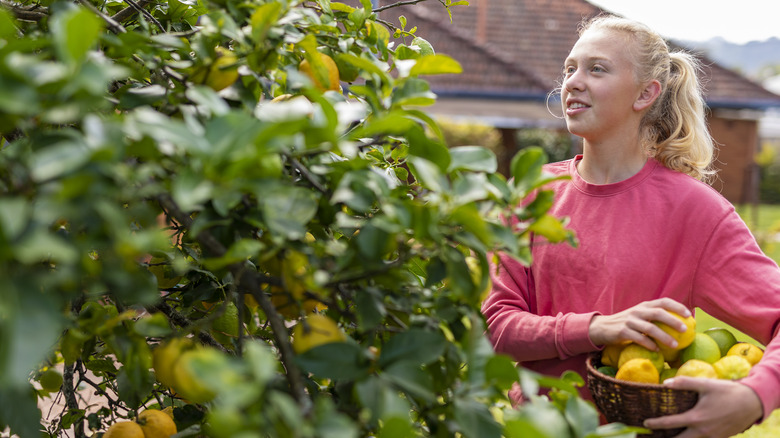
Multiple methods for propagating fruit trees? Why not just plant seeds? The reason is that the seeds of any fruit will produce fruiting trees, but the fruit is unlikely to be true-to-type to the parent tree. Will it be an edible fruit? Probably, but it just won't be the same as the fruit it grew from. That's why we're describing four ways to propagate a fruit tree for an endless supply of delicious produce.
Not all methods apply to all kinds of fruit trees. The propagation methods we're covering and the fruits best suited to them include cuttings, best suited for fruit shrubs like blueberries and blackberries, and some trees like fig and mulberry. Grafting, the most widely used propagation used on fruit trees, works well on apples, pears, stone fruits, and citrus trees. Budding can be used on any deciduous fruit tree grown in the temperate-zone. Air layering can be used on most fruit trees, is especially suited to citrus fruits and avocados, and is often used on tropical fruits.
A few caveats apply to all methods. Be sure that all equipment used in propagation processes is clean and sanitized. All cutting instruments should be sharp. Special tools for grafting are commercially available. Don't allow tree parts to dry out during propagation processes. Keep in mind that fruit trees may be patented, which means propagating them could cause you a legal headache. Let's look at each of the propagation methods in depth.
Propagate fruit shrubs and trees from cuttings
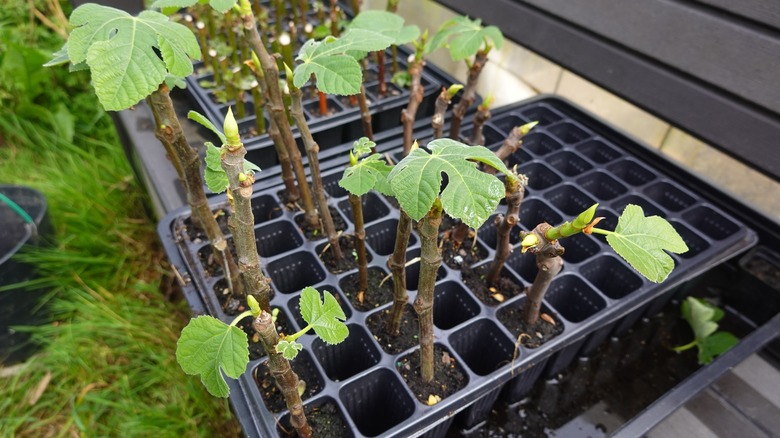
The cuttings method of propagation is probably the technique most familiar to you, because it's essentially the same as propagation through cuttings of any plant. For fruit trees, you can gather softwood, semi-hardwood, and hardwood stem cuttings from your fruit trees, best harvested in the morning and in the spring as new growth occurs. Gather hardwood stems only when trees are dormant. Cuttings should be 4-6 inches long and cut diagonally. Plant quickly to avoid drying. After making 1-2 inch slits in hardwood and semi-hardwood stems (not needed for softwood), you'll dip the stems in rooting hormone and stick into potted, soilless growing medium, such as perlite or vermiculite.
Place a plastic bag with a few holes cut into it over the cutting for a greenhouse effect, but take the bag off for a brief period daily to give the cutting some aeration. A heating pad at 70 degrees Farenheit under pots will promote faster root growth, but most cuttings will also do well in a temperature range of 60 to 65 degrees Farenheit. Roots should appear at 3-6 weeks. Once roots are well established (at about 3 months), transplant into a nutrient-rich soil. Be careful of delicate roots as you transplant.
Some experts suggest using cuttings for fruit tree propagation is challenging, largely because roots don't always establish well as the cuttings may be putting their energy toward the shoots. That's why it's best to choose fruit trees and shrubs you can grow from cuttings, such as gooseberries and elderberries. It's also a good idea to root more cuttings than you need in case some don't take.
Propagate fruit trees by grafting
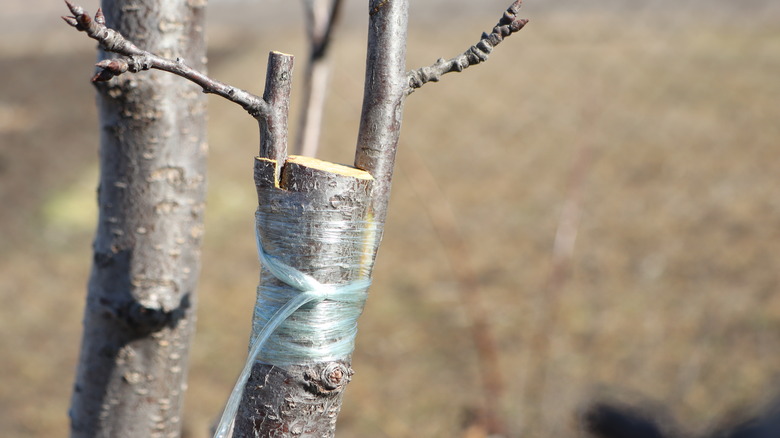
Grafting is the process of joining two vegetative tree parts with the goal of fusing them into a single plant, thereby obtaining the characteristics of both parts. In essence, the grafting technique calls for making cuts in two tree parts, then connecting them with tape. The grafted parts are comprised of rootstock (for the lower, root-bearing part) and the scion, a cutting from a young tree.
Although the rootstock does not need to be the identical variety as the scion, it should ideally be the same species. There are several grafting techniques, such as whip and tongue, cleft, bark, saw-kerf (also known as notch grafting), four-flap, and side veneer; you can learn the details of these methods in our beginner's guide to grafting fruit trees (and common mistakes to avoid).
A grafting mode said to work well for novice grafters is bench grafting, which is not a technique but rather involves a specific setting (indoors), timing (late winter or early spring), and type of rootstock and scions (dormant). You'll need year-old scion shoots close in diameter to your rootstock. Bench grafters often use the whip and tongue technique to make matching cuts in the two parts.
Joining the cut areas of the two parts with tape also keeps the connection from drying out. Masking tape is fine, but tape especially made for grafting is best. Grafting wax and rubber bands are options for sealing the union and applying extra pressure to keep the parts from shifting. Store grafted trees in moist, aged sawdust for up to 10 days as a callous forms around the wound. Trees may take up to two years to heal and become ready to plant in an orchard. In the interim, they can be planted in the garden.
Propagate fruit trees by budding
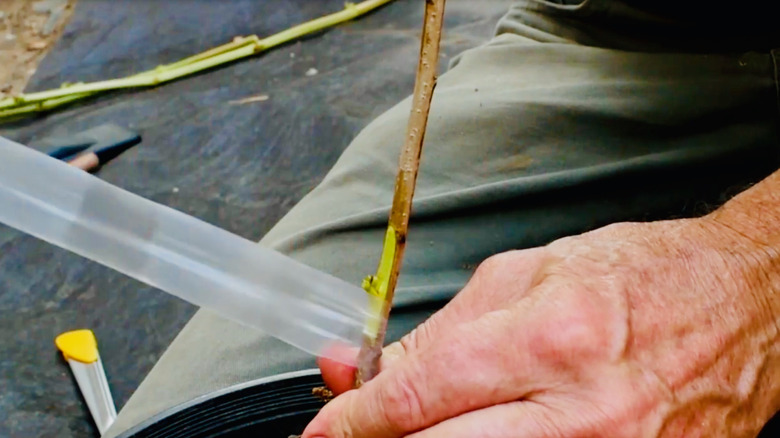
The budding method of propagation can be thought of as a subset of grafting; it's a grafting method in which an individual bud — as opposed to a larger section of the scion with multiple buds — is attached to rootstock. The most used sub-methods of budding are T-budding and chip budding.
As in regular grafting, rootstock and scions should be compatible. You'll need fully developed and dormant buds. You can bud potted or planted rootstocks when they reach a pencil's diameter. Collect healthy, robust current-season shoots with prominent buds as your scions in late summer. Strip scion pieces of their leaves, but let the petiole (leaf stem) remain. For chip budding, make a downward cut in the rootstock at a 45-degree angle, and then form the chip shape with a second downward cut. Cut the bud from the scion in the same way. Insert the bud chip into the chip-shaped cut in the rootstock.
If you use a stretchy, low-molecular-weight polyethylene tape, you can completely cover the bud because the tape is breathable and allows moisture to penetrate. The bud will eventually emerge from the tape, and the tape will decompose. If using other kinds of tape, allow the tip of the bud to peek out from the tape.
With T-budding, a T-shaped cut is made in the rootstock, and the bud piece tucked inside it. Some propagators prefer chip budding to t-budding because chip budding can be done at most times of the year and tends to succeed more often than t-budding. For either method, keep the tape on till spring. Before bud break, check to see if the bud graft has taken; if so, cut the rootstock off just above the bud.
Propagate fruit trees by air layering
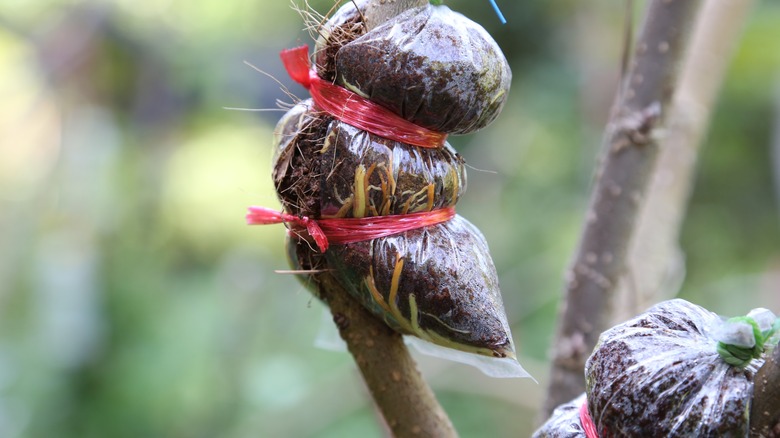
In air layering tree branches are encouraged to grow roots though still attached to the tree. For fruit trees, the timespan from April to May is the recommended period for this process.
To air layer, identify a suitable fruit-tree branch of about pencil diameter size and the location on the branch from which you want roots to grow. Scrape off a 1½ to 2 inch ring of bark just below the spot you've selected for roots, removing wood, green, and cambium, the layer between the wood and the tree's vascular layer (xylem). Optionally, apply rooting hormone to the ring at this point. Wrap wet sphagnum moss, coconut coir, or even a ball of wet soil snugly around the cut area and cover securely with a plastic bag or clear polyethylene sheeting, providing a small hole for irrigation. Keep the moss moist through regular watering. Depending on which fruit tree you're growing, you can expect to see roots emerging in three weeks to three months.
Watch for browning and mature roots to be visible through the plastic, letting you know it's time to remove the new tree. Retain as much of the original branch as possible below the new roots. Pot the new tree in sphagnum moss, place it in the shade, and keep it from drying out with regular watering and misting. Place a plastic bag with a few holes over the tree to help sustain the top of the tree as roots are still developing. Poke more holes in the plastic bag as the root system develops so humidity inside and outside the bag are equal. One variation on the air layering technique involves tightly winding a wire around the branch instead of cutting the bark.