

The Easy De-Icer Trick That Instantly Adds Grip To Any Icy Driveway Or Steps
We may receive a commission on purchases made from links.
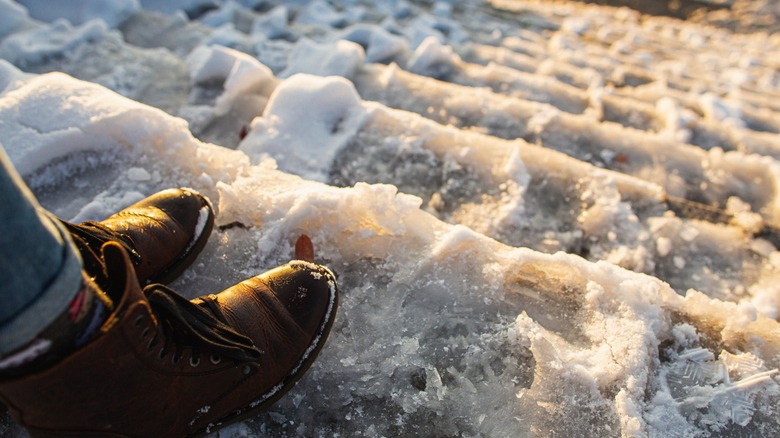
Dashing out the door in the morning and falling flat on your back end can be a jarring way to begin the day. In that kind of scenario, not having adequate traction is a key missing element. People spread rock salt on hard surfaces to melt away ice sheets. But a big mistake you might be making when using rock salt to prevent slips and falls on concrete is not thinking of adding sand to the equation. Sand, when mixed with salt, gives surfaces improved traction, limits environmental damage from salt runoff, and protects your hard surfaces.
If you try this method for melting ice and adding traction without rock salt, the result will be a gritty layer on top of icy surfaces to prevent falls. You can't use sand to melt ice on its own, as it has no natural properties to do so. However, mixing it together with salt gives you reduced slipperiness on surfaces while the ice melts. At very low temperatures, adding sand can help improve the safety of walkways when salt might not be fully effective. The gritty texture it embeds into the ice gives your shoes something to grip.
Why you should try mixing sand with salt this winter
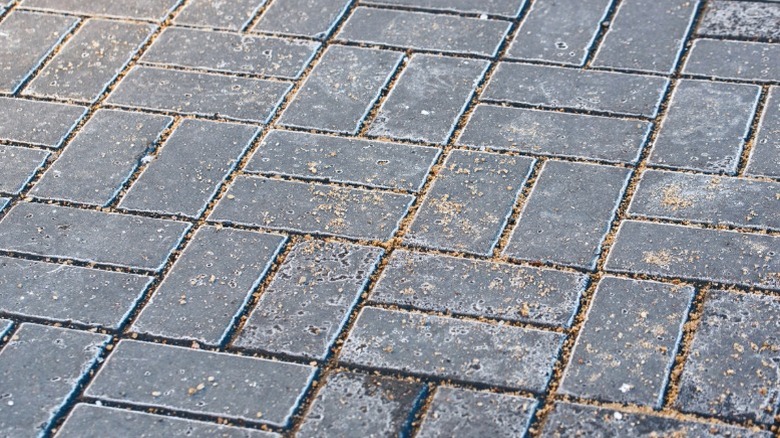
If you are stuck choosing between salt or sand to best melt ice for winter driveway safety, go with rock salt if your main goal is just melting the ice. As mentioned, sand alone will not melt ice on your hard surfaces. However, mixing together sand and salt in equal amounts is a trick to create a reliable de-icer with optimal traction. Some recommendations on how to execute this de-icing trick provide different ratios, like using only 10% salt. However, the goal of this particular salt and sand combination isn't to melt the ice, but to provide traction when it's too cold for traditional de-icers to work as they should.
Mixing sand into your ice in the winter does more than add a little extra grip to your icy driveway or steps. A salt and sand mixture is a more environmentally friendly de-icer than pure salt. Beyond being kinder to your nearby vegetation, this unique ice melt solution prevents some of the corrosive impact of a pure salt ice melt. When putting large quantities of salt onto your steps, you can keep it from coming into contact with your surfaces using a little sand. Another perk of using sand is that you can collect it afterwards to use again and save a bit of money. But even if you don't, putting a little sand with your salt is cost-effective; a bag of Quikrete 50 lb. All-Purpose Sand is available at Home Depot for $4.73 a bag.