

The Sleek Holly Plant Variety That Is Perfect For Growing In Containers

We may receive a commission on purchases made from links.
Virtually synonymous with the holiday season, English holly (Ilex aquifolium) is well-loved for its dark green leaves and characteristic red berries. In fact, this lovely plant has been used for millennia in everything from decoration to gifting and even ancient rituals. But if you're looking for some beautiful foliage for your modern-day pots and containers, you may want to look into one specific holly variety that offers its own unique silhouette.
Columnar Japanese holly (Ilex crenata 'Sky Pencil') has a narrow shape that can grow up to 10 feet tall in its native forested habitat. However, the spread of this holly variety is relatively limited — only about 2 or 3 feet wide — meaning it is one the best plants to grow in containers. Columnar Japanese holly not only grows happily within a smaller space but also does not need pruning in order to keep its distinctive pencil-like structure. This means its tall, thin aspect makes it a great, low-maintenance option for growing in planters, as it can work as a living screen, allowing you to create some privacy in your outdoor space without the need for a fence.
'Sky Pencil' holly can be found at a variety of garden stores, though many different companies have their own cultivar of it, so it can appear under a variety of trademarked names, such as 'Red Sky' and 'Straight & Narrow.' So, if you're captivated by the sweet, rounded leaves and impressive height of this holly plant, why not look into how to grow one or more in your own containers?
How to grow columnar Japanese holly in a container
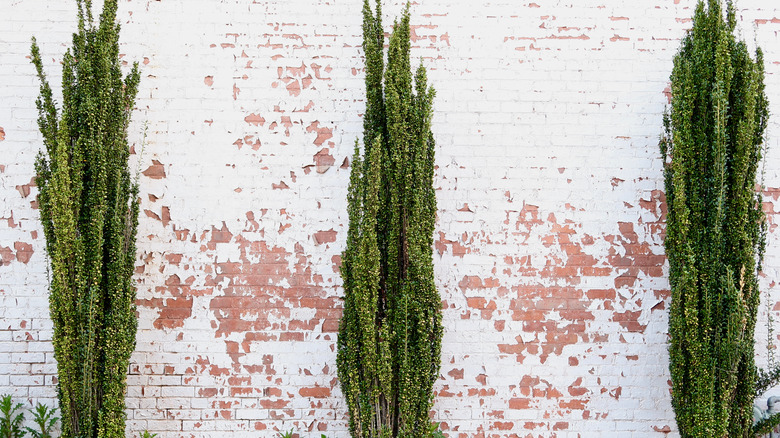
Luckily, columnar Japanese holly can be considered relatively low maintenance due to its tolerance of a variety of soil types and its ability to withstand mild drought. Well-draining soil is best, however, to prevent the roots from getting too waterlogged.
This plant tends to grow well in USDA Hardiness Zones 6 to 8 because it is not generally cold hardy enough to handle winter temperatures in colder zones. That's another reason why it's a great plant to grow in containers, because if you do live in a chillier region, you can simply move the plant inside or into a sheltered area, where it will be more likely to survive the winter. Just keep in mind that it is toxic to pets so should be kept in a pet-free area. If you decide to leave your holly outside in a protected location, make sure to lay extra mulch over the roots so that they will be less likely to freeze.
It's also important to know that this type of Japanese holly can be susceptible to pests known as spider mites. One way to manually remove these small, eight-legged creatures from your holly is by regularly spraying the plant with a stream of water. This will help to knock the majority of the mites off the leaves without harming the plant itself. However, if the infestation worsens, a product such as Bonide Insecticidal Soap can be used to get the pests under control.
So, with well-drained soil, some awareness of local temperatures, and a keen eye on any sneaky spider mites, you can easily transform your patio or balcony with this striking plant in your chosen containers.