

How To Determine The Best Type Of Bolts For Your Next Project
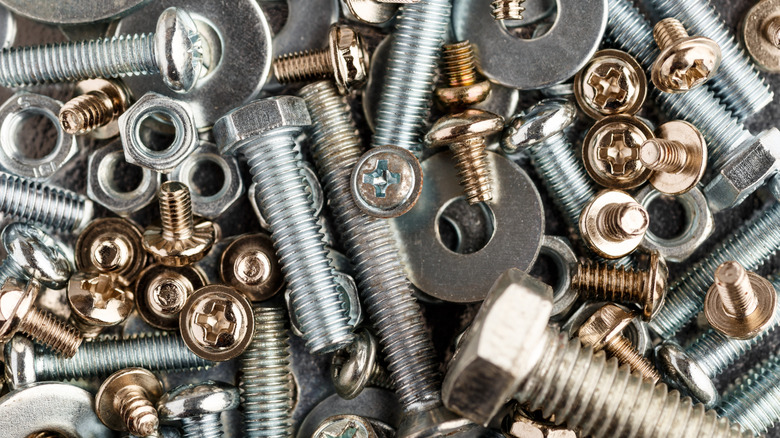
Look around any home and yard, and you'll find dozens of screws, nuts, and bolts. Screws are usually used in wood and drywall. They fix into something. While it's important to know the right screw for your DIY project, they are not the same thing as bolts, which are typically used to hold two items together. There are exceptions, though. Lag bolts, often used in decking, are actually screws with hexagonal heads, and blind bolts don't use a nut; they go into a pre-threaded hole.
When the term 'bolt' is used, most people probably think of the standard nut and bolt, maybe with a couple of washers that spread the load and help prevent damage to surfaces. However, there are lots of different types of bolts. Knowing what's best for your project can impact both appearance and durability.
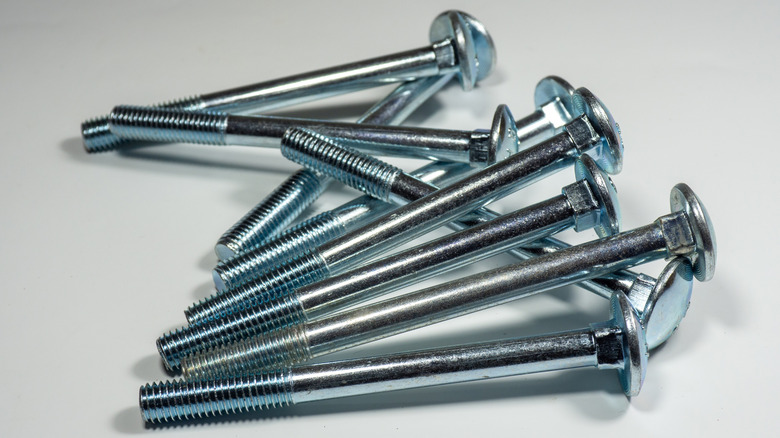
For example, instead of a standard hexagonal shape, the head on a dome bolt is smooth and often shiny. It's a more decorative option. However, they are difficult to grip, so you need access to the nut at the other end to tighten them. Carriage bolts are similar, with a square section under the head that helps stop them from rotating. They often have a bright finish, but some are black and look good in a rustic setting. Countersunk head bolts are designed to be mounted flush with the surface. You need an Allen wrench to tighten them rather than a standard wrench.
Bolt size, material, and finish will determine which is best for your project
So far, we've covered the common bolt types that you're likely to use in home and yard projects, but there are many more. You might have noticed 'headless' hanger bolts in self-assembly furniture, for holding legs on tables, for example. Anchor bolts and J-bolts are used in construction. So while simple bolts are often used to fix things around the house on the cheap, before you start your next project, it's worth checking if there's a bolt that will give better strength or is more attractive than the common solutions.
The finish may also be important. Many bolts are made of plain steel, but they are prone to rust. While there are lots of ways to remove stubborn, rusted bolts, it's something that might be better avoided in the first place, particularly if the bolt is visible. Stainless steel is highly resistant to rust. Chrome, nickel, zinc, and galvanized are also popular finish options. Even gold is sometimes used.
Diameter and length are obviously important. The shaft should be a snug fit in the hole, and the head should be big enough to prevent it from pulling through (another area where washers help). Finally, there's the amount of the shank that's threaded. Unlike screws, where the thread goes all the way up, bolts often have an unthreaded portion. How long this is isn't important, as long as there's enough thread to securely fasten the nut.