

11 Budget-Friendly Tricks HGTV Stars Use To Fill Up Empty Wall Space
We may receive a commission on purchases made from links.
Empty walls can make a space feel unfinished or uncurated, leaving large gaps in your design. However, filling up an entire wall isn't cheap, especially when you start looking up print and canvas prices. Luckily, transforming blank walls into stylish focal points doesn't have to break the bank. In fact, some of your favorite HGTV stars have been practicing wallet-friendly wall designs for years, transforming entire spaces with carefully placed pieces or cleverly repurposed materials.
These HGTV stars are used to working within the confines of a budget, whether because of a challenge or because that's how much their client has earmarked to spend, so they know how to use all of the resources available to them to create a punch without breaking the bank. Luckily, you can use some of their ingenious ideas to dress up your own blank walls at home.
Whether that's using leftover particleboard and glue from a demo to create large abstract art, or repurposing wooden crates to create a massive bookshelf, these ideas will bring a lot of drama to your space while keeping your budget in mind. Many of them can be done with materials you already have in your home from previous projects, like leftover paint to create color-blocked murals. Others can be achieved by thrifting or picking up inexpensive items on Facebook Marketplace, like curated plate walls. Use these 11 budget-friendly tips to help turn any bare wall in your home into a statement piece.
Erin Napier makes large-form art using particle board and glue
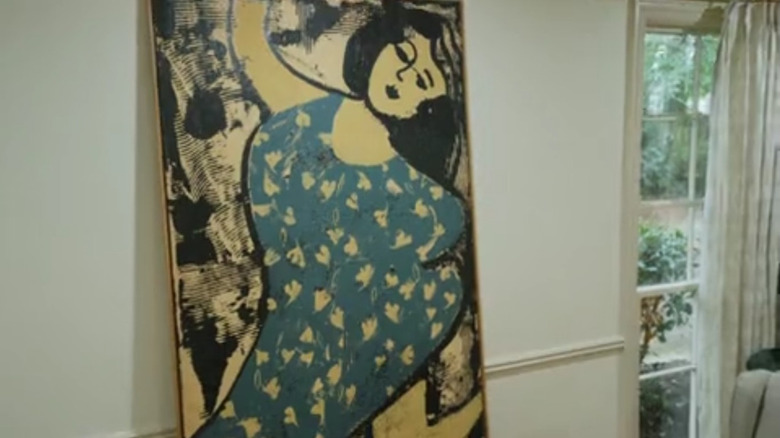
Rather than drawing a wall mural or spending thousands of dollars on large canvas art, Erin Napier has a budget-friendly hack to fill an empty wall: use particle board and glue. In the Season 9 episode of "Home Town" titled "Making the Nest", the designer showed viewers just how cost-efficient the project could be. In fact, she didn't buy a single thing to pull it off. Instead, she salvaged the particle board during a demo -– it was covering a hole in the hardwood flooring, and when they ripped it off, it had a ton of adhesive.
The patterns the glue created inspired Napier, and she thought she could make an interesting art piece from them. "This came off your floor!" she told the owners when they pointed out the painting during the reveal. "It had glue all over the back of it, and I looked at it and thought this looked like an abstract painting. And so I just added paint to it. I made it a dancing lady."
If you're doing some remodeling, this is a great way to keep supplies from going to the dumpster. However, if you're not currently ripping up any carpet or flooring, you can get particleboard at any hardware store. For instance, a 2x4-foot sheet costs $10.98 at Lowe's. You can then add globs of adhesive to the board to add texture, splattering them randomly to give it an abstract feel. Then, grab some paint leftover from previous remodels or craft projects and create an image with the adhesive.
Nate Berkus makes wall art using blown up photos
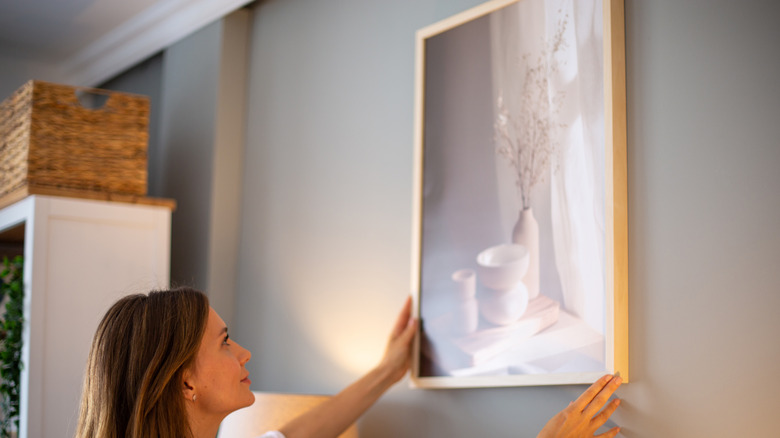
Most people love to display family photos in their homes, but a snapshot from an important birthday or a memorable vacation might look odd if it's blown up to large proportions. It might read as "formal painting hanging in the great hall." To avoid that, Nate Berkus has a clever trick for transforming family photos into non-cheesy large-scale art, and that is to only use parts of them. (It's also an affordable way Berkus fills wall space.)
"Take imagery that you have taken with your phone on trips [or] of people that you love, crop it in really interesting ways, like the steps of a building or just an angle of the beach where you had a great vacation, blow it up, [and] frame it," he shared on an Instagram Reel. "Even one large-scale piece can have a huge impact over a sofa or a bed."
If you took the photos with a digital camera, the resolution should be sharp enough to make large-scale prints from the file. However, if you took them on your iPhone, you will need to transfer the photo to something such as Lightroom to ensure the stretched-out image doesn't end up pixelated. Put the image into Lightroom, then hit "Export As" instead of "Export to Camera Roll." In the option "Long Side Pixels", type in 10,000. This should allow you to get a crisp image as large as 6 feet. You can then print it as a banner in places like CVS or Walmart to keep it budget-friendly.
Erin Napier loves plate walls

Who says canvases and prints are the only way to fill up a wall? In Season 3, Episode 1 of "Home Town Takeover," Erin Napier makes a case for the vintage-inspired wall design of using plates to decorate the majority of an empty wall. The best part is that you can thrift the pieces to keep it as affordable as possible. When Napier was scouring antique stores for the perfect pieces for a client, she told the camera, "It's something that she can add to as the years go on. Add to for the rest of your life," indicating that the wall could get bigger and bigger as the client finds more plates.
Napier mixed the plates with other thrifted and antique art pieces, creating a mixed-medium gallery wall. Depending on where you go, vintage plates can cost as little as a dollar, especially if you get them from thrift stores or garage sales. However, if you would rather look through a more curated selection, then an antique store is the way to go, though the price tags will reflect that convenience. If a gallery wall isn't to your liking, you can also arrange the plates on plate racks or display them in bookcases with guard rails, similar to how Gwyneth Paltrow's timeless white kitchen does. If you like the latter idea, consider using IKEA's BILLY bookcases to keep costs down, which retail for an affordable $79.
Dave and Jenny Marrs use box trim
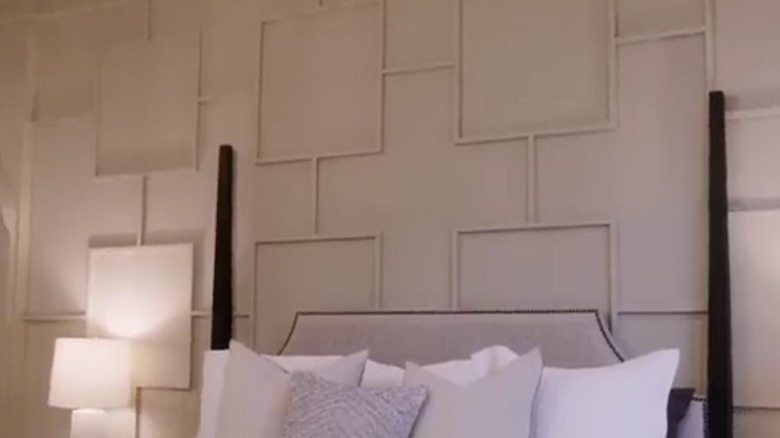
Art isn't the only thing that can cover a large blank wall. You can also add decorative trim to transform a run-of-the-mill wall into a focal feature. That's exactly what Dave and Jenny Marrs did in Season 5 of "Fixer to Fabulous." In the episode "A Grand Makeover Meets the Marrs," the designing couple found a stunning solution to dress up a big, boring wall by using box trim to create an Art Deco-inspired pattern. "This is a big room, so we wanted something that kind of draws your eye, gives you some texture," Jenny explained during the reveal.
Molding costs as little as 98 cents per linear foot, allowing you to cover an entire wall even if you're on a strict budget. This is especially true if you already have a nail gun and caulk on hand, which you will need for the job. However, if you're not handy with power tools, you can also buy pre-assembled box trim kits. While they will cost more, they're still budget-conscious. For instance, Trimold's Self-Adhesive Wall Trim costs $30 for nearly 10 feet.
Jenn Todryk uses shiplap
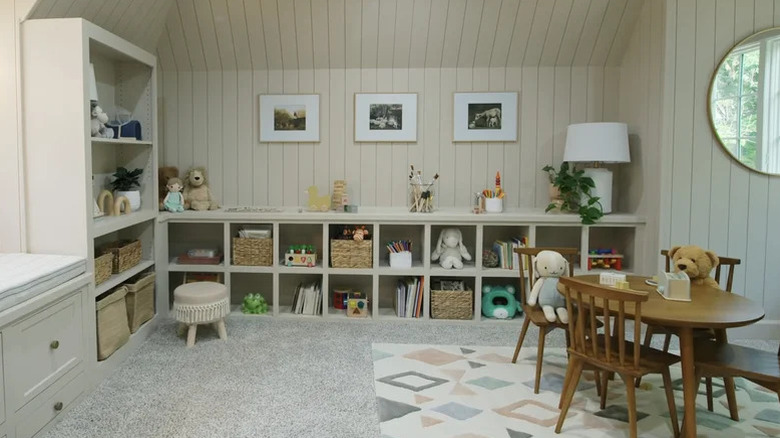
Joanna Gaines might have been the HGTV star who put shiplap on the map, but she's not the only designer to use it in her designs. Jenn Todryk is also a fan, especially when it comes to covering walls to create interest on a budget. In the Season 3 episode of "No Demo Reno" titled "Tudor is Cuter," the designer explains how it's not only an architectural feature but also something of a decorative piece. Due to this, you won't have to spend money on things like art and frames. "With the shiplap being on the walls, it gives you freedom to not feel like you need to decorate the walls too much," she said in the episode. "You have a lot of interest in here."
Rather than buying individual wood planks and attaching them to the wall one by one, you can now get an entire sheet of shiplap for faster installation. Luckily, it's quite affordable. For instance, a 48x96 inch panel costs $38, making it roughly $1.20 per square foot. An average 12x8-foot wall is 96 square feet, so it will cost around $115 to cover it.
Jasmine Roth likes color blocking

Another budget-friendly way to create interest on a wall is to use paint. Rather than just painting it in a solid, eye-catching color, you can turn it into a piece of art with color blocking. That way, you don't have to spend money on prints and frames. Instead, you can turn the entire wall into a canvas. That's a technique that Jasmine Roth likes to employ both in clients' houses and her own home. "Color blocking is when you take parts of your wall, and you paint different parts of the wall different colors, but big parts of the wall," she told The List. "You would take maybe paint and just do a big circle on the wall. You would do a big square. I've done it at my own house."
She also likes it because it's not as permanent as, say, box trim or shiplap paneling. "If you get sick of it, you can just paint right over it," she explained. In the end, you would be out the cost of a can of paint. To keep costs down, you can use leftover paint you have on hand from previous projects. If you want more colors, you don't need to buy a gallon since the idea is to use multiple hues. Instead, get a sample size of paint from the hardware store, which usually costs between $6 and $7.
Hilary Farr sometimes uses vintage room screens

When it comes to finding affordable large-scale wall art, Hilary Farr doesn't want you to discount the power of vintage room screens. They're a great way to cover up a swathe of blank wall without breaking the bank. In fact, it's an HGTV-approved design trend she uses in her own home. In the Season 19 episode of "Love it or List It" titled "Hilary Loves It or Lists It," the designer showed off her primary bedroom, which was generous in square footage. While Farr had one gallery wall filled with frames and another flanked by patterned floor-to-ceiling curtains, the one perpendicular to her bed was empty. To fill it, she found a vintage silk-screen divider, which she propped against the wall like a work of art.
The cost of a divider depends on where you find it. For instance, if you source one from a consignment or antique store, you will pay a premium since those stores are curated and only accept pieces in good condition. However, if you hunt one down at a thrift store or on an online platform like Facebook Marketplace, you can snag it for much less, since the donor or seller is (most likely) just trying to clean out their house and will price it accordingly. The only downside is that it might not be easy to find — you might have to check listings for weeks, if not months, before finding the perfect piece.
Kim Myles uses stencils

Wallpaper adds instant drama to a room, but it's not within everyone's price range. Buying rolls and hiring a professional to paper your walls can cost hundreds of dollars, and even the peel-and-stick route can rack up to a few hundred. If that's not within your budget but you're looking to fill up empty wall space, then take a page out of Kim Myles' book and use stencils instead.
"I'm a huge, huge fan of wallpaper, but it can be prohibited as far as cost as well as — I lived in rentals for most of my life, so that kind of commitment wasn't going to fly," she told MyFixItUpLife. "So I was like, alright, well, I want the look of wallpaper. I want that giant scale stencil that you, in four hours, can do an entire room and it looks fantastic and it's like 30 to 50 bucks and it's done. That is my kind of design right there."
With careful planning and positioning, the end result can look like an authentic wallpaper pattern. If you want to complete the project quickly, take Myles' advice and choose a large pattern such as this Turkish Poppy Wall Stencil, which can create 15-inch florals. However, if you want a more compact pattern, you can try something like the Endless Vine Wall Stencil, which creates small, creeping vines. Don't worry, the application won't take years. The stencil itself is 22x26 inches, and you simply roll paint on top of it, creating a two-foot pattern at a time.
Erin Napier creates a vintage mirror gallery wall
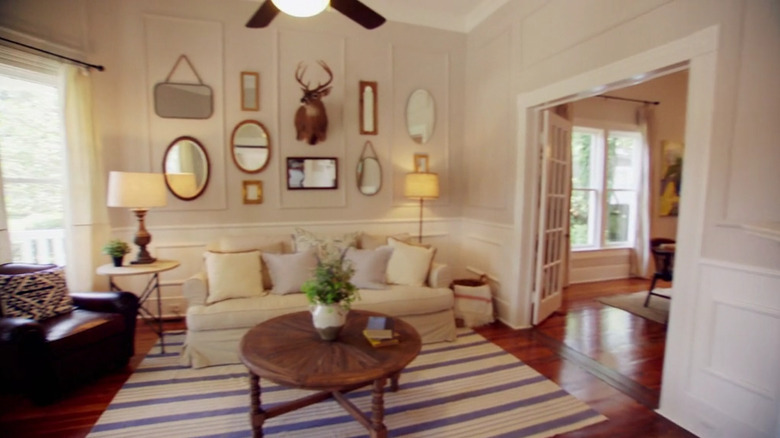
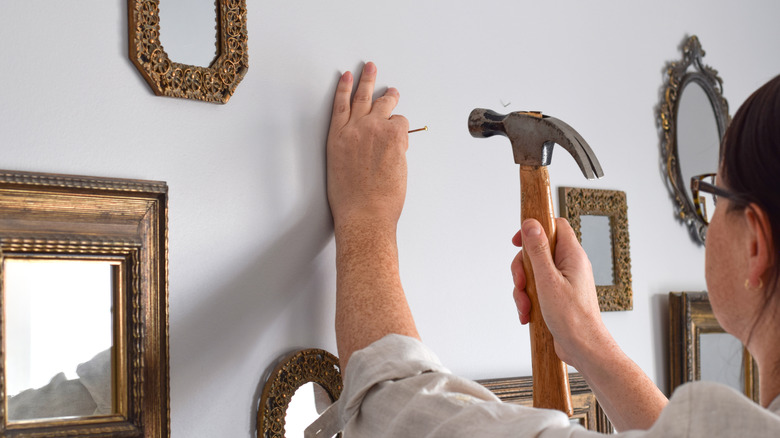
If you want to cover a wall quickly but in a whimsical way, copy Erin Napier's design move and create a mirror gallery wall. Everyone is familiar with a picture gallery wall, which uses a mix of art, photographs, and prints. But if that feels too predictable for you, give the design a twist by curating a wall of mirrors. Erin did just that in the pilot episode of "Home Town," where she transformed a charming 1940s home for her clients. In order to create a vintage-inspired focal point in the living room, she hung two rows of mirrors between the wainscotting. Using different shapes, sizes, and frame finishes, she created a charming collection that feels curated and layered.
To keep costs down, you can focus on thrifting the mirrors. You can do so by either rooting around thrift stores or scrolling through Facebook Marketplace. Once you have all of your pieces, you can figure out how to arrange them by tracing the mirrors onto kraft paper or cardboard and cutting them out as templates. Then, organize the templates on your wall until you get the arrangement you like.
Tristyn and Kamohai Kalama create a gallery wall with their kids' art

If you love the look of gallery walls but don't have the funds (or patience) to curate a whole wall of canvases and prints, turn to your kids to do the heavy lifting. Tristyn and Kamohai Kalama encourage fans to use some of their kids' art, putting it on display on a wall that needs some interest.
"Our kids are the most important things in our lives, so it only made sense for [the wall of their art] to greet people right when they come in," Tristyn told HGTV during their Oahu home tour. Nine black frames filled with colorful drawings adorn the foyer wall, creating a cheerful display as you walk in. Not only is it a cost-effective way to cover a wall, but it also makes your kids feel more included in the house. "This is just as much their house as it is our house," Kamohai explained. "We want them to be represented in it."
There are hundreds of places to buy frames, but IKEA offers some of the most budget-friendly options. You can get an 8x10 LOMVIKEN frame for just $12.99. However, if you want to rotate which pictures are displayed, you can make swapping them out more convenient by getting a storage frame. For example, Studio Decor's Kids Art Frame is $12.49 at Michaels, but it swings open on hinges, letting you change the picture without removing the frame from the wall.
Jasmine Roth creates a bookshelf wall using crates

One great way to cover up a wall is to fill it with built-ins, but those either cost an arm and a leg for a carpenter to design and install, or require an intermediate level of DIY knowledge. However, if you have neither a large budget nor much power tool know-how, then you can achieve a similar look with much less fuss with crates. That's exactly what Jasmine Roth did when designing her baby's nursery in 2020. She and her team built an entire crate wall — one that spanned a whole wall and even wrapped around a mirror. The end result was a rustic but playful display, allowing her to arrange all sorts of trinkets and toys on its shelves.
"My friends were selling a bunch of vintage produce crates, which I purchased, power-washed, lightly sanded, clear-coated (to block any weird toxins from entering the nursery), and then installed [them] really securely to take up an entire wall," she told People. "I love these crate shelves because not only do they look cool, they store all the awesome baby stuff that I think I would forget to use if it was jammed in a closet."
You can try sourcing similar crates from Etsy or eBay, but if they cost between $5 and $10 each, filling a whole wall with them can get pricey. To keep costs down, consider calling your local grocery store, Costco, farmers market, or a nearby farm to see if they would be willing to get rid of their crates for free.