

Icicles Aren't A Pretty Winter Decoration, It's A Sign Of A Bigger Problem
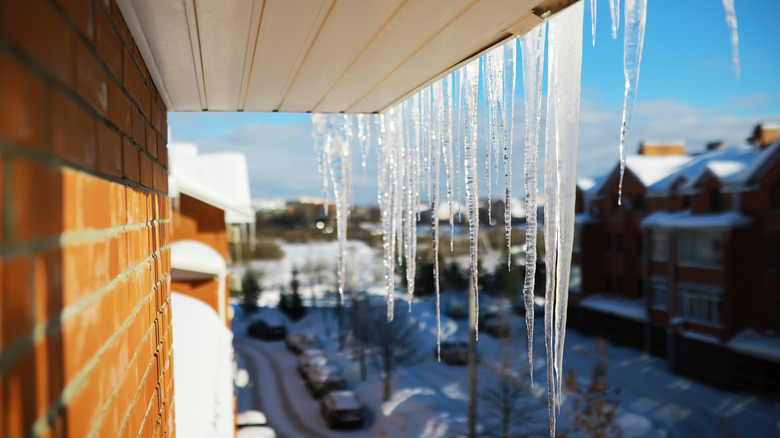
When we see a row of shimmering icicles hanging from a house, we can't help but think about how pretty and wintery it looks, like a scene from a holiday movie. But for homeowners, they should be a bright red flag. Icicles are rarely just a result of the weather and are more often evidence of a phenomenon known as ice dams. These happen when snow runoff drips down your roof then re-freezes, creating a blockage around your gutters and eaves (the part of your roof that overhangs your house). That ice sits, collects water, and obstructs proper runoff, which can then pool up and seep into your home's interior.
This problem occurs when heat escapes from your living space into the attic, warming the roof deck and melting the layer of snow sitting on top of it. As that melted snow flows down and turns to ice again, it builds up along your roof's edges and worsens the ice dam issue. That's bad news since your gutters and eaves are important for your home — any damage to them could have further-reaching consequences, like jeopardizing the structural integrity of your walls and roof.
Your roof's asphalt shingles are designed to shed water downward. Any water held by the ice dam is forced to sit on your roof; it may push shingles away from your roof as it re-freezes, letting it find its way under your shingles and into the plywood sheathing. This winter moisture getting in is a big problem, as any water that gets under your shingles can lead to rot and a variety of structural issues that often go unnoticed until it's too late.
The costly aftermath and how to prevent future ice dams
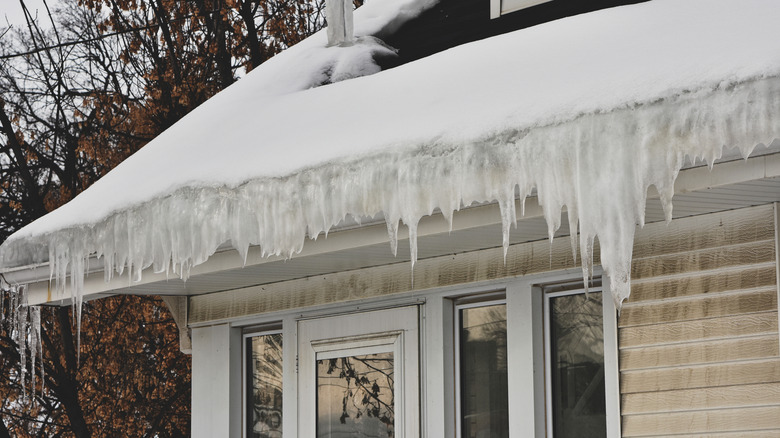
Once water held by an ice dam breaches the roofline, the damage can move quickly through your house's interior. If it makes its way into your attic, it'll likely soak into the insulation and significantly lower its resistance to heat flow (also known as its R-value), making it less effective and harder for your home to stay warm overall. From there, the moisture can continue its journey further into the house, potentially causing ugly yellow ceiling stains, peeling paint, and mold and mildew growth.
As for your house's exterior, the increasing weight of the ice also causes damage. If an ice dam gets heavy enough, it can start to peel the gutters away from your house's fascia, the long board running along the edge of your roof line that protects eaves and rafters. Besides this damage making your gutters less effective, it also often leads to expensive repair bills. To get ahead of this, we recommend getting rid of ice dams now and preventing them in the future.
Properly addressing potential future dams starts with your home's thermal situation. The most effective way to stop icicles from forming is to ensure your attic stays cool and well-insulated, as well as clearing the vents on your roof's soffit (the finished horizontal surface under your eaves) to ensure proper airflow. That, along with preventing your gutters from clogging and freezing to begin with, goes a long way towards keeping your home warm and dry during even the roughest winter months.