

The Trailing Plant With Stunning Foliage That's Perfect For Hanging Baskets
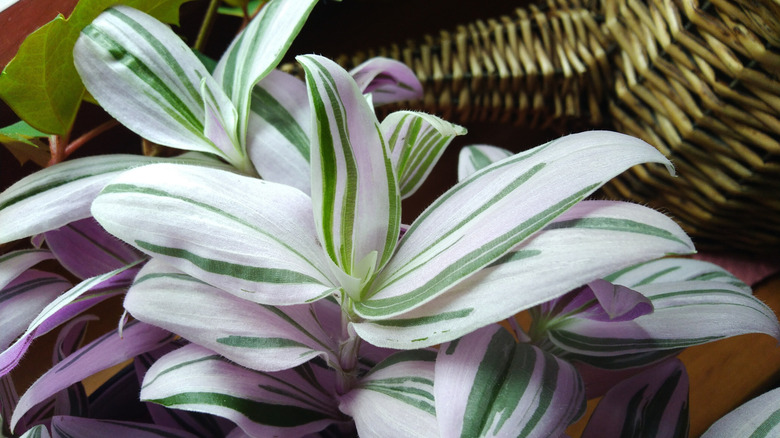
Bored with your hanging basket components and looking to add a subtle pop of color with an easy-to-grow indoor plant? If uniquely colorful leaves and graceful trailing stems full of foliage excite you in a hanging basket, inch plants (Tradescantia zebrina) could be just what you're looking for. Dark green leaves with stripes of silvery green and purple make the inch plant a standout, along with trailing stems that can reach 18 inches as they cascade from a hanging basket. Even the undersides of the leaves present dramatic, deep purple color. Leaves may sometimes appear to shimmer or glitter thanks to what's known as structural variegation, a colorful foliage pattern determined by a plant's cell structure. Tiny flowers with three petals appear intermittently on outdoor inch plants but rarely on those kept as houseplants.
You'll find leaf nodes at inch-long increments on the stems, giving the plant its name. Those nodes can become problematic, though, because if given a chance, the plant will set down roots at each node, potentially making it invasive. That's why, when planted outdoors, they need to be in containers. Luckily, inch plants are fast-growing and tolerate a wide variety of growing conditions. With the right care, it can easily be one of the trailing plants perfect for hanging baskets.
Add inch plants to your hanging baskets for colorful trailing foliage
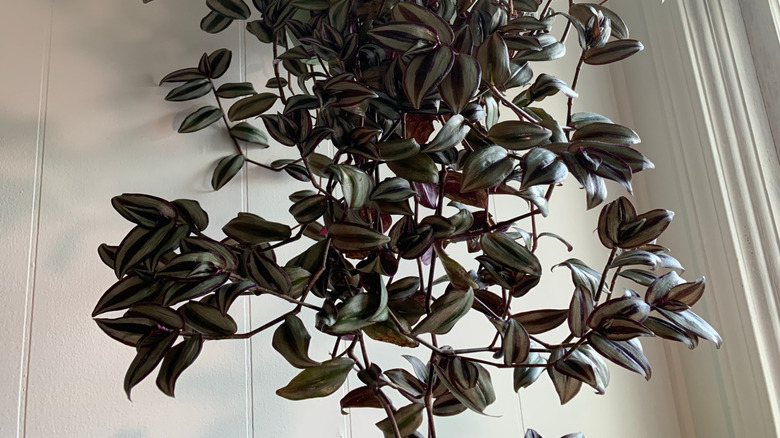
To plant this tough perennial in a hanging basket, use a moist, well-draining indoor potting mix. Inch plants thrive in room temperatures of 65 to 75 degrees Fahrenheit and are happy with both average and high home humidity levels. Make sure it receives indirect or filtered sunlight and provide regular watering, but allow the basket's potting medium to dry before the next watering and water less in the winter.
Apply a slow-release granular fertilizer early in the season during spring and summer, then apply water-soluble fertilizer regularly throughout the season, typically every two to three weeks. For hanging baskets, the recommended ratio of nitrogen, phosphorus, and potassium is 1:2:1. Be sure to follow fertilizer label instructions, and don't fertilize in fall or winter. If desired, you can give your inch plant a hard pruning in the early spring and pinch back stems regularly to prevent the plant from looking leggy.
A bit of easy care will help your hanging inch plants thrive
As long as you're located in USDA zones 9 to 11, where the inch plant is cold-hardy, you can consider giving your hanging inch plants a vacation outdoors once spring frost danger passes. In warmer months, check baskets daily for water needs. Inch plants are easy to propagate with stem cuttings, but take care when breaking off stems, as the inch plant's watery sap can irritate skin. Humans and pets may also experience stomach irritation from consuming this plant.
It's not easy to kill an inch plant, but if your plant doesn't seem to be thriving in its hanging basket, check out common reasons why your indoor inch plant is dying, such as overwatering until roots become soggy, neglecting water for too long, inadequate sunlight, or too much fertilizer. Avoid overwatering, as the inch plant is susceptible to both root and stem rot. To prevent leaf spot and other fungal diseases, don't overcrowd it or get its leaves wet when you water. Spider mites, mealybugs, aphids, scale, and whiteflies could also visit your plant, so be on the lookout.