

The Minimalist Furniture Experiment Some People Are Loving

Have you ever looked around your house and felt utterly overwhelmed by the amount of inventory you own? While it's common to look at accessories and loose items — children's toys, books, throw pillows, or decorations — as the major offenders, what if the true culprit of your overwhelm was actually your furniture? Since furniture is so integral to your way of life, you probably have never actually looked at it as an optional possession — you need a bed, couch, dining room table, etc — but the reality is that you can say goodbye to these items, and you might be happier if you did.
It doesn't take much digging to find the corner of the internet where individuals are discussing minimal living experiments and challenges. The idea of a furniture-free home might not appeal to everyone. While some say the "less is more" style is being replaced, others swear by it, saying that their life is simpler, their routines are easier, and their bodies are more flexible after parting with bulky furniture. There's a simple way to try out this minimalist style in your house: move the bulk of your furniture into another space of your home (like a spare bedroom or basement). If you are short on space, you can alternately dissemble some pieces or push your furniture to the perimeter of the room, leaving the center clear. Individuals with furniture-free homes still often retain a couple pieces, like a low-to-the-ground table that can serve as a desk when working on a laptop, so don't overstress about getting rid of everything. The key is removing bulky pieces that you can live without.
Benefits of furniture-free living
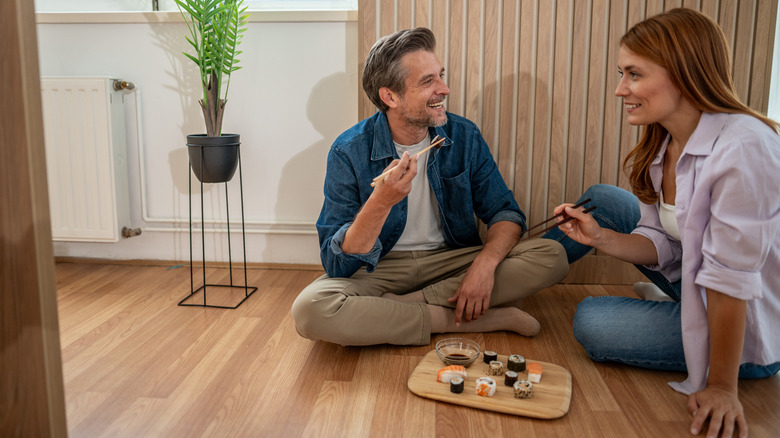
While living without furniture may sound strange at first, it's not without its benefits. The first and most obvious perk is that less furniture means more available space. This can be ideal for families with kids who like to run around, or individuals who thrive in wide open spaces, since it means your home can be more dynamic and less calcified in its design. In Japan, open floor spaces are coveted and culturally normal, with beds that are often rolled up and stashed during the day to make the space useful beyond just sleeping. Your home can experience the same benefits with a furniture-free philosophy. If the no-furniture aesthetic is a little too sterile for your taste, experiment with the similar yet cozier Japandi style and how you can use it in your home.
With less furniture filling the house, you will also likely find that maintaining a clean and clutter-free home is easier than ever. No more moving the couch to vacuum under it or having to fluff the throw pillows. Simply put, you'll have less inventory to maintain. If the furniture-free living experiment resonates with your home and you plan to keep it up long term, you will be freed from the endless furniture-buying cycle, too. For instance, if you don't use a couch in your home, there's no need to save up $1,000 for a new one.
Pitfalls to avoid with furniture-free living
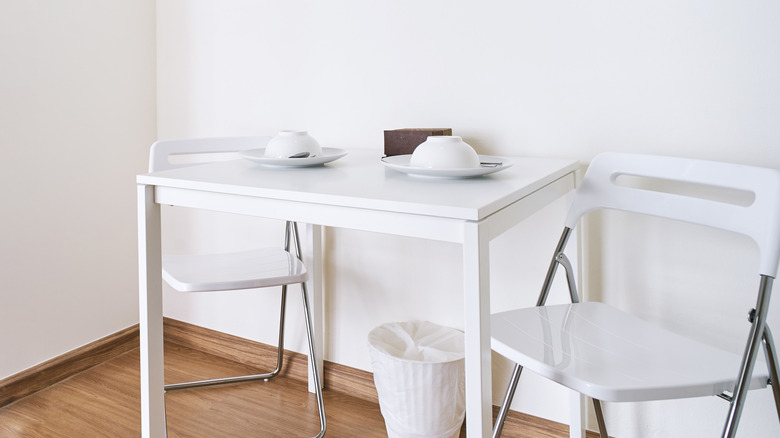
Minimalist experiments are meant to be life-changing — true — but that change should be for the better. There's always the possibility the revolutionary test of living without furniture can bring some of the same disappointing downsides to embracing minimalism. In the event that you are beginning to resent living without your couch, coffee table, or dining room table, that should be a strong signal that the furniture you've been going without was actually necessary for your lifestyle. Which is exactly why you should approach this as an experiment; truly test it out before you make any permanent decisions like selling your couch or dining room table.
It's also imperative that you go into the experiment with your eyes wide open. One of the challenges cited with furniture-free living is the fact that having company over is a big ask. No furniture to sit on means that dinner parties, movie nights, and the like will be out of reach (at least if your guests are anticipating normal seating options). Furniture-free homes, however, can work around this challenge by having a select number of pieces that your company can use — or camping furniture that easily folds up when not in use. It's also recommended to keep a loveseat in the house even if you don't use it, so that guests or older family members don't have to sit on the floor.