

Expert Tips To Follow For A More Successful Garage Sale

We may receive a commission on purchases made from links.
Hosting a sale in your driveway (or yard) is one of the best tips for decluttering your garage. However, it isn't as simple as putting your clutter for sale and expecting people to show up. There are many steps involved here. For starters, you need to declutter your junk, print eye-catching signs, market the event online, buy the necessary supplies (like Dreecy Colored Round Price Stickers), and borrow tables and racks. And although these tasks don't seem too daunting in theory, preparing for a garage sale requires a lot of time and effort.
To ensure you don't get lost in all the tasks and lose track of the big picture, House Digest sat down for an exclusive interview with three experts. Drawing inspiration from their real-world experiences, they recommend being clear on what your end goal is before moving ahead. Since this will inform your pricing, deals, and display strategy, keep this at the center of your plans. Moreover, choose a day after careful deliberation (random dates won't offer fruitful results) and devise a layout that makes it easier for people to move about. Interested in learning more about how to host a successful garage sale? Here are 11 expert-approved tips to nudge you in the right direction. That being said, always check and follow your HOA or local government rules before throwing a yard sale.
Determine your goal before hosting a garage sale

Prior to printing out flyers and asking your neighbors to spread the word, "Get clear on your goal beforehand and stick to it," advises Jennifer Du Bois, home organization coach, interior stylist, and owner of Home with Jen D. For instance, "If it is to make space in your home, state it clearly," and get rid of all the things that don't add value to your life anymore. Further, be open to negotiation so you can rehome most of your belongings by the end of the sale. In case you don't want to lose money on high-ticket items, set them aside and list them on online platforms — like Craigslist, eBay, or Facebook Marketplace — before or after hosting the sale.
To ensure you can reclaim some much-needed space in your home or remain organized before making a big move, "make it a rule: any item that does not sell is not coming back into the home. Schedule a donation pickup for the very next morning so you don't lose momentum. The win is a home that finally feels lighter," adds Du Bois. Jamie Hord, founder of Horderly Professional Organizing, agrees and says, "After the sale, donate or recycle immediately so the items that you don't want go back into your house as junk." And if you end up giving away a good number of items, determine their estimated value and try donating them to an IRS-recognized organization to claim potential tax benefits.
Pick a suitable date and time after careful consideration

The date you pick can make or break your garage sale. So, don't rush the decision. Consider the number of items you wish to rehome and estimate how much time you'll need to get them ready for the event. Additionally, factor in the hours you'll require to print and display your signs, clear out the space in your yard, organize tables, and price your wares. Be generous with the timeline if you're hosting your first-ever sale or have a busy schedule to give yourself enough time to prepare.
For a successful event, "Plan ahead and set a date and time, ideally a weekend morning towards the end of the month and make sure it's not landing on a holiday or other big event day," recommends Jamie Hord. You can even schedule it toward the start of the month if you'd like to take advantage of your shoppers' paydays. Also, check out the weather forecast in advance and try picking a day that's supposed to be sunny and pleasant. However, be prepared to put up tarps or plastic sheets at a moment's notice if storm clouds roll in suddenly. Regarding the day, Saturdays are generally the best for holding a yard sale, but you can start on Friday if you're in the mood for a multi-day event. Avoid Sundays if a lot of people in your neighborhood go to church then. As for the time, don't set up shop before 7 a.m.
Sort items into categories ahead of time

After you bring out all the things cluttering your home, don't dump them on a table unceremoniously. "Declutter and have the items that you want to sell ready ahead of time," mentions Jamie Hord. Go through everything and put all your broken, old (unless they're antique), and worn belongings in the trash or recycling bin. Through this exercise, you might even come across the user manual, warranty details, or original box for a tool, which will help you fetch a higher price for it. Once you have everything you want to sell, "Sort by category, this way people can come in and look for something specific easily because they might be swinging by in a rush and might not give something enough time if they can't quickly see or find it," she recommends.
But don't have odd pairings, like books and shoes. You want to make this a no-brainer activity for people instead of a low-stakes treasure hunt. "Group items like you'd find at a department store. Garage sales are where people make quick decisions, so make it easy for your shoppers by grouping items like you'd find at a department store. All kitchenware together, glass ware, etc," directs Jessica Litman, founder of The Organized Mama and ADHD and family organizing expert. That being said, break up a grouping further if it's too broad. For example, you can have distinct sections for women, men, and kids' clothing. Besides being pleasing to the eye, "This also helps people grab things quickly that they are shopping for, which leads to more sales for you," she says.
Don't price just according to what you paid for the item originally

When setting the rates for your wares, don't think of a product's original price or let your emotions get in the way. Instead, be rational and put a justified tag on it, suggests Jennifer Du Bois. "Don't price from emotions or based on how much you paid for the item. Maybe you got your money's worth, maybe you didn't. Either way, pricing high will just discourage the sale." Remember, people go thrifting to score great deals, not to pay the same price as they would at a retail store.
In case your end goal is to declutter your home, set competitive rates. Du Bois encourages, "Price to move so that you can get the space back and someone else gets to enjoy it." However, if you aim to earn a good sum of money, jot down each item's original pricing on a scrap piece of paper. Then, offer rarely used things (that are in excellent condition) at 50% off. Ones sporting mysterious stains, a few missing buttons, a dated sheen, or a slightly faded look can be estimated at ¼ of their original price. The rest should be valued at 10 or 5% of their retail price.
Alternatively, take time to thoroughly research pricing beforehand

In case you don't remember the original cost of an item or it's still too expensive after you mark it down by 75%, check out what similar things are retailing for in thrift stores or go online. Jessica Litman, feels the same. She emphasizes, "Do your research before pricing! While garage sales can be a lot of work, and you just want to get things out of your house, make sure you are pricing your items appropriately." Detailing her experience, she shares, "I have found that looking on FB Marketplace, eBay, estate sales, and other garage sales gives a good idea for pricing items."
Even if this feels like piling on extra work on top of everything else you have to do, don't skip this step. "We recently held a garage sale and the items I didn't price appropriately didn't sell. The items I did my research on sold within the first few hours of the sale," she adds. Understanding what sells and for how much will allow you to attract buyers and clear out your stock quickly. Who knows? Sometimes, you might just discover that your household items are more valuable than you think. And when it looks like the sale is winding down, slash the prices further to clear out as much of your stock as possible.
Draw in buyers with a free box and bundle deals
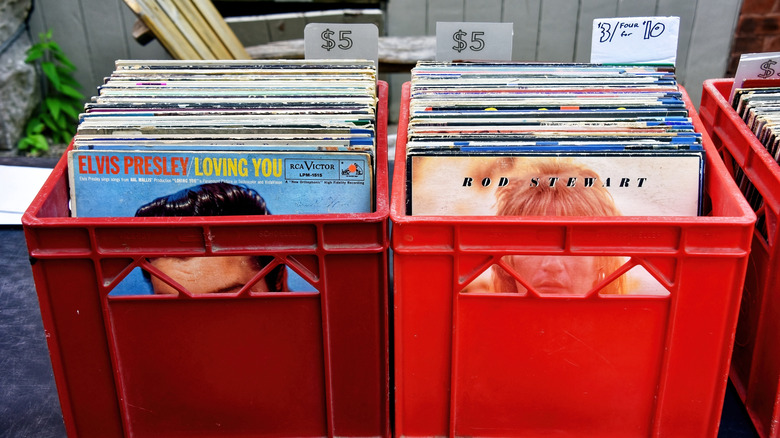
Still can't decide the pricing for your kids 'action figures, old holiday ornaments, or no-lid Tupperware containers? "Have a 'free' box to draw people in," suggests Jamie Hord. You just have to put them in a box marked "free." Interested parties can go through it and pick out the items worth buying at a garage sale before you donate the rest. But do this only for your low-value items. Even if your goal is to clear out your garage, you don't want to lose money on good-quality pieces. Moreover, "Consider bundling items together," especially for like items. For instance, if you're selling paperbacks, you can price one for $2 and offer a set of three for $5. This will work out particularly well if the books are part of a series or belong to the same genre. You can also run offers like "buy one, get one" to entice people.
Finally, "Be open to discounting or wheeling and dealing," proposes Hord. This is because no matter how reasonably priced your goods are, people will negotiate further to get the best possible deal (according to them). So, have a fixed floor price for each of your belongings. Moreover, "Price strategically and use easy, round numbers." This will come in handy while you're giving out change (you won't go crazy counting nickels and dimes). Bonus tip: If you aren't a pro negotiator or buckle under pressure, set your initial price slightly higher than your base to give yourself a little wiggle room.
Structure displays that enable people to move around while browsing
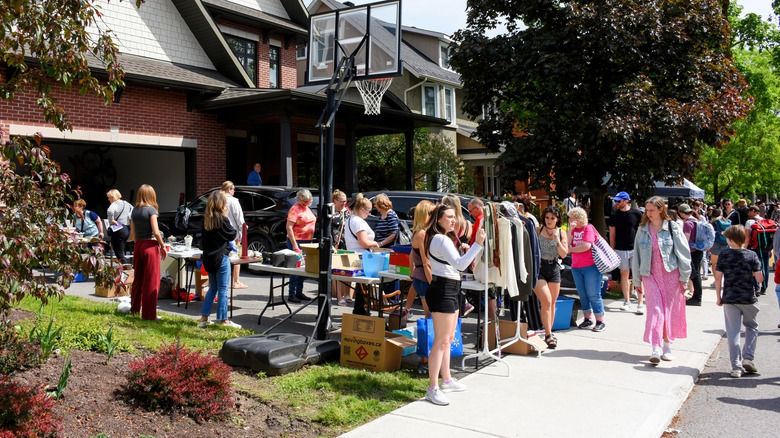
To have a winning display, segregating the items isn't enough. You need to pay attention to the floor plan as well. "Create a layout that is easy for a lot of people to go back and forth and easily shop," advocates Jamie Hord. You also want to leave enough room between your tables that wheelchairs or strollers can pass through without issues. So, draw plans to make the most of your yard or driveway's limited space.
Start by judging the shape of your site. This will let you plan out your layout and decide whether you can have a circular design or whether an L-shaped flow works better. Either way, ensure you have a bird's-eye view of your belongings and place the high-value items near you to discourage theft. The next step is to finalize the entrance and exit to your garage sale. This will allow you to control the crowd better and remove bottlenecks, especially if the "pathway" is only large enough to fit one wheelchair at a time. Once you have a somewhat okay plan, grab a few tables and racks (rent them if you need more) and arrange them like you envisioned to determine what changes you need to make.
Focus on clean, tidy displays, and refresh them through the day
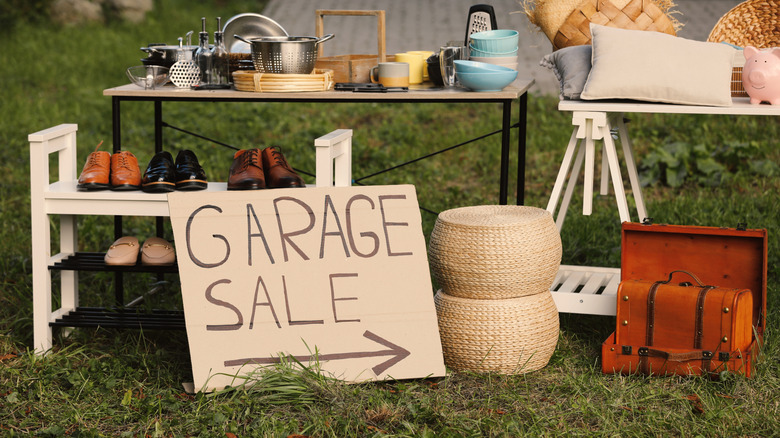
On the morning of your garage sale, set aside at least 45 minutes to two hours (depending on the amount of stuff you plan on selling) before the advertised time to display your wares neatly. This is because no bargain shopper wants to rifle around a pile of clothes or dive deep into a chaotic table hoping to spot valuable, high-end items. Favoring this sentiment, Jessica Litman says, "Put everything on display. Don't pile things on top of each other. No one digs through garage sale items, they scan. So make it easy for them to find things by laying everything out on tables, blankets, or hanging things up to shop." Old cardboard boxes turned upside-down work, too, if you're running low on racks. Just ensure you tape their openings well and only use them to display lightweight items. The key is to ensure your belongings are clearly visible from the street, as this will coax people to come closer and take a second look.
Jamie Hord believes an organized display will make your items seem valuable and worth the hassle. "Make everything look as clean and tidy as possible so that it reflects that the items you're selling have some value vs junk that is uncared for and refresh tables throughout the day." This means you should keep an eye out for pieces that might not belong in a particular section and put them back in their rightful spot to maintain a clutter-free zone. After all, you wouldn't want to clump your kids' toys with your cast-iron skillet, or mix in bundle deal items with ones from the "free" box.
Create vignettes of related items to increase your sales

Hoping to make a good sum from your garage sale? Then, create vignettes of related items to increase your chances of selling everything you display. Jennifer Du Bois elaborates, "Help buyers picture the item in their home or life. Don't just set things out. Arrange them in moments." Illustrating her point, she continues, "Place a few cups next to a coffee maker and place [them] on a tray. Or, arrange furniture in a cozy seating moment like a chair with a blanket draped over it." Similarly, you can create a snug reading nook featuring a comfy chair holding a few cushions, a sturdy table, a vintage (or contemporary) lamp, a vase of flowers, and books galore. Other examples include vinyl records beside a turntable, jewelry nestled within a catch-all dish, and a console table decorated with beautiful decor pieces.
Although it'll spell more work for you, this can have a positive impact on your cash flow. Du Bois reasons, "This helps the buyer imagine themselves using the items and may encourage them to buy more with confidence." So, channel your inner retail-chain merchandiser and craft beautiful scenes to draw in people with your products. With that said, don't go overboard since you still want to maintain distinct zones for your belongings for a smooth experience.
Have labels handy when hosting a multi-family sale

Hosting a garage sale with your friends, family, or neighbors can be a fun activity. You get to have ample support on a hectic day, while the pooled products will attract shoppers from different backgrounds. However, a multi-family sale can be confusing, too, because it can be quite difficult to make note of the items you sell and the family they belong to. Unless you plan on dividing the revenue equally without getting into who contributed what, it's best to have a clear pricing strategy in place to avoid disputes later.
There are multiple ways you can go about this, including separate zones for each family or a spreadsheet containing details about the listed items. But if you aren't a fan of either idea, Jessica Litman advocates the use of color-coded labels. "If you are doing a multi-family sale, give each family a color and they are to label and price their items in that color only. When someone purchases an item, add that colored label to paper with the pricing already on that label. Then you can settle up later instead of during the sale." Don't forget to mention the final selling price for items you (or another member) offer a discount on, or it'll be impossible to settle up the accounts after the sale. Also, keep track of all the sale-related expenses so you can account for them while distributing profits.
Assign roles to helpers like you're running a store

Even if you aren't hosting a multi-family garage sale, you can still ask your friends or family to help you run the show. And to give your shoppers a hassle-free experience and minimize confusion, "Designate roles if you have others helping you with the garage sale," commends Jamie Hord. Consider how different roles exist at a store and assign roles according to your needs. For instance, you can tap into your siblings' love for numbers and have them handle the cash. In a similar way, you can have one of your gym-obsessed friends help people carry large items to their car, your social butterfly relative meet and greet people, and another one to play bouncer and break up petty spats. They can also monitor the shoppers to prevent theft of high-ticket products. Since you'll be putting up your belongings for sale, ask your minions to direct all niche questions, like those related to an appliance's warranty, your way.
Besides assigning roles, you want to establish a few boundaries to avoid arguments later. To illustrate, decide in advance who has the authority to slash prices to keep your well-meaning friends or your teenage children from giving away your branded coffee maker for $1. And although you'll need help traversing the chaos, don't crowd your driveway with your friends or family members. Leave ample room for bargain hunters to roam and mill about.