

How To DIY Your Own Yard Pinwheels To Scare Off Pests
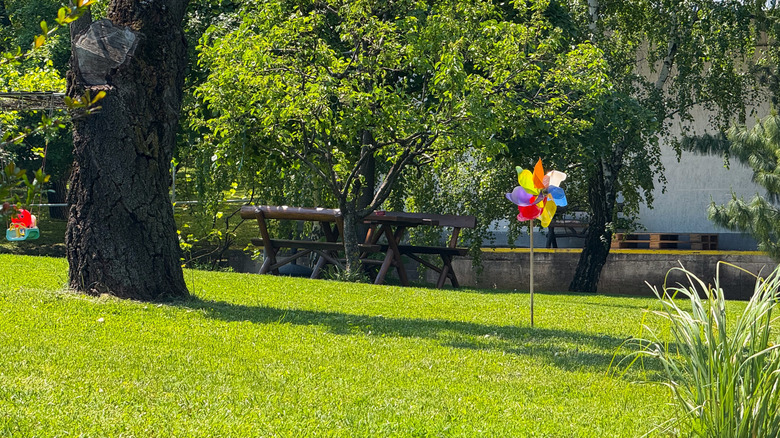
Managing garden pest deterrents — noise makers, foul smells, loud noises, faux predators, fences, and more — can quickly take up your time, money, and outdoor space. If you are tired of seeing birds, squirrels, and rabbits in your garden but are committed to finding humane ways to keep critters out of your yard, then it may be time to try a new solution. Pinwheels may help protect your yard from animal pests while making it more welcoming and fun for humans. While far from a foolproof method, anecdotal evidence from gardeners hints at success with pinwheels as deterrents, making them at least worth trying. With a few cheap or even repurposed materials, some simple tools, and a little origami-like folding, you can easily create your own colorful garden pinwheels.
For the blades, you need a sturdy, weatherproof material like colorful Benecreat PVC Flexible Plastic Sheets or a roll of blue Yaocom Aluminum Metal Crafts DIY Foil. Why not take this as an opportunity to repurpose empty soda cans in your garden? Many common backyard pests are prey animals, and they're easily frightened by anything they think is a predator. The movement and flashes of color or light created by a whirling metal or plastic pinwheel startles animals into thinking the environment is unsafe. Birds, for example, may avoid white. If you're dealing with pests of the avian variety, make and mount a white pinwheel in your yard. Otherwise, choose your blade material in any bright color. You'll also need a long length of thin wood dowel (for the handle), sharp scissors, a hot glue gun, an unfolded paperclip, a hole punch, and a plastic straw.
How to create a metal or plastic pinwheel for your backyard
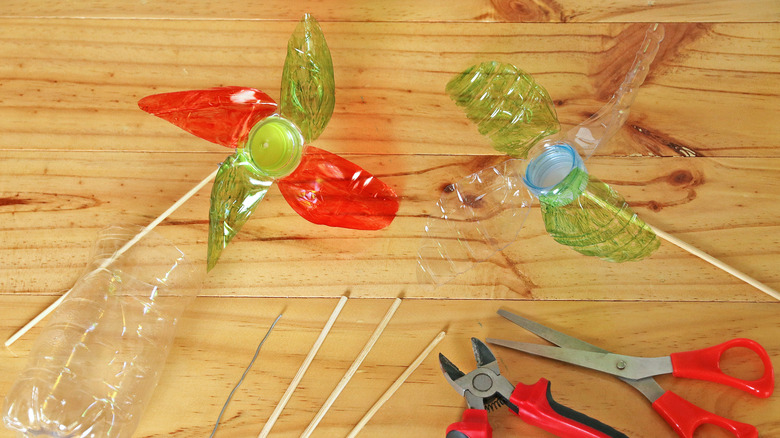
Once you have your materials, start by cutting your sheet of flexible plastic or metal into a square. If you're repurposing aluminum cans or plastic soda bottles, remove the two ends and slice the cylinder lengthwise. Flatten the material into a sheet. While the size of the square can vary, aim for at least 5 inches diagonally from one corner to the other. Find the center point on the square and mark it. Make a cut directly toward the center point from each corner, leaving about 1 inch between the end of the cut and the center point uncut. You'll be left with two flaps at each corner of the square.
Punch a hole into the top of the left flap, leaving about ¾ inch between the hole and the flap's end. Repeat this for each corner until you have punched four holes total. Then, punch a fifth hole at the center of the square. Insert the unfolded paperclip through the center hole, and bend each hole-punched flap onto it, layering them one atop the other. You should see a pinwheel shape forming, with most of the paperclip extending behind the pinwheel. Bend the front end of the paperclip onto the pinwheel to lock everything in place. Feed the other end of the paperclip through a 1-inch piece of plastic straw. Bend it and secure it to your wood dowel handle using hot glue.
Test and mount your DIY pinwheel pest deterrent in your yard
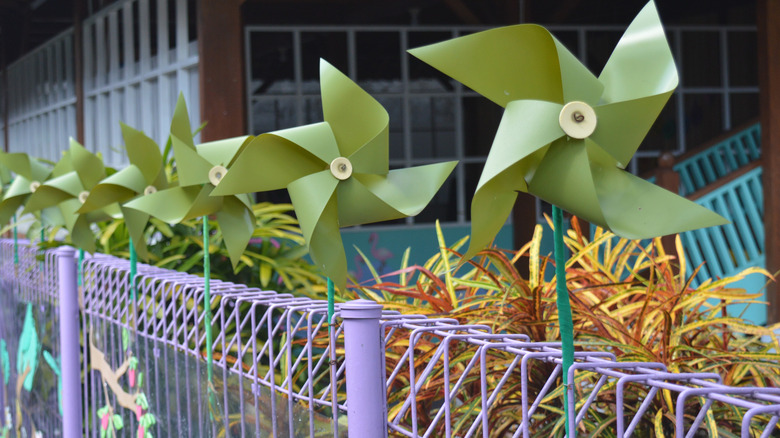
First, test your pinwheel indoors to make sure that it spins fluidly around the paperclip. If it doesn't, you may need to unbend the paperclip at the front of the pinwheel, enlarge the holes slightly, and try again. Even just loosening the paperclip a little may help the pinwheel blades spin freely on the axis. Then test it again outdoors, preferably on a breezy day or in a windy area so you can see it spin naturally. Your affordable DIY pest deterrent is complete! When using this method to keep pests off of your property, you need to make sure you place it correctly — and cleverly — in your garden. You put all this effort into making the pinwheel, so you may as well give it the best chance at being effective.
The spot you choose needs to be out on the open, so the pinwheel is highly visible. If whatever you're trying to scare away can't see your pinwheel, it will be useless. For example, avoid placing it beside or within dense shrubs, overgrown garden beds, or overhanging tree branches. If you crafted a reflective pinwheel, make sure you mount it in a spot that gets lots of bright sunlight. That way, it will catch and reflect the light as it spins, better protecting your plants. You can push the handle into the soil of, say, a raised vegetable bed, but high places in your yard also work well, such as on top of a fence, pergola, or trellis wire. Move them frequently — when critters get used to a pinwheel in one place, it loses its effectiveness.