

13 Winter Shelter Ideas That Keep Birds Coming To Your Yard
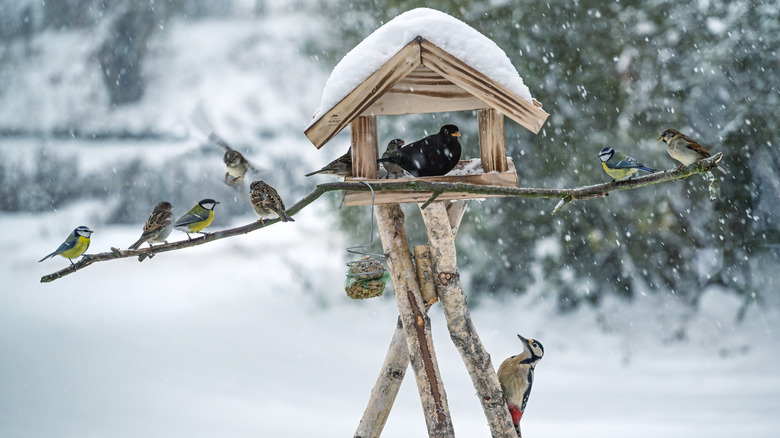
Birds can animate even the dreariest of winters. A blue-clad tufted titmouse settling on the bird bath or a chickadee's staid face while inspecting your yard's berries make delightful displays. However, food and water alone aren't enough to keep these birds returning to your yard — at least not in winter, when adverse weather events are at play. Like us, birds seek cozy spots where they can sleep without feeling cold, stay out of the rain, and escape the worst ice storms.
Fortunately, there's plenty you can do to provide them with the shelter they need. For instance, you can plant evergreen trees and shrubs to provide year-round cover and shelter. Just ensure you opt for multi-level plantings to accommodate birds with various needs. After all, not all of them reside in the tree tops. You can also create brush piles, rock walls, or DIY hedges from plant litter to create shelter nooks. Leaving out birdhouses through the winter or installing roost boxes should also keep these winged creatures warm through the worst of the season. You may also add a roof to your bird feeders or repurpose hanging baskets into roosting spots where space is limited. Curious to know more? Here are 13 winter shelter ideas that will keep birds coming to your yard.
Plant evergreen trees for perching birds
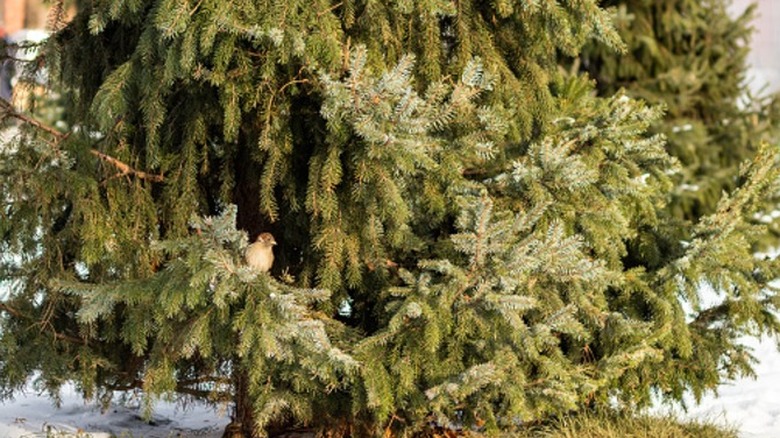
Plenty of birds seek evergreen trees as a means of shelter from winter rain, snow, and ice storms, as well as a safe respite from their predators. These trees hold on to their needles or foliage through the coldest months and are dense enough to offer insulation, blocking out the worst of nature's elements. Depending on your location and its bird diversity, you may chance upon owls roosting in the cavities or juncos hunkered beneath the evergreen's lower limbs. Perching birds, like cardinals, jays, and crows, may squat down on the thickest branch and monopolize its fork, with the main stem as their evening bed. Forest birds are also used to hiding in evergreen stands.
Some of the most beautiful and fast-growing conifers, which also add privacy to your yard, are spruces, firs, junipers, arborvitae, and yews. Eastern red cedars (Juniperus virginiana), in particular, provide excellent cover and adapt to most sites. In larger spaces, white pines are a great addition, especially if black-capped chickadees are present. You may also consider broadleaf evergreens like the much-loved American holly (Ilex opaca). Apart from providing winter shelter, these trees will also feed the birds since they tend to like the fruit.
Group native, dense shrubs for shelter and cover
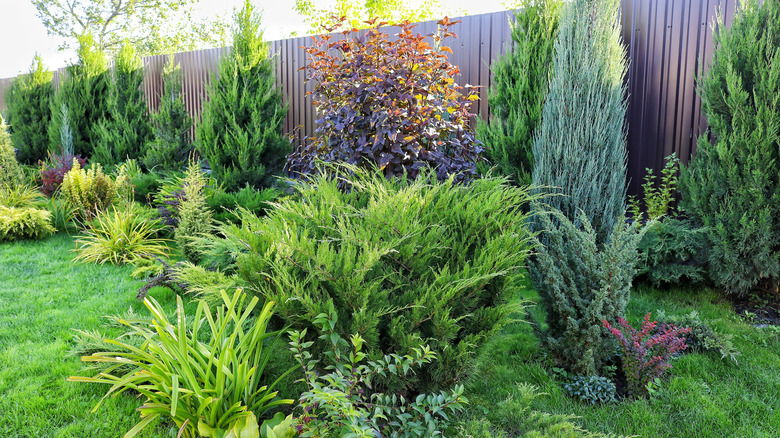
Other than broadleaf evergreens and conifers, you can also create winter shelter for birds through evergreen shrubs. Bonus points if they're regionally native, as birds are already familiar with them. When multiple shrubs are massed together, they create a dense thicket that birds can hide in to evade their hunters. In fact, the greater and thicker your plantings, the better the protection. But if space is limited, look for multi-stemmed shrubs, such as inkberry (Ilex glabra), as their natural form offers multiple shelter sites. In mild climates, semi-evergreen plantings like northern bayberry (Myrica pensylvanica) can lure in feathered creatures, including bluebirds and tree swallows.
Remember, to attract a more diverse variety of birds to your yard, you must layer your plantings. Use evergreen options like great laurel (Rhododendron maximum), mountain laurel (Kalmia latifolia), wax myrtle (Morella cerifera), wintergreen (Gaultheria procumbens), and roses (Rosa) to create different canopy levels. When interplanting different shrubs, arrange them in curves, drifts, groups, or clusters to enhance appeal to birds.
Build a brush pile for ground-dwelling birds
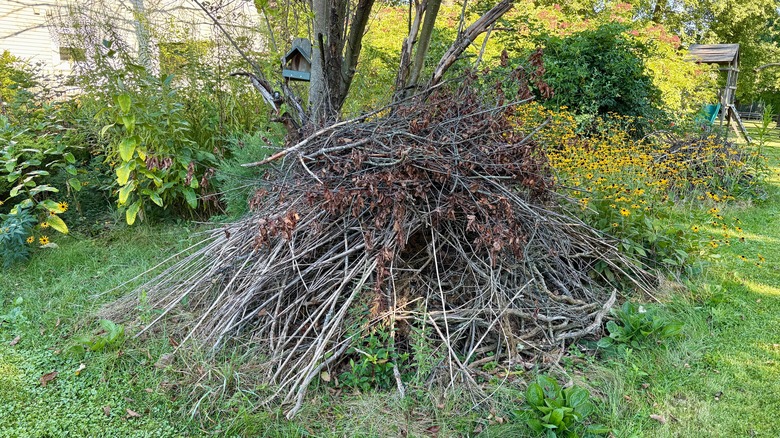
If your yard is inundated with broken boughs and twigs after a storm or due to messy trees, set up brush piles. Since ground dwellers, like towhees and sparrows, prefer to reside and feed not too far up from the ground, they utilize these spaces for shelter. Even wrens, cardinals, flickers, and nuthatches take cover in them from inclement weather conditions, zooming in and out from the various openings arranged in a honeycomb pattern. Bats, too, are open to turning brush piles into cozy cocoons on a particularly cold night.
To build a brush pile, start by grouping the tree branches into different sizes. The longest logs, approximating 20 feet, should form the base. Stagger the remaining perpendicularly in each layer, knitting a maze. Ensure the thinnest branches are on the top, or your pile will be unstable. Loosely layer up dead foliage, pine needles, and other brush, leaving aside mini 6- to 8-inch-long openings for the birds. Retain heavier branches on the sides most exposed to winter winds for greater protection and structural integrity. Locate these piles in isolated spots, away from foot traffic and flame sources to minimize the risk of fire. Alternatively, place them behind shrubs and vines. Although bird baths and bird feeders also offer nice spots, they may become the new haunts of rodents and snakes that enjoy hunting insects inside the brush. So, choose your brush pile's location wisely.
Install roosting boxes to keep the birds warm overnight
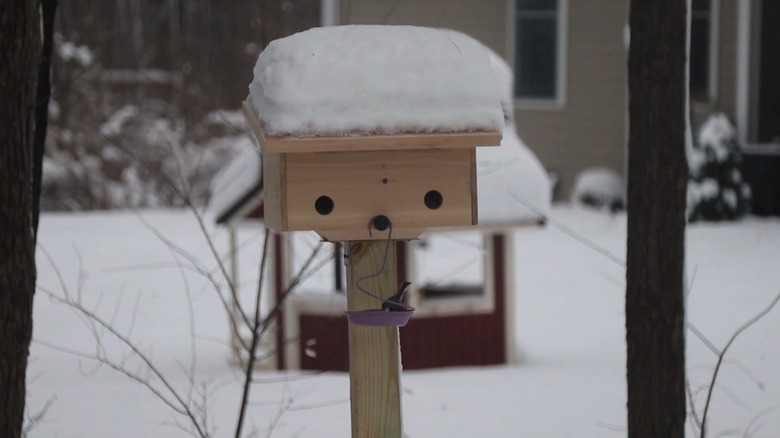
You can keep birds visiting your yard during winter with a roosting box. Unlike bird houses, roosting boxes are specially designed to retain more heat. This is achieved by reducing ventilation holes and relocating the entrance to the bottom. They also have thicker interior walls. Moreover, numerous perches are placed inside the box. This allows the birds to huddle together while clutching their landing spot, benefiting from the collective body warmth. Simply put, roosting boxes act as warm shelters where birds can spend nights when temperatures plummet to sub-freezing levels.
If you're into woodworking, DIY a roosting box using the Washington Department of Fish and Wildlife's roost box design for songbirds. Otherwise, purchase ready-made boxes from Amazon, like the Coveside Store's Small Winter Roost Bird House. Whichever way you go, don't forget to factor in the size of your backyard visitors. Small, cavity-nesting birds can fit in tiny roost boxes where entrance holes are at least 1.5 inches wide, depending on what kinds of birds you're trying to attract. In woodland lots, you'll need boxes with 3-inch-wide entrances to accommodate larger owls and flickers. Choose roost boxes in dark colors since they absorb more heat. Place them along south-facing walls where they catch the most sun, and are hopefully unexposed to cold snaps. Also, make sure they have a hinged top that you can unlatch for cleaning.
Reuse birdhouses for cavity-nesting birds in winter
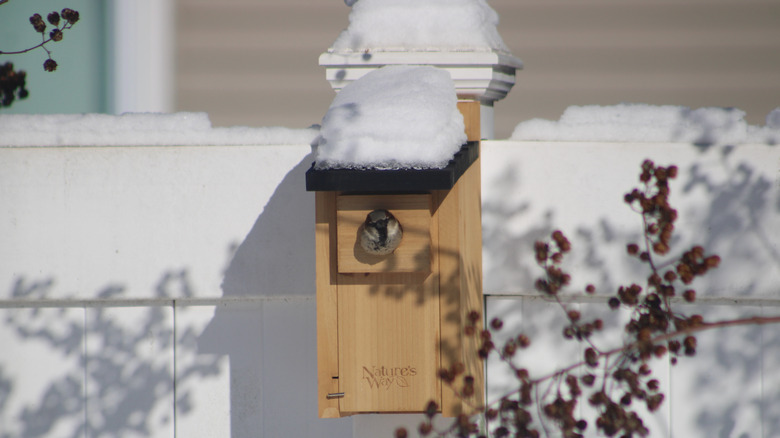
If you've taken down the nesting boxes and birdhouses because the breeding season is officially over, you may want to put them back — after disinfecting and cleaning them, of course. The same legion of birds that incubate their eggs and rear their young in nest houses can later take cover in them when escaping winds, snow, and rain. They may also huddle together inside the box to keep warm overnight. Indeed, installing bird-specific nesting houses for chickadees, bluebirds, nuthatches, and downy woodpeckers can pay off year-round.
However, consider making a few adjustments to the nesting boxes to make them even more hospitable as overnight shelters. Since it's important to minimize heat loss during cold months, plug ventilation and drainage holes with a rag or foam and cover the base with wood chips, grass, hay, or other green materials for thermal insulation. And as birds require perches while sleeping, add a few twigs inside. For roosting woodpeckers, scratch the interior walls to enable a better hold. Wherever possible, switch over the entrance panel to the bottom to retain more heat. You may also want to put up baffles to dissuade squirrels and snakes. Station these boxes where they receive maximum sunlight.
Leave tall grasses unpruned for grassland birds
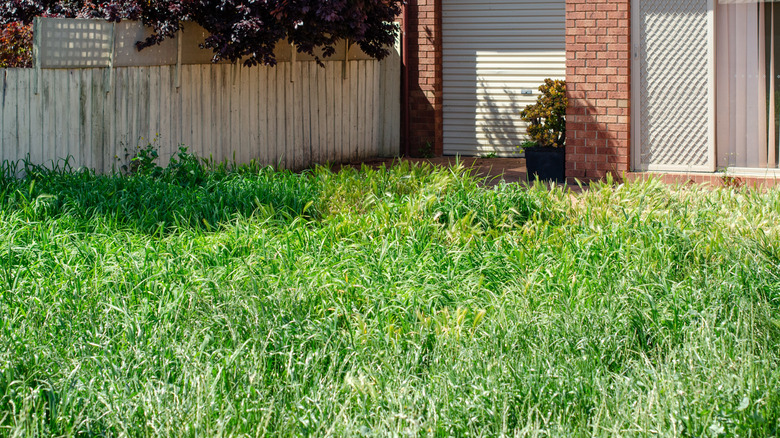
It can be tempting to clear out your yard of dead foliage and seedheads by cutting back dormant plants and grasses. But if grassland or ground-nesting birds such as juncos, sparrows, mourning doves, bobwhites, and quails visit your yard, it makes sense to delay this cleanup until spring. Tall grasses, even when dormant or dead, create dense screens that small birds utilize to dodge their predators. Even when draped in snow, the area around their crowns remains warm because of the snow's insulating effect. This offers the birds a cozy spot during the winter. Moreover, many birds enjoy their seedheads, turning these untrimmed grasses into perfect bird B&Bs.
Most wild grasses can work. But, it's best to include native grasses in your yard for the greatest impact. Indiangrass (Sorghastrum nutans), big bluestem (Andropogon gerardii), broomsedge (Anatherum virginicum), and prairie dropseed (Sporobolus heterolepis) are a few examples to get you started.
Retain snags to offer weather protection
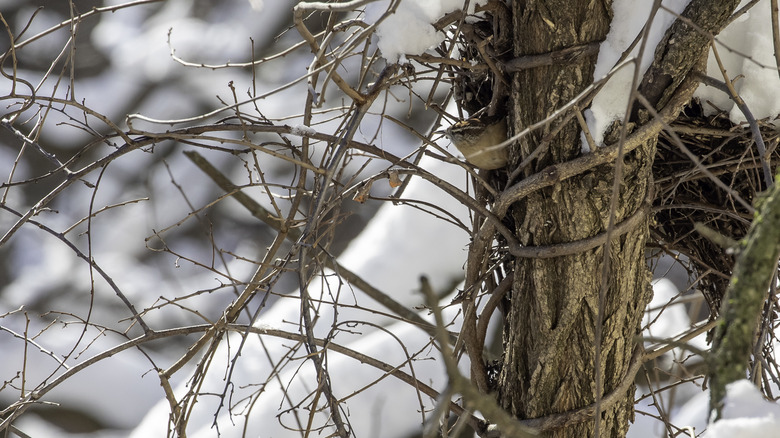
Thinking of giving your backyard a visual lift? Consider leaving dead trees in your yard alone. With time, dead trees — also called snags — decompose and develop hollows and cavities. Birds, as well as bats, hunker down in these snug spots while they wait for the rain to die down or storms to pass. These places also serve as easy drop-off and storage points for birds that cache food. Bark tissues also tend to stay warmer and can be used for roosting. When the winter passes, these areas serve double duty as nesting sites for woodpeckers and other cavity-nesting birds.
That being said, make sure the dead trees don't pose any safety hazard before retaining them. For instance, don't keep dead branches that are above walkways or other areas where family members might stroll underneath. Also, only keep dead trees if they're a safe distance from your house, and won't damage any structures if they blow over in a storm one day.
Repurpose flower baskets into roosting pockets
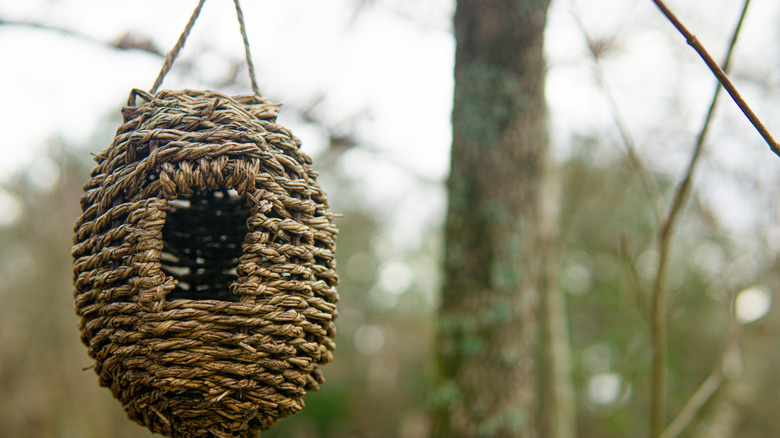
Another nifty way to protect your backyard visitors from dreary winters is to upcycle your hanging or flower baskets into roosting pods, similar to the one pictured above. If you prepare them well, they'll provide the same function as roosting boxes, providing a nice, cozy nook where birds can cram in together and sleep for the night.
To make this work, use baskets woven from natural materials like seagrass, wicker, or straw. La Jolie Muse's Natural Seagrass Hanging Planter Basket Set is one such option (just be sure to remove the plastic lining). Cover the exposed areas with hay or grass bundles, like these from the Momarsh Store, for insulation or even to create a small roof. You can also line the basket with grass for wind- and rain-proofing as well as additional warmth. Make sure to create a tiny entrance hole on the front for birds. You may place dry leaves or moss inside for the birds as well. Et voilà, the roosting pocket is ready for visiting birds.
Create a sheltered area around feeders using logs or repurposed materials
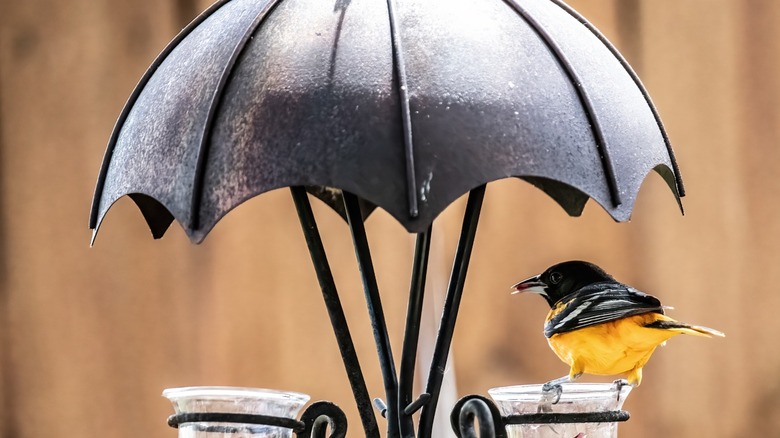
If you don't have the space to create additional, dedicated shelter spots for winter birds, you can add roofing around bird feeders or bird baths. This will allow them to enjoy their meals even when it's pouring, or prevent their anxious dash for safety at the first sign of snow.
You don't have to go through any crazy hoops to add roofing. Prop up any broken limbs or boughs strewn across your yard or saw a few from your evergreens. Alternatively, pick a log or two from your firewood stack and secure them to the feeder's hook with rope. You can also upcycle an old dog umbrella and place it over the bird feeder to shield it from rain. Going forward, when you're in the market for new feeders, look for designs with plexiglass roofing or baffles. The extended roofing will catch some of the snow and keep predators out, ensuring birds can feed or loiter in peace.
Repurpose your old Christmas tree as a temporary shelter
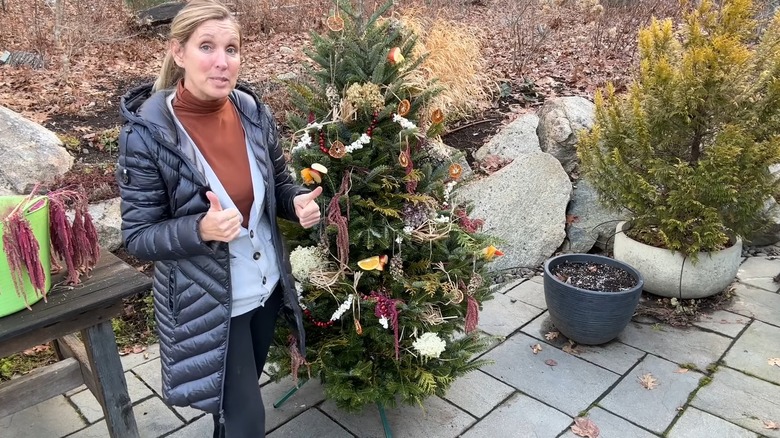
Don't have a yard that can support evergreen trees and shrubs? No problem. Repurpose your Christmas tree instead. While you can choose to leave a minimalist, faux Christmas tree up all year inside your home, if you have a natural tree, a better option is to put it out in the yard. That way, the birds can shelter in the needles or seek temporary protection against cold winds — at least until the old tree loses its needles.
For maximum impact, move your holiday tree near the bird feeder so the birds won't miss out on their snacks. You can even snip the tree's top and a few limbs, and arrange them like a cute bouquet if you're feeling particularly creative. In case you have taken measures to keep your bird bath from freezing this winter, your Christmas tree could border it as well. Then, once it outlives its usefulness, add the tree to your brush pile after it drops all its needles.
Create a rock wall to shelter birds in winter
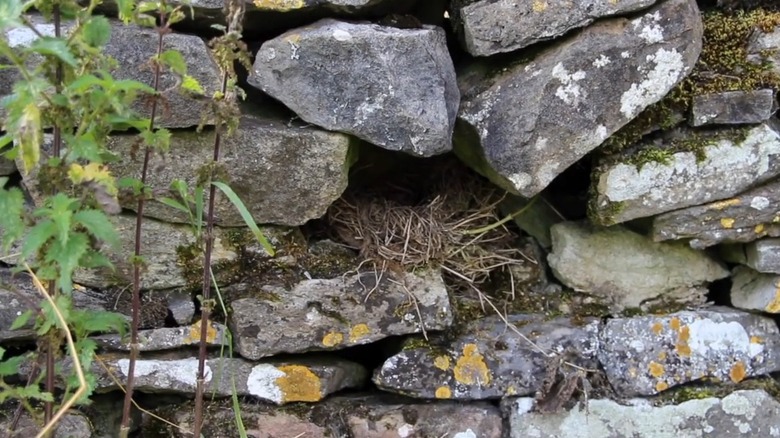
Not too enthused with the idea of a brush pile, given the fire risk? Create a rock wall instead. It will also double as an attractive focal point in your yard and hopefully won't ruffle the feathers of your HOA. When built without mortar, a rock wall also offers various nooks and crannies in which birds can wait out unpleasant weather conditions during winter. Luckily, it isn't too complex to DIY.
Around your property line or against a wall, pile up heavy stones. Keep the broadest pieces at the base and stagger the smaller ones higher. If you only have open spaces, you can build two short walls in an "A" shape, filling the in-between space with tiny stones, or form a cave-like structure. If desired, you can even plant the rock walls with moss or ferns. Make sure to place your rock pile in a sunny spot so it stays warmer for longer. Be cautious, though, as other wildlife, including snakes, may also use these piles for overwintering.
Add a mighty oak tree to your yard
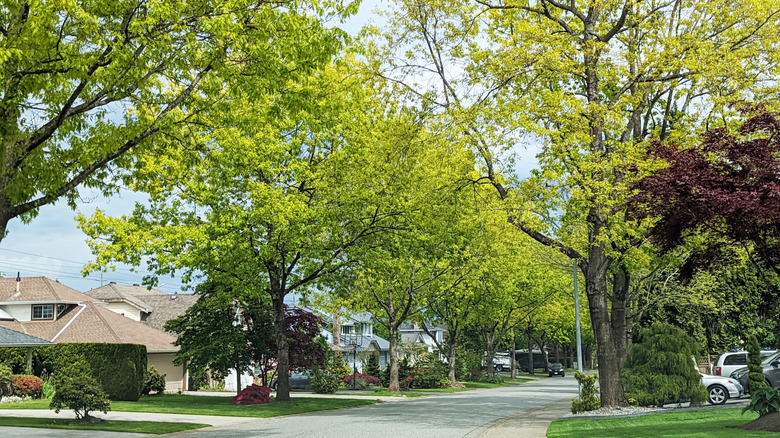
In large yards, you can introduce an oak tree (Quercus spp.) to help out your feathered visitors. As they mature and age, their bark starts to hollow — creating cavities that birds can monopolize for winter shelter. Some, including woodpeckers and owls, may even use these nooks as roosting grounds. Bonus advantage: Oaks provide year-round benefits, including shade in your yard. During spring and summer, they offer nesting grounds, and then tasty acorns during fall and winter. They also cater to the needs of the local wildlife and pollinators.
While selecting an oak for your yard, ensure it's native to your area — this Native Plant Finder tool can help with that. Also, make sure that it's the right size for your yard. Evergreen options include sand hill oak (Q. inopina) and live oaks (Q. virginiana). Multi-stemmed, thicket-forming shrubs like shingle oaks (Q. imbricaria), gamble oaks (Q. gambelii), and bluejack oaks (Q. incana) are other likely contenders.
DIY a hedge with garden debris
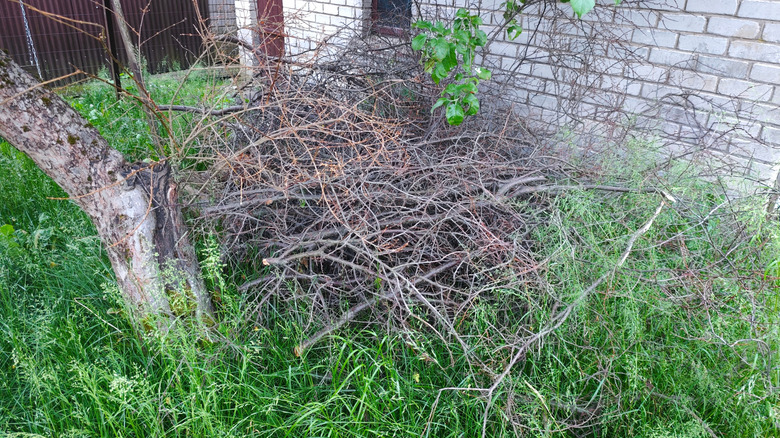
Another way you can lure in backyard visitors during winter is by creating a hedge with plant debris. The process, and thus the benefits, are similar to that of a brush pile. Brush hedges can look quaintly cute in a garden, and serve multiple purposes, such as defining zones or blocking wind.
To make the design intentional and prevent it from becoming messy, push down wooden stakes into the ground, like Vevor's Wooden Garden Stakes. Determine the hedge's dimensions according to the space available, but make sure to leave at least 1.5 feet between the rows of stakes. With the boundaries established, deposit garden litter like leaves, pine cones, cornstalks, moss, perennial stems, and more. Cut down any long limbs to size and add them to the pile. Your feathered friends will love to hide in the nooks and crevices when the weather gets cold. As plant litter tends to decompose over time, continue adding plant matter next season(except for diseased segments, which must be trashed), to maintain the hedge.