

How To Prune A Young Pomegranate Tree To Keep It Strong And Healthy For Years To Come
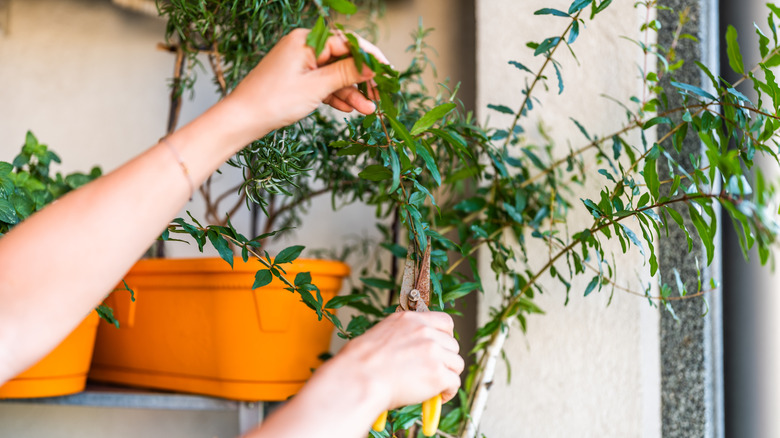
If you've started growing and taking care of pomegranate trees, you probably don't expect the topic of pruning to come up early in the tree's life. A lot of people don't touch their pomegranate trees at first because they seem to be doing fine on their own. And honestly, they probably are, as they're pretty tough trees. But pruning is actually a great step to take in your pomegranate tree's early years because it will help decide how the tree ultimately ends up looking.
So first, it helps to know the difference between shearing vs. pruning, because they're not interchangeable. While shearing is more of an all-over trim which works for hedges, pruning is slower and more selective, and that's what is needed for young pomegranate trees. To prune, you should start in late winter or early spring, when the tree isn't actively growing, and you should decide what you want the tree to look like long term. Some people prefer one main trunk, while others let it grow more like a bush with a few main stems. Early on, it's mostly about taking out branches that don't really make sense with the rest of the tree — the ones that shoot straight up, grow inward, or sit in a way that feels awkward compared to the rest of the tree.
Ongoing pruning helps keep pomegranate trees healthy
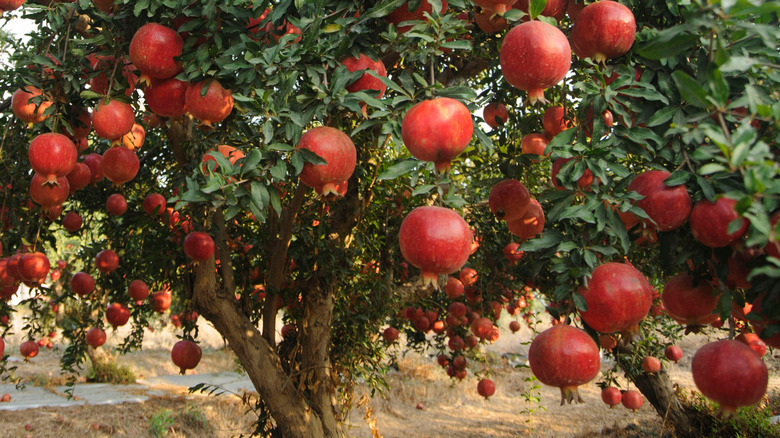
Once the tree is established, pruning turns into more of a routine thing. And it's certainly a routine to adopt in the winter, whilst the tree is in its resting phase. A good starting point is to follow the three D rule of pruning, which means to remove any dead, diseased, or damaged branches. If a branch looks unhealthy, it probably doesn't need to stay. There's also the issue of branches crossing over each other or rubbing. That tends to cause problems later, so you might want to remove one of them — which one you remove depends on the shape of the tree and which looks stronger. As pomegranate trees can get heavy with fruit, weaker branches can't always handle the weight.
Suckers are another thing that come up with pomegranate trees. They are growths that come from the base and don't actually help with fruiting, plus they tend to make the tree look messy and more like a bush, so it's often best to just cut them off when you see them. You basically want to let some light through and around the tree without removing more than one third of it at any time. Pruning your pomegranate tree doesn't have to be perfect, you simply need to adjust as the tree grows and keep an eye on how it responds.