

The Rubber Plant Variety That Brings Happiness & Good Luck, According To Feng Shui

Feng Shui is an ancient Chinese practice that aims to make an environment feel balanced and harmonious by organizing spaces and objects a certain way. The idea is that a strategic placement of objects and elements brings prosperity and peace. And plants hold a special place in fostering good energy and harmony within a home, according to Feng Shui. Take, for instance, the 'Tineke' rubber plant (Ficus elastica 'Tineke'). It is a striking cultivar of the classic rubber plant, and people love it for its beautiful, variegated leaves. No matter where you plant it, indoors or outdoors, it is guaranteed to brighten and elevate the place with its large, glossy, leathery leaves.
The best part? According to Feng Shui, the 'Tineke' rubber plant brings prosperity, good luck, and happiness. And don't we all need those things? Another aspect that makes this rubber plant even more desirable is that it is really easy to care for. And when you pair that with its stunning variegated leaves in shades of green and white, edged with creamy white borders, you get a unique-looking houseplant that could be a statement piece in your home — and a big conversation starter when the guests come.
How to properly care for your 'Tineke' rubber plant
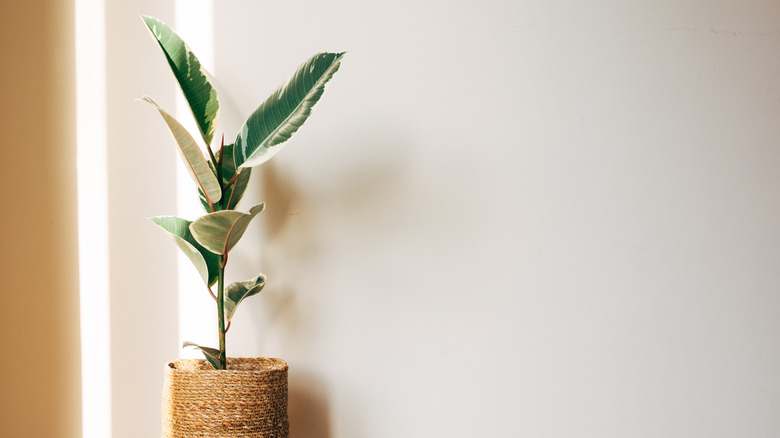
The first and foremost consideration when bringing a 'Tineke' rubber plant home is its placement. It needs bright light — it won't thrive in low-light situations. Good sunlight is also necessary for it to truly show off its variegation. So, place it near a bright window, especially an east- or west-facing one. Just don't let it get too much direct sunlight, as it can scorch the plants.
Secondly, you need to keep it away from drafty areas and ensure it has humid living conditions. If your home is dry, which is usually the case in winter, consider adding a humidifier to raise the indoor moisture level. If that is not possible, you can also fill a tray with pebbles and water and place it near your plants.
As far as watering and fertilizing go, the 'Tineke' rubber plant isn't particularly fussy. You only need to fertilize it once every few weeks with a diluted general-purpose houseplant fertilizer. Water it when the top inch or two of the potting soil feels dry. All you have to do test the moisture level is insert your finger in the soil. It is a simple technique, but it will make sure you never overwater your plants again.
'Tineke' rubber plant pest, problems, and diseases
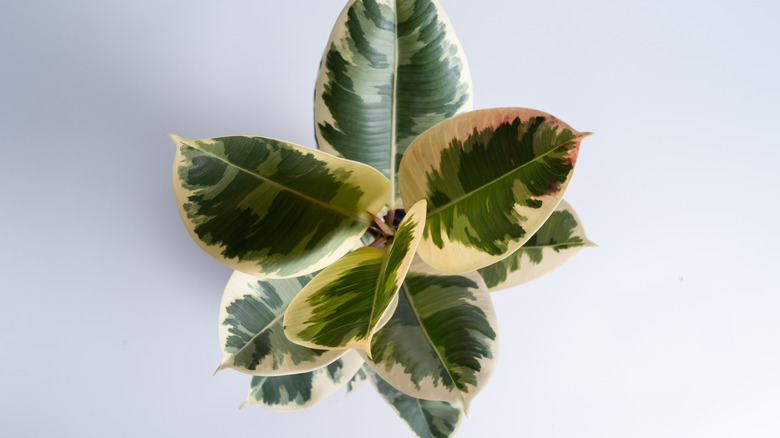
As stunning and easy-going as the 'Tineke' rubber plant is, it is not without its flaws. The plant has quite a few pests, diseases, and other problems that you should definitely be aware of. Let's start with pests. Like many other houseplants and other rubber plant varieties, the 'Tineke' rubber plant is also susceptible to scales, mites, and aphids. Check your plants regularly for any small holes, yellow leaves, and sticky or slimy residues. These are tell-tale signs of pest infestation in houseplants. If you find any of these on your 'Tineke' rubber plant, take immediate action. You can apply neem oil or spray the plant with soapy water to get rid of the bugs.
As for the other problems, drooping and yellowing leaves, and leaf drop are common problems with this plant. More often than not, inappropriate growing conditions, such as inadequate light, improper watering, and sudden temperature changes, are the culprit. Fix these, and the problems will go away.
Lastly, when it comes to diseases, the 'Tineke' rubber plant is vulnerable to honey fungus. It attacks and decays the roots. If your 'Tineke' rubber plant is showing stunted growth, dieback, and wilted branches, a honey fungus attack might be the cause.