

The One Place To Avoid Growing A Peace Lily Plant At All Costs

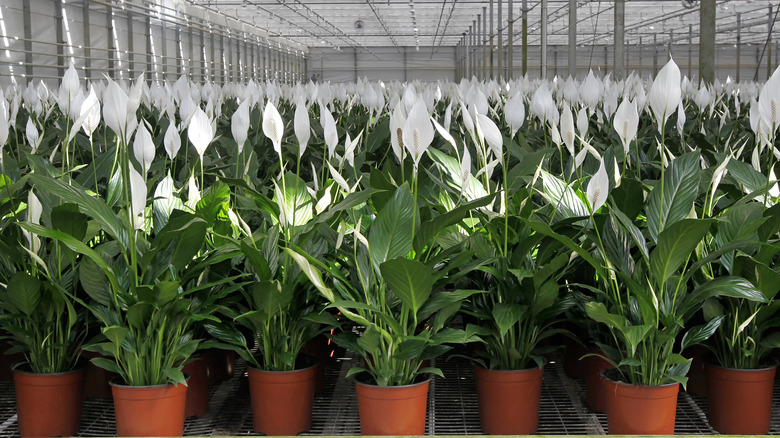
We've all heard the expression "don't try this at home?" Let's face it, some things in life are better left to the professionals. One example of this is the peace lily (Spathiphyllum), a popular houseplant that grows naturally on rainforest floors. When produced for sale to consumers, it is typically grown in a commercial greenhouse. But those same consumers are advised not to keep or grow the plant in their own home greenhouses, sometimes known as "hobby greenhouses."
So, why can't peace lily enthusiasts grow these attractive plants in greenhouses if commercial growers can? It all comes down to light, temperature, and humidity, all things that commercial growers can more easily control. While It's certainly possible to add environmental controls to a hobby greenhouse, it is expensive and complex. Therefore, if you want to see your peace lily thrive, avoid growing it in your greenhouse.
Peace lilies are shade-loving plants. While greenhouses are designed to let light in, commercial growers use heavy shade cloths, which provides the 70 to 80% shade peace lilies need. It would be difficult to replicate that in a home greenhouse, leaving peace lilies exposed to excessive light, which can cause can bleach out, brown tips or sunburn. In fact, improper lighting is one of the common mistakes that are sure to kill your peace lily plants.
Don't grow peace lilies in a home greenhouse
Peace lilies prefer the narrow temperature range of 65 to 80 degrees Fahrenheit and do not tolerate temps of 55 degrees or lower. Without a heating and cooling system, it can be tricky to control temperature in a home greenhouse, given the daytime heat spikes and rapid plunges at night. Peace lilies will die if they are exposed to colder temperatures for a sustained time. On the other hand, prolonged exposure to excessive heat (above 95 degrees Fahrenheit) can cause leaves to narrow. The plant's roots, flowers, and leaf color may also be affected.
Like most tropical plants, peace lilies thrive on humidity, which greenhouses certainly provide. However, the humidity in your personal greenhouse may not supply sufficient air circulation that is needed to prevent pathogens and fungi. The infectious fungus, Cylindrocladium spathiphylli, which causes a form of root rot, can result in rapid death for the plant. If fungus, or any other greenhouse-related issue has caused damage, don't throw out your peace lily; you may be able to revive it by giving it optimal light, temperature, water, humidity, and fertilizer. Learn the hacks to help your peace lilies flourish as indoor houseplants and forget about the greenhouse.