

Give Your Garden A New Sense Of Purpose By Dividing It Into Rooms

Most gardens start out as one open area, simply because that's how they're built, but that doesn't mean they work best that way. And in fact, dividing a garden into smaller sections or rooms is a great way to give you places to do different things in — imagine having a space to sit with a coffee, another space to cook a barbecue or sit down to eat, somewhere just for kids or pets, and an area you don't mind leaving a bit messy.
Breaking a garden up doesn't usually make it feel smaller, even though that's a reasonable worry. In fact, it could have the opposite effect. Just a planted strip across the middle of the garden, a path that bends slightly, or a change in surface underfoot can all create separation without closing things off. This approach is also helpful when you're trying to include practical features without letting them take over. Giving these elements a defined spot makes them feel planned rather than accidental, whether it's a pizza oven or barbecue station, a hammock space, or an area for an inground or above ground trampoline (is one better than the other?). And when the whole space isn't visible at once, it is often described as having a "hide and reveal" effect, which makes your eye slow down and means you have to actually walk into the space in order to explore it all.
Ways to define garden spaces without building solid walls
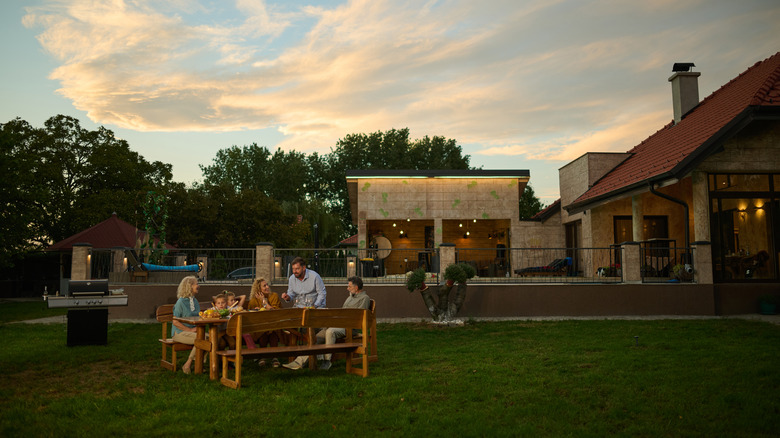
You don't need fences or tall hedges to create these garden rooms; sometimes it's enough to suggest a boundary rather than draw a hard line. You can utilize elements such as low walls, raised beds, or hedges to signal the end of one area and the start of another. These work to give definition and the sense of boundaries, a sense of movement from one "space" to the next, while still letting light and air through. Plus, many of them can be themselves moved and are not rigid structures if you decide to switch your space around. And in smaller gardens, elements such as trellises, arches, and climbing plants can also work to add height and give the space the sense of enclosure without using too much of your limited ground space. In fact, even really simple solutions like two tall planters placed opposite each other can create a sort of doorway effect that changes how you perceive a space.
And one of the easiest mistakes to avoid when designing your garden in a style like this is not treating each section as a separate project — if every area adopted a totally different style, the whole space could start to feel disjointed and disorganized. By simply repeating a few details such as the same paving, similar planting, or a consistent color palette, it will help everything sit together more comfortably while retaining the "separateness" of the designated areas. Clear paths and plantings that reflect the home's proportions will all help create a cohesive garden where the spaces flow naturally from one to the next, making your garden feel calmer and more usable so you'll be able to enjoy your different garden rooms.