

The Sneaky Downsides To Living Near An AI Center
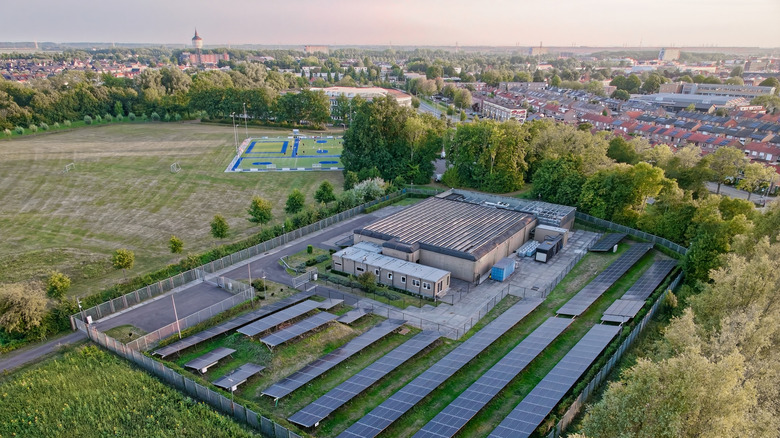
Whether you're practically in a relationship with ChatGPT or you're proudly clinging to your Luddite ways for dear life, most people rely on artificial intelligence (AI) every week. From weather apps and Alexa to streaming and navigation tools, according to Gallup, 99 percent of Americans are using at least one AI-enabled product each week, whether they know it or not. Thanks to insatiable demand for task automation, restaurant recommendations, optimizing logistics, free therapy, and everything in between, enormous data centers are on their way to a neighborhood near you. But from soaring energy bills to devastating environmental impacts, there are several sneaky downsides to living near an AI center.
Beyond power grid strain and daily water consumption that dwarfs entire towns, the arrival of data centers can reshape communities in other ways. Cooling systems and backup generators running around the clock create constant noise. Along with being generally irritating, especially late at night when ambient volumes are otherwise lower, some residents say the noise drives away local wildlife.
This environmental impact issue is compounded by the fact that AI center developers often favor rural sites because the surrounding power grid demand isn't as high. But since data center construction is frequently heralded by massive clear-cutting and site preparation, large parcels of forested or otherwise undeveloped land are permanently altered. The sheer size of hyperscale data centers, which can reach up to a million square feet and span hundreds of acres, drives significant habitat and green space losses. Changes in zoning, traffic patterns, and surrounding development objectives frequently surface during the permitting process. The end result for residents is often the transformation of quiet rural areas into congested industrial zones
Public health and safety concerns are growing

The rapid expansion of AI centers also raises consequential questions about public health and safety for nearby residents, especially when it comes to air quality and water stress. There's widespread discussion about these facilities' electricity consumption and how that impacts consumer prices. But less attention is paid to the fact that some of that power still comes from air-polluting, fossil-fuel dependent systems.
Researchers recently published a study in Computers and Science, finding that training a large AI model "can produce air pollutants equivalent to more than 10,000 round trips by car between Los Angeles and New York City." They estimate that fine particulate emissions associated with data center activity could contribute to as many as 1,300 premature deaths each year by 2030. Air pollution is widely considered a silent killer and is well established as a risk factor for asthma, diabetes, and cardiovascular disease. For nearby residents, especially children, older adults, or people with preexisting conditions, repeated exposure, even at low levels, can contribute to serious health risks.
Water supplies are also at risk. Hyperscale AI centers can consume millions of gallons of freshwater each day. The sheer volume required to cool these massive facilities can strain local water supplies, especially in drought-prone regions. In turn, this creates the potential for water shortages, which leads to heightened competition (and therefore, prices) for drinking and agricultural water. In some systems, the water discharged after cooling is chemically treated, affecting downstream ecosystems and municipal treatment capacities. Although data centers are often marketed as low-impact neighbors, their scale and complexity mean that the health and safety implications make oversight essential for the communities asked to welcome them.
Data centers shift corporate costs (and consequences) onto homeowners
Unfortunately, the downsides to living near an AI center go well beyond the environmental and public health impacts. The promised economic benefits often fall short of expectations. Although some politicians may point to increased property tax revenue, in reality, most states offer such generous tax abatements to attract data center construction that local revenue generation remains on already overburdened homeowners. The question of whether data centers harm or help your property value is nuanced, but available data clearly shows they do not permanently improve local economies through job creation. As property values become harder to predict, insurance premiums rise, and neighborhood character indelibly changes, many homeowners find themselves absorbing long-term financial and quality-of-life impacts from data centers designed to serve tech companies, not local communities.
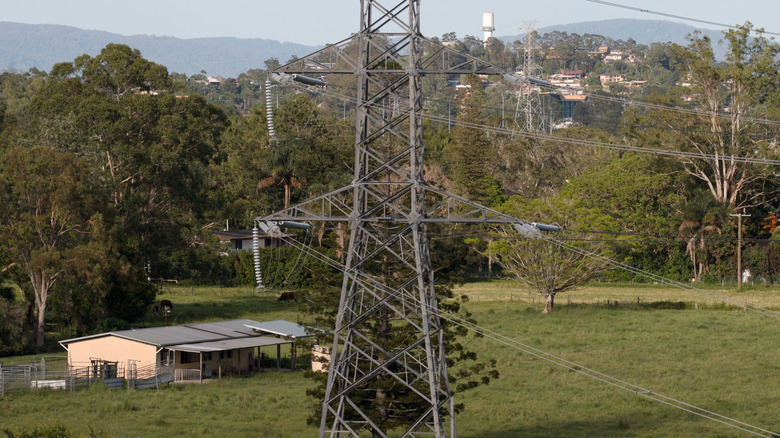
There are even cases where the arrival of a data center means homeowners are forced out altogether. To meet the enormous electricity demands of AI centers, power companies are investing in new transmission lines capable of meeting energy demands now and in the future. Most of the cost is passed on to residential customers through rate increases rather than being absorbed by the data centers themselves, meaning local residents are essentially subsidizing high-voltage buildouts. Worse yet, public utilities with eminent domain authority are engaging in contentious efforts to acquire permanent easements and even entire residential properties located along planned transmission routes.
From eroding wildlife habitats to driving up costs for residents, the real cost of AI centers is often paid by the people who benefit from it the least. Staying aware of local data center projects allows homeowners to prepare and advocate for their neighborhood's best interests.