

Keep Your Home Warmer During Winter Months With This Type Of Curtain

Home heating can get expensive during the cold winter months, accounting for around 30% of your utility bills, according to the U.S. Department of Energy. As electricity ekes toward usurping natural gas as the main residential heating fuel in the United States, there are plenty of steps you can take to efficiently keep your home warm. Installing new equipment like a heat pump is one example, especially if your HVAC system is more than a decade old and not running certified tools by the government's Energy Star program. However, ensuring your home can lock in the heat it's generating is, perhaps, more important in the long run. One easy way to retain heat during the winter is by installing floor-length curtains.
According to the Pacific Northwest National Laboratory (PNNL), windows make up around 8% of a home's surface area but account for nearly half of its heat loss. Having the right curtains can help. Keep your drapes open for south-facing windows during the day so sunlight streams in, then close them at night to reduce the chill. Heat transfers through multiple processes including convection, in which heat rises, and denser, cold air drops to the floor. This can happen after contacting a cool glass window. Having long curtains that block off your windows will prevent contact-based transfer of heat and ensure that drafts are trapped behind the fabric. It's much the same as you might seal heating and cooling ducts to prevent heat loss, which would increase your energy bills.
Long curtains that can help insulate your home
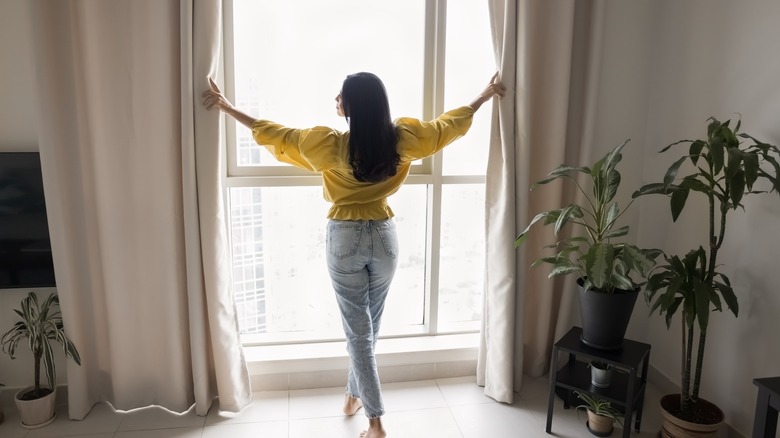
There are several types of floor-length curtains you could consider for your windows: float length, break length, and puddle length. There's an aesthetic difference to all three, from the clean lines of a curtain barely reaching the floor at float length to those lines bending as they hit the ground or completely pooling out past the main drapes. However, you may want to pass on float length if you're concerned about drafts squeezing beneath the curtains (if anything, break-length curtains are the most versatile and least intrusive style if you don't have unfinished wood floors). For more efficient insulation than a standard sheet set, try installing heavier, opaque curtains one inch away from the wall. Using a closed-top cornice can also help prevent the convection effect of a trapped air tunnel between the curtain and window.
Classic pull-apart curtains might still leave space for breezes to escape in the slit between the fabric. There are some more unique window treatment trends you can try in 2026. For instance, roman shades pull straight down to cover a window vertically rather than horizontally. Installing extra-long sets should put them at floor-length. You can also supplement your long curtains with honeycomb shades, which are 10 to 15 percent more effective than slat blinds at reducing window-based heat transfer, per the PNNL. Some windows are also built with a film that's tested to see how it retains heat and keeps out wind.
Long curtains for the winter can have drawbacks
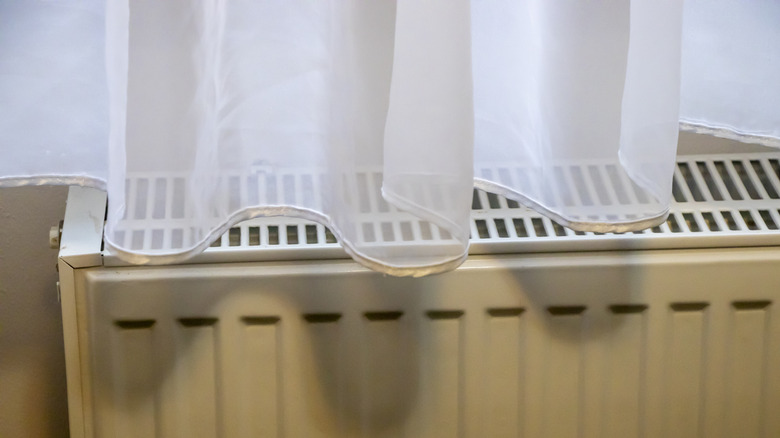
Having floor-length curtains is a great way to tackle heat loss through cold windows and unseen drafts, but it also has some potential drawbacks that you should be aware of. For example, you don't want curtains that are too long, as bunching fabric on the floor could be a tripping hazard. You also don't want to install them on any window that is built above baseboard heaters. Flammable fabric like curtains should be kept at least 3 feet away from heaters so it does not block the air intake or exhaust.
You should also be careful not to completely seal your home with long curtains during the winter if you're generating more moisture during activities like cooking or if you don't have appropriate ventilation around your shower. Proper air flow is needed to prevent mold from entering your home. As mentioned, curtains are a convenient solution because they'll still allow you to open the windows, if you so desire, while also helping you black out a space if the shades are long enough. Curtains come in all shapes, sizes, styles, and colors, and won't break the bank if you're looking to invest in a new set that will protect your home from a strong cold snap.