

You'll Want To Remember The Simple Three Cs Rule When Pruning Plants
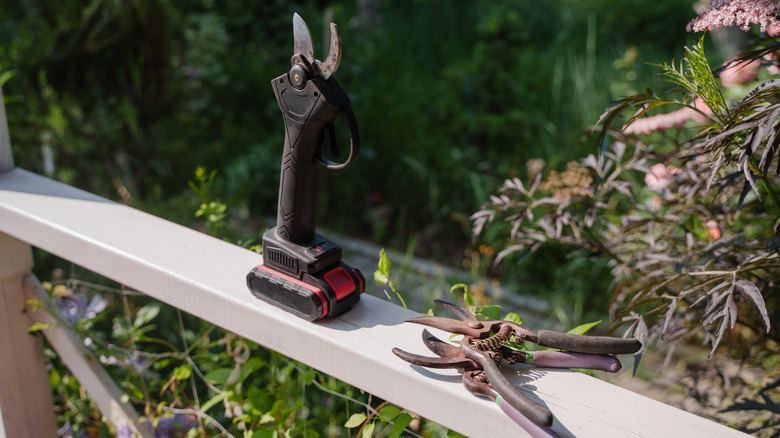
Learn to prune your trees the right way without calling a pro and you'll not only grow a beautiful, healthy garden — you'll also save money. One challenge when pruning the plants, shrubs, and trees in your backyard yourself is knowing which tools to use for which application. Between shears, loppers, and chainsaws, there's an array of options. While you can get away with pretty much anything that cuts through branches in a pinch, knowing which branches to prune and which to leave alone is vital. It's easy to overdo things when you're DIYing your tree trimming. The three Cs rule can help you decide which get the snip — that is, you select only the branches that are competing, crowded, or crossing for removal.
Removing stems, branches, or even flowers from plants (called deadheading) improves the aesthetics of the plant and manages its growth. However, you need to be careful not to cut away too many branches or you'll stress the tree or shrub. There are lots of common mistakes to avoid when pruning your plants — pruning at the wrong time of year, using dirty tools, or making cuts you later regret, among many others. Most of these errors can be avoided with careful planning. The three Cs rule should be a part of any pruning plan. It helps you identify which branches are a priority for reduction or removal. What's more, three C pruning should always be done in the dormant season.
Identifying stems and branches for pruning according to the three Cs
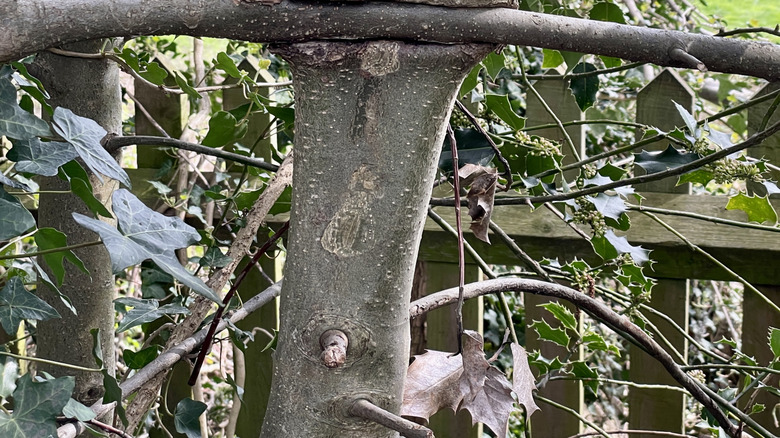
In trees and large shrubs, peripheral branches can compete with the vertical (sky to ground) central leader, which is the main branch running from the trunk up through the center of the tree. Competing branches — the first of the three Cs — are a priority for dormant-season pruning because they pull energy away from the central leader or other structural branches. To find competing branches, first identify the main leader and then look for any branches growing parallel to it. Finding and pruning these offending stems early on in a plant's life helps prevent stress as it grows.
Crowding (the second of the three Cs) occurs when several branches grow out of the same part of the trunk. The branches compete with each other for water, sunlight, air, and nutrients, weakening them. Cutting off crowded stems opens up the canopy of the shrub or tree and redistributes resources more evenly, promoting healthy growth. Crossed branches, the final of the three Cs, are easy to identify. It's in the name: a branch quite literally crossed over another, each growing in their own direction. Sometimes, these branches rub together, creating an open wound where they cross. This makes the shrub or tree more vulnerable to disease and can temporarily damage the plant's internal structures.
How to prune three C stems and branches
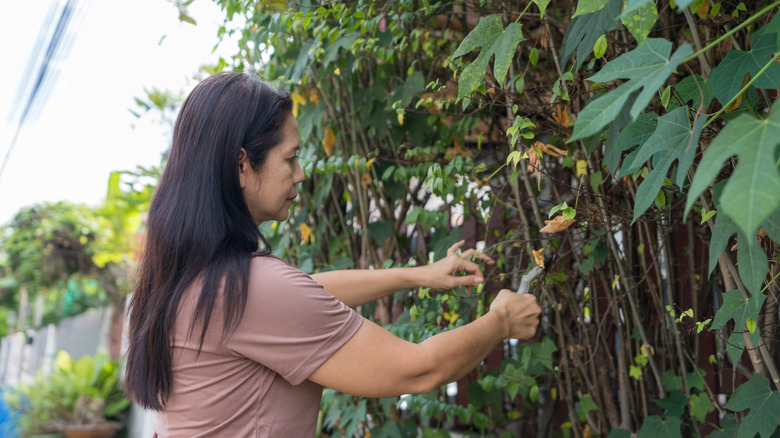
First, check the time of year. Three C pruning should always be done when your plants are dormant. Next, choose the best pruning tool for your needs. Broadly speaking, use shears for stems up to ¾ of an inch in diameter and loppers, pruning saws, or pole pruners for anything larger. With your chosen tool in hand, examine the shrub or tree you wish to prune to identify any competing, crossing, or crowded branches. The best way to remove competing branches depends on whether they're co-dominant stems or competing laterals. Completely remove co-dominant stems and insubstantial competing laterals. If a competing lateral has grown as tall as the central leader, reduce its size to slow its growth.
Alleviate crowding in shrubs or trees by thinning out excess branches; the action stimulates plant-wide growth, improves air circulation, reduces wind resistance, and increases sunlight exposure. When removing crowded stems, prune right back to the next branch — the point of stem origin or attachment. It's important to take a step back and observe the situation carefully before pruning crossing branches. You only want to cut off stems that are touching or rubbing on one another, or have the potential to do so in the future. Plus, only one of the branches needs to be removed: the one growing toward the middle of the tree. Removing it ensures healthy growth of the other and helps sunlight reach deeper into the canopy.