

What You're Not Allowed To Do To Your Neighbor's Tree (And What You May Be Able To Get Away With)
We may receive a commission on purchases made from links.
When your neighbor's poplar straggles your fence line, shadowing your flower beds while dumping a host of leaves and twigs, you may feel tempted to grab a chainsaw and cut it all off. But that's likely to get you in hot water with the neighbors and the law. No matter how hazardous, you aren't allowed to trespass on your neighbor's property to take down their tree. Similarly, you can't take any adverse measures, such as using an herbicide or inserting copper nails in the trunk, that could destroy or kill the offending tree. Otherwise, you may be liable for damages and imprisonment. These same rules apply even if your neighbor has planted an invasive species, though some states allow you to sue your neighbor for damages if it's noxious.
That being said, the tree law does show regard for property rights. This means you can get away with cutting any encroaching branches or roots right up to your property line. Unless you can prove the tree was already dead or damaged, you must bear these expenses on your own and can't sue your neighbor for compensation. Disposing of the plant material is also your responsibility — don't throw it back into your neighbor's yard to be petty. With these key pointers established, below is a detailed breakdown of what you aren't and are allowed to do to your neighbor's tree.
What you can't do to your neighbor's tree
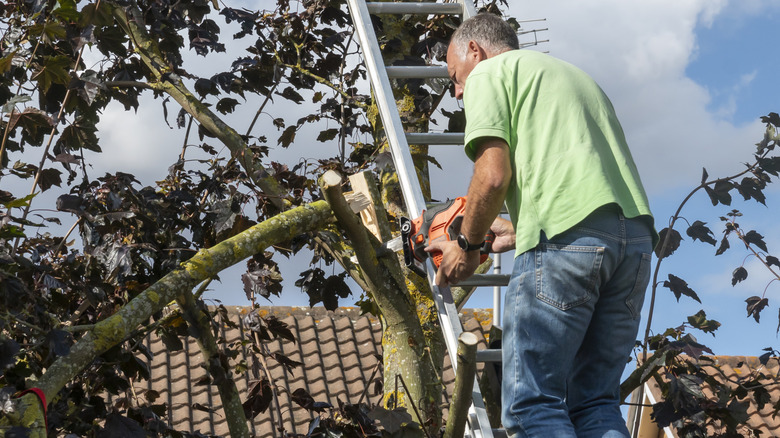
No matter how far out the errant branches overhang your yard or the roots buckle your driveway, you can't enter your neighbor's property to tackle the issue. Otherwise, it'll be treated as criminal trespassing, and you can be sued in court for this. With their written consent, however, you may enter their yard to remove the interfering growth.
Even if you're allowed to remove encroaching growth (detailed below), don't cut back the tree recklessly. Avoid topping the canopy, hacking the roots haphazardly, or taking any action that could cause tree failure. You're also not allowed to prune the limbs in any way that ruins the tree's form and aesthetic. Many states, including Washington, Minnesota, and Utah, impose treble charges (three times the tree's replacement cost) when a tree is wrongfully injured, which you may have to pay.
In the case of a "boundary tree" — whose trunk spans both properties — you can't take any unilateral action. Such trees have shared ownership, and you must come together with your neighbor or acquire their consent before cutting down the tree, though branch removal is allowed on your side. You also can't take any action on trees protected under local ordinances or private covenants without permission or permits. If the leaning tree poses a hazard risk, you may, after communicating your concerns to your neighbor, file a nuisance claim or speak to the local municipality for redress.
What you can do to your neighbor's tree
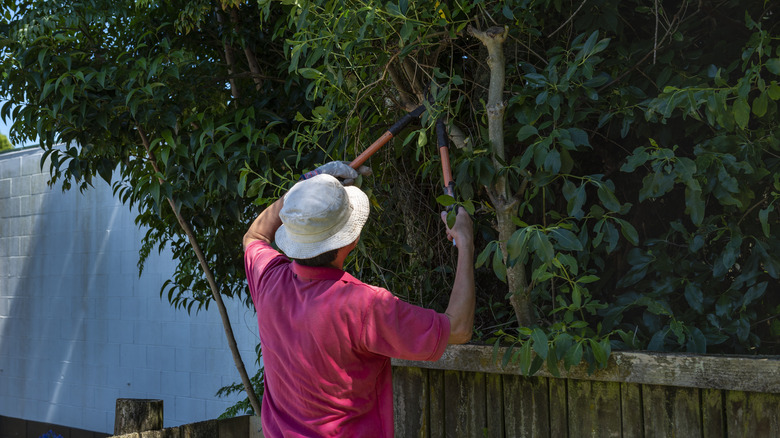
Despite these limitations, there are a few things you can do when a neighbor's tree is overhanging your garden, subject to the state and local laws as well as HOA rules and ordinances. Most states, including Iowa, follow the "Massachusetts Rule," or the "right to self-help," which protects your right to enjoy your property. So, when branches or roots of your neighbor's tree sprawl into your yard, you're allowed to prune them for containment, at your own expense. But you can't cross the property line. Before fetching your lopper, ensure you have the exact measurements of where your property ends. Property deed papers or city records will contain this information, or you may trace survey pins along the fence line using a metal detector, such as the DR.ÖTEK Metal Detector for Adults.
Although you can prune your neighbor's overhanging branches without advance notification or permission, it's best to communicate beforehand to avoid souring your relationship with them (and some counties necessitate this). Nice, friendly neighbors will understand your predicament and may even resolve it on their own by taking it up with their landscaper. If not, hire a licensed arborist. Only after factoring in all the possible risks will they prune out the intruding growth in accordance with ANSI A300, ensuring no long-term harm comes to the tree. Where damage is imminent, consult a real estate attorney to avoid any liabilities later and document the process for proof.