

The Laundry Room Upgrade That Can Help Save On Energy Costs & Drying Time

We may receive a commission on purchases made from links.
There's a feeling of excitement and even a sense of achievement when you discover a new gadget or hack that makes one of your regular household chores faster, easier, or best of all, cheaper to do. The laundry room is one area of a home that can benefit from such tricks, especially when it comes to drying clothes. Even though tumble dryers are a great help, they're energy guzzlers. When the House Digest team ranked 15 home appliances by how much energy they use, dryers came in second place. But guess what? A simple upgrade to your laundry room can make a big difference. All you need to do is install a ceiling fan.
On the surface, ceiling fans are unrelated to laundry management. Don't they just help you to cool a room on hot summer days? However, this seemingly random fixture can save you a lot in drying time and, subsequently, electricity costs. Let's say that instead of running your tumble dryer to dry your freshly washed clothes or linens, you hang them over a rack or pin them on a clothes line in your laundry room. They'll eventually air dry, but it will likely take a long time, especially in homes with high humidity. Running a ceiling fan speeds up the drying process while using less energy than a big appliance. The moisture evaporates from your clothes as with air drying, only faster.
Breaking down the benefits of a ceiling fan in the laundry room
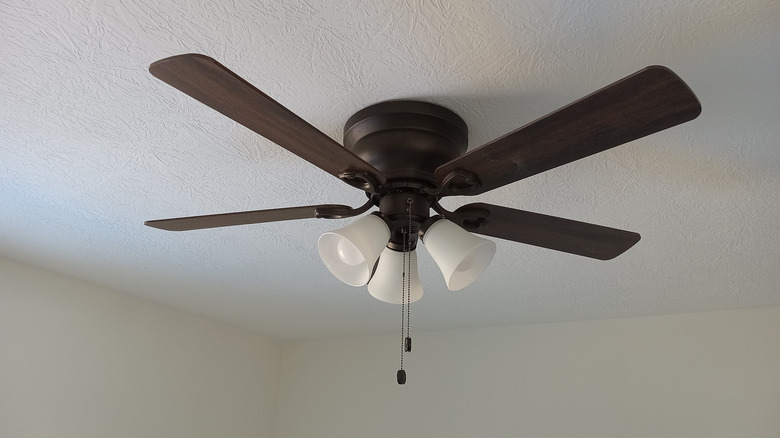
Ceiling fans don't physically remove moisture like an air conditioner does. They keep the air in circulation, and moving air dries damp things faster. This only works, however, if you select the best ceiling fan for this room of your home. For maximum efficiency and safety, pick a fan that fits within the laundry room's footprint. The blades should be at least 7 feet from the floor and up to 10 inches from the ceiling. It also doesn't hurt to get a design that fits your style or has nifty features, like smart controls, low-profile or flush-mount blades, and bright LED lights. The diminutive, easy-to-install Dreo Low Profile Ceiling Fan for about $153 is a good example.
In terms of saving energy, the numbers, as they say, don't lie. Tumble dryers consume an average of 3,000 watts per load, taking roughly one hour to complete, which means it costs approximately $0.39 per load at the electric rate of $0.13 per kWh (the U.S. average). On the other hand, a standard-sized ceiling fan uses roughly 75 watts, costing about $0.01 per hour. The time it takes to air-dry clothes indoors can vary greatly, based on the fabric and humidity levels — from two hours up to 24 hours for heavy garments and linens. Using an average of 12 hours, the electricity bill for the ceiling fan comes to $0.12 for one load. That's less than half of the $0.39 per load using a dryer, proving this laundry room upgrade is one of the easiest ways to save on your electric bill. Of course, exact savings may vary depending on your dryer and ceiling fan model, your local utility rates, and the humidity level.