

Warm Up Common Areas Of Your Home With A Small, Cozy Solution

We may receive a commission on purchases made from links.
Even a well-heated, well-insulated house can have persistent, chilly spots. You might find that the corner under your desk or that area in front of the door is always too cold, no matter what remedies you try. The common areas in open concept homes can be especially prone to temperature variations, resulting in shivery spots that suck the coziness out of the room. To remedy this, heated mats — rectangular rugs with an integrated heating element — are an economical way to warm up those cool areas without having to make a major investment in upgrading your HVAC system. They offer a similar function to the electric blanket you have on your bed.
Unlike the rubber or plastic outdoor mats that are meant for melting snow and ice, indoor heated mats come in a wide range of styles and sizes that blend in with your decor. The simplest ones are about the size of a doormat and have an on/off switch. They're good for under a desk, or in the spot where you put your feet when you're watching TV. The largest ones are designed to be put under your existing area rugs, giving you the benefit of small-space radiant floor heating without having to tear up the floor to install traditional radiant heat.
These innovative mats, like the well-reviewed 120-volt AC power WhisperHeat heated floor mat, provide warmth without generating the white noise you expect from a space heater. They can be plugged into a standard outlet and used on any floor type, including hardwood, tile, and carpet. The mats heat up quickly, and some reach temperatures as high as 150 degrees Fahrenheit.
Heated floor mats are more energy efficient and economical to use
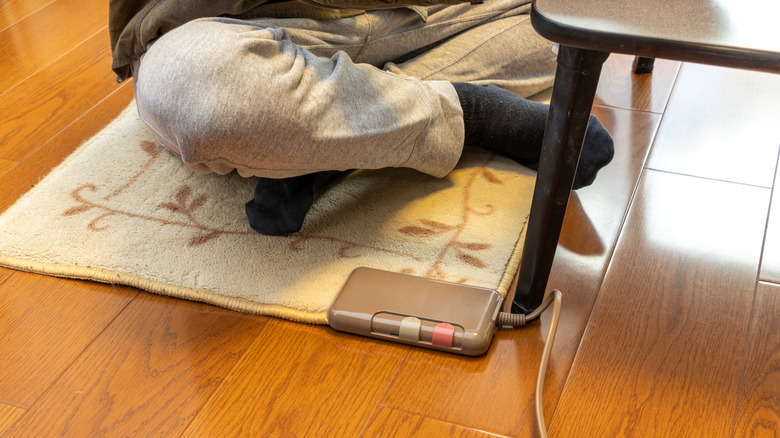
A typical small heated floor mat uses around 90 to 135 watts of power, considerably less than a standard space heater that uses 1500 watts, but the cost of energy in your area, how big a floor mat is, and how often you use it, factor into how much it costs to operate one of these. Of course, they're much more economical than running a whole house furnace or heating rooms that aren't being used. Keep in mind that no matter the size of the mat, heating mats require a power source, so if the electricity goes out, they won't be useful unless you have a backup generator or use an alternative energy source like a portable power station or solar shingles on your roof.
Larger, more expensive heated floor mats have a thermostat to control the temperature in addition to an on/off switch and a timer, making them more versatile but potentially less energy efficient. They're especially good for anyone who might forget to turn the mat off, or for mobility-impaired users who may not be able to easily access the controls. The approximately 5-foot by 7-foot 1200-watt NujorWarm electric heated rug uses more energy, but it has more features, like a wide selection of heating levels and protection against static electricity. A large heated floor mat under the dining room table might make your family linger rather than scattering to their rooms after the meal is finished.
Is a heated floor mat for you?

Heated floor mats create a cozy spot in your common spaces without the dangers of a space heater. They don't tip over, they aren't noisy, they're almost universally waterproof, and they won't burn a curious child or pet. But, as with any appliance that relies on electricity, you should exercise caution and only use the mat according to the manufacturer's instructions. Don't use it anywhere it might be subject to damage that would allow water to come into contact with the heating element.
Before you settle on which heated mat to buy, there are a few things to check. First, look for a UL rating mark, meaning that it meets safety standards, and a ground-fault circuit interrupter (GFCI) that will turn the heating element off if there's a problem, such as a power surge. If the mat itself doesn't have a GFCI, plug it into a wall outlet that has this safety feature. Some heating mats have requirements like an additional pad on the floor. Make sure you have all the necessary parts before you start using yours, and check to see if you can wash the rug yourself or if you will have to send it to the cleaners.