

The Stunning Tree That Adds Major Visual Interest To Your Yard In Winter

Winter isn't a very exciting time when it comes to gardens and yards. Many plants go dormant, and you may be left with muted colors, bare branches, and not much to look at. So, having a plant that could add visual interest to your yard in winter is definitely something most people would appreciate. That is exactly where paperbark maple (Acer griseum) can help. Its beautiful cinnamon-orange bark sheds in thin, papery curls that look really stunning against snow and dull gray skies in the winter. The best part? Unlike most maple tree varieties, which can often grow about 50 feet tall and 35 feet wide, paperbark maple typically only reaches about 25 feet high and 20 feet wide. This makes it a wonderful choice for people with small yards who want to bring visual interest to their homes but don't have much space.
The real bonus, though, is that paperbark maple also keeps the landscape looking pretty in spring and summer. It boasts small greenish-yellow flowers in spring. However, the real beauty comes later in the season, when its leaves open in shades of orange or red, giving you a quick burst of color before everything turns green. It is truly a tree for all seasons. Just make sure that you are in USDA Plant Hardiness Zones 4 through 8 before you decide to plant it in your yard. As for the growing conditions, paperbark maple tolerates a range of soil types and pH levels. However, if you really want it to thrive, aim for slightly acidic, medium-moist, well-drained soil. If the soil drainage is good, it can even thrive and grow well in clay soil.
Elements that make the paperbark maple pop in winter
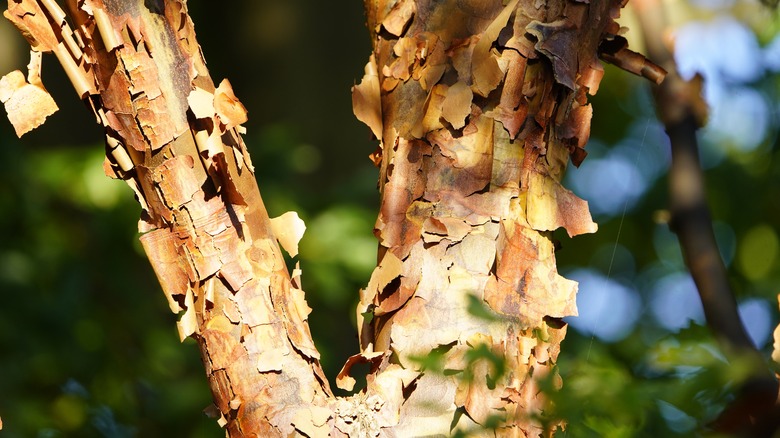
One feature that makes paperbark maple really special for winter gardens is that it is one of the last maple tree varieties to take on the fall color. And these pretty shades even persist into the winter. During this time, the leaves take on showy hues of red and orange, which can really brighten up the landscape. And, thanks to its small size, paperbark maple serves as an accent plant near patios and pool sides. Just make sure you plant it somewhere that doesn't hide its ornamental features, especially its peeling bark, and choose the best spot in your yard to grow this stunning tree. And don't worry about the mess. The peeling bark doesn't fall off the tree. Instead, it hangs on to the tree in papery curls. The best part? You don't have to wait long for this show. Even when the tree is young, and the branches are small, it exfoliates, making it a perfect choice for winter and nighttime gardens.
Furthermore, you can increase the visual appeal of your paperbark maple tree by adding some hardscape elements. For instance, you can create stone edging around your tree or add charcoal gravel and slate chips around it to enhance the tree's look. Likewise, you can add lights to your paperbark maple to keep it looking beautiful even at night. For instance, you can place a single low-voltage uplight aimed at the trunk to create a museum-style display, highlighting the shadows and textures of the peeling bark curls. Just try using a warm-toned light, as it will maintain a cozy atmosphere in your yard during winter.
Caring for your paperbark maple tree during winter
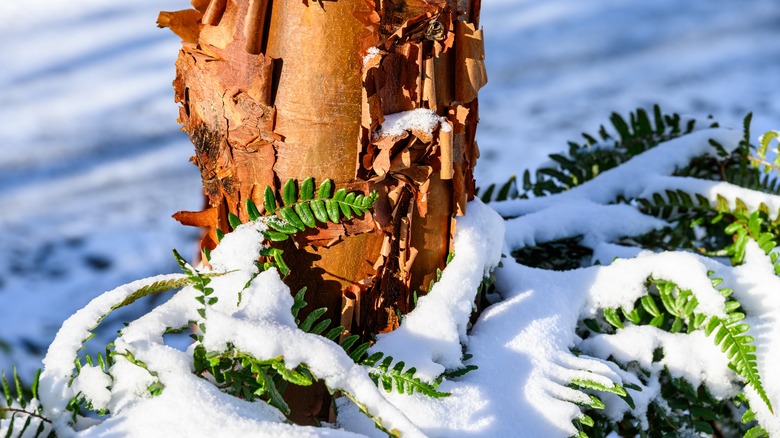
Even though paperbark maple is a cold-hardy tree and can survive temperatures as low as -30 degrees Fahrenheit, giving it some winter care can really help it stay healthy and look good. And you need to start this care routine before winter even begins. For instance, you need to keep your tree well-hydrated, especially when winter is about to start. Paperbark maple is not a drought-resistant tree, and if you water it well, it will have a better chance of avoiding winter dieback. To help maintain soil moisture, you can also mulch around the base of the plant. Just make sure to keep mulch off the trunk.
Furthermore, you can prune your paperbark maple tree in the winter as well. During this time, the tree has entered dormancy, and it won't bleed sap. Just remember that paperbark maples do not need much pruning, so prune to enhance the look, not shear. Get rid of any rubbing, crossing, or any other branches that might block the view of the main scaffold limbs and the trunk. And be sure to remember the simple three Cs rule when pruning your plants: Only remove branches that are competing, crowded, or crossing.
Lastly, in regions with extreme temperatures, you might also need to protect your paperbark male tree against the winter sunscald. It affects the trees when bright winter sun warms the bark of the paperbark maple during the day, and cold air freezes it at night. Using a trunk wrap usually solves the problem. Just make sure that you remove the wrap as soon as the spring arrives so that the moisture doesn't build up and the bark can breathe again.