

Say Goodbye To Popcorn Ceilings With A DIY Solution From HGTV's Property Brothers

We may receive a commission on purchases made from links.
There are a few ways to cover up an ugly popcorn ceiling without the hassle of scraping. You could try installing drywall panels over the top, but honestly, that usually turns into a massive production. Between planning the layout, the taping, the mudding, and the fact that you may have to lower all your light fixtures and trim, it can quickly become an expensive project.
There's the option of ceiling tiles, which can look great in the right space, but they eat up your ceiling height. If you're already in a small room, losing even an inch can make the space feel cramped. Plus, trying to cut tiles perfectly around a ceiling fan or a recessed light is pretty tedious work. That's why we prefer the approach the Property Brothers often take. In a Facebook post about a remodeling project, Jonathan Scott skipped the scraping and simply plastered right over the popcorn ceiling of a 30-year-old house.
It's a clever hack because it lets you keep every bit of your ceiling height while still updating the room's look. You also don't have to worry about grids or joints if that's not your style. Of course, be warned: skim coating with plaster is a bit of a shoulder workout. You can't just slap the compound on and call it a day; you have to work in thin layers to avoid ending up with weird, uneven splotches. But even then, it's relatively cleaner, cheaper, and in many cases, it's just as effective as alternate solutions.
Prep the area and make sure your ceiling is in good condition

If the popcorn is already loose or peeling, plastering over it is not a good idea. You'll end up with a surface that eventually cracks or bubbles. In that situation, you're better off scraping first or calling in a professional. Also, if your home was built before the mid-1980s, you'll need a professional to test for asbestos and lead paint before you disturb the ceiling in any way. To make sure your popcorn ceiling is in good condition for plastering, check that it's not water-damaged, sagging, flaking, and it's tested negative for asbestos.
Once you've confirmed it's safe to go ahead with plastering, you'll need a sturdy ladder, a bucket of pre-mixed joint compound, and a stainless steel flat finishing trowel. A pre-mixed joint compound like DAP's 10100 is recommended because it takes out the stress of mixing and figuring out the perfect consistency. Some people prefer a hawk and trowel, but if you're new to this, it takes a while to get the hang of it. A wide trowel on its own usually works just fine.
Although skim coating with plaster is generally cleaner than scraping, you're still going to have some drips. To keep your floors and furniture splatter-free, you'll want drop cloths. You'll also want some painter's tape to shield the walls where they meet the ceiling, and a pole sander with fine-grit paper.
How to apply the plaster and finish the ceiling
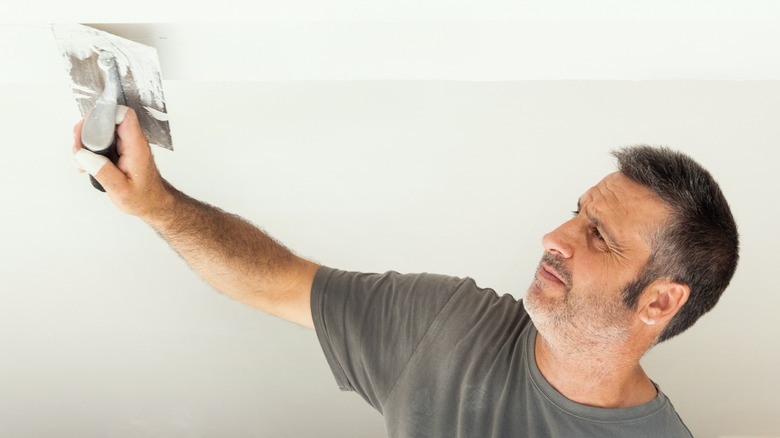
Popcorn ceilings easily trap nearly every dust bunny and cobweb that floats through the room. If you try to plaster over that grime, the compound won't bond well, so start by cleaning the ceiling. You can use a vacuum with a soft brush attachment or a dry microfiber cloth to give the ceiling a thorough pass.
Once it's clean, load your trowel with compound and spread it in thin, even coats. It's tempting to bury the texture in one heavy go because the motion gets tiring fast, but thick coats dry slowly and make it easier to create waves. Try to work in small sections. Your shoulders and wrists will feel it, but slowing down helps you avoid lumps and ridges. Now comes the part most DIYers hate: waiting. You have to give the first coat at least 24 hours to fully dry.
When it's dry, you'll probably spot low areas and trowel lines. That's what a second, and sometimes third, thin coat is for. After your final coat dries, do a light sanding with a pole sander, and the ceiling will start to look properly smooth. Don't forget to wipe off sanding dust before painting. When you're ready to paint, don't just grab a leftover can from the garage. Use ceiling paint. It's usually thicker and less drippy for overhead work, and the ultra-flat finish helps hide any minor trowel marks you might still have.