

If Your Furnace Is Blowing Cold Air, Here's What It's Trying To Tell You

Turning on your furnace, you expect warm air, yet sometimes you get just the opposite. When your furnace is blowing cold air, it tells you something is not working properly in the system. The problem could be related to efficiency, the thermostat setting, a faulty sensor, or several other issues. While you can check for the simple fixes, such as a clogged air filter, sometimes an older unit consistently blowing cold air is one of the signs that it's time to replace your furnace. However, if your furnace is new, the cause could be poor installation.
If your furnace is producing cool air, don't panic. There may be quick solutions. If it's your first time turning on the heat after a long period of running only the air conditioner, a little cool air is normal. A furnace isn't designed for delivering instant warmth when you set your thermostat and needs a few minutes to heat up. In fact, it goes through a series of cycles, gradually raising the air's temperature to the desired setting. As it works, you may feel cooler air as the warm air steadily circulates in your home. If the cold air persists though, it's a sign that your furnace requires attention. And you'll want to address that because when your furnace faces more strain, it can cause your energy bills to skyrocket.
Thermostats and pilot lights may be the cause of cold air
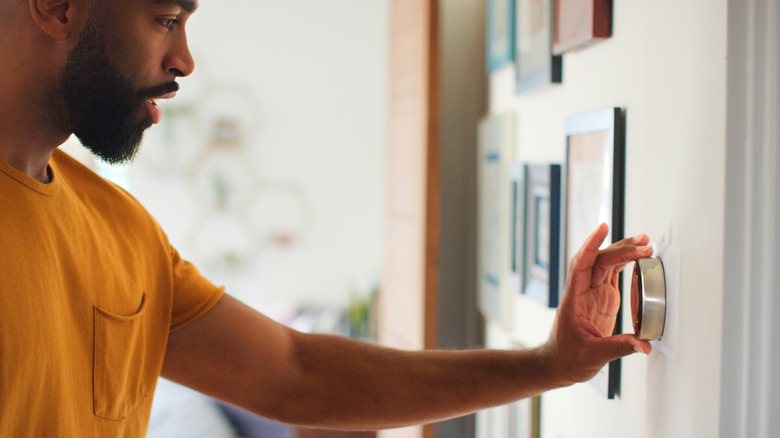
Check your thermostat. Is it set on "Cool," instead of "Heat" or "Fan," because you didn't push the button firmly? If so, switch to "Heat" and "Auto." Are you using a smart thermostat that could be set on an automated cooling schedule? Check these settings. If that doesn't resolve the problem, move on to the next steps. Cold air can also happen when a gas furnace pilot light goes out, because it won't ignite properly. Check for a blown pilot light. You can either attempt to re-light it by following the instructions in your unit's manual or contact a furnace repair professional for assistance. If you smell gas, avoid lighting it again and open your windows before stepping outside to call the gas supplier.
Sometimes the issue boils down to upkeep. Furnace maintenance is important for a properly working unit. Neglecting it can lead to issues like cold air blowing from your vents. A clogged filter can block airflow, trapping heat inside the furnace instead of sending it through your ductwork. When this happens, the system may overheat and shut down for safety, leaving your home without warm air. Dirt can also cause cold air if present on the flame sensor. A blocked or broken sensor cannot accurately detect the burner's heat, so it powers down. The sensor consists of a thin metal rod near the flame. If it's not covered in soot, you should be able to see it. A technician can also check to see if that's the problem.
Your furnace may have an issue with its vents or ducts
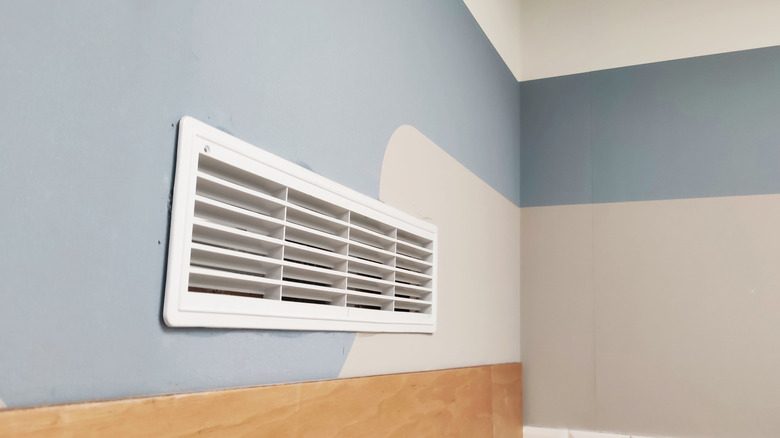
The cool air coming from your heater may actually originate from the vents, while the furnace is working as it should. Because a furnace needs proper airflow, it may overheat if you have too many vents closed. One reason you need to think twice about closing your vents in the winter is because of the extra pressure it puts on your heating system as it works harder to push out warm air. Check your home for any closed vents, then try kicking on the furnace again.
It is possible that your home's ductwork system may be leaking warm air, letting it seep through hidden gaps and cracks. Because the hot air escapes from the leaks in the duct, the air that reaches your room is cooler than it should be. If you have exposed ductwork, you may be able to test it. Simply place your hand on the duct's seal. Do you feel air escaping? If the answer is no, you might need a more thorough inspection of your attic or crawlspace. If you've performed these simple checks and you still cannot pinpoint the problem, you may need to contact a furnace repair professional so that you can feel comfortable in your home once again.