

Michigan Just Joined The List Banning The Japanese Barberry Shrub: Is Your State Next?
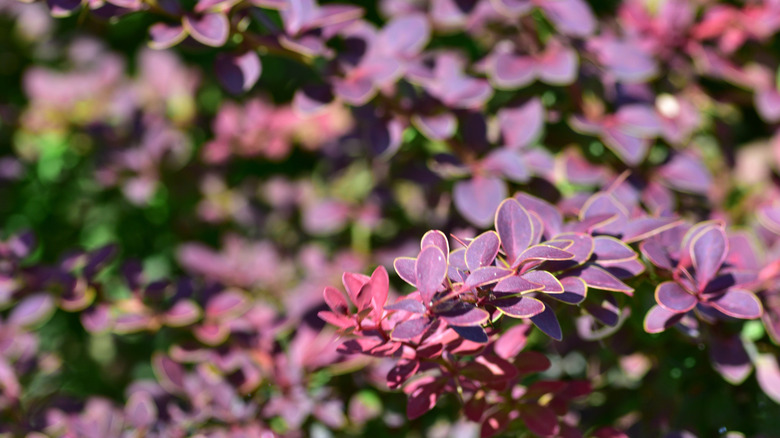
In January 2026, Michigan announced that by 2028, it would no longer allow landscapers or homeowners to purchase, sell, or plant the coveted Japanese barberry shrub (Berberis thunbergii). The news came bittersweet to gardening enthusiasts because the Japanese barberry shrub produces stunning blooms that are hardy and resilient in various landscaping applications. However, looks aren't everything. Even if your state hasn't banned it yet, you may want to think twice before planting Japanese barberry in your garden.
Japanese barberry is a hardy perennial that grows in USDA hardiness zones 4 to 8. It was brought to the United States in the 1800s, but it wasn't until the 1970s that it gained popularity. Less than 20 years later, the plant began taking over natural habitats in the northeastern United States, where it was evaluated as an invasive species as early as 1994. By the early 2000s, states began banning the plant altogether. Michigan is the latest state to add Japanese barberry to its local invasive species list with a proposed plan for removal and management. Even though the vibrant shrub is a gardener's dream, it can wreak havoc on the local environment. These shrubs are exceptionally difficult to remove once they are fully established.
Why Japanese barberry shrubs are being added to invasive species lists

An invasive species is defined by the U.S. Department of Agriculture as a non-native species that causes economic, environmental, or human harm. When it comes to Japanese barberry, the impact is largely environmental, but it can indirectly impact human health as well. Ultimately, it has been included in numerous invasive species lists because the underground rhizomes make removal difficult and the seeds spread aggressively, choking out native plants and harboring dangerous pests. It can also be harmful to local wildlife.
As if the spreading habits weren't bad enough, Japanese barberry is also a host for damaging diseases and pests that can impact local wildlife and human health. In 2008, it was confirmed that Japanese barberry is a host for black stem rust, which is a fungal disease that can eradicate entire grain crops like wheat, barley, and rye. But that's not the only thing these shrubs are hosts for. Both black-legged ticks and deer ticks love Japanese barberry plants, which can increase the chance of Lyme disease and the demand for protection from ticks. Local wildlife also suffers when Japanese barberry takes over. Aside from disrupting habitats, the plant is toxic to some animals, especially deer, which can have a significant impact on herd populations.
What states banned the Japanese barberry shrub and which ones are next?

Japanese barberry was first introduced in a single park in Boston in 1875. By 2012, it was recorded to have established growth across 31 states and some areas of Canada. Yet there are currently only 23 states that have it included in their invasive species list. Michigan will be the 12th state to introduce state laws banning the sale and growth of the plant. States that already have bans in place include Maine, New Hampshire, Vermont, New York, Massachusetts, Maryland, Indiana, Wisconsin, and Minnesota. Pennsylvania and West Virginia introduced bans in 2021 and 2020, respectively, and are still in the process of implementing these bans.
Some states still consider Japanese barberry an aggressive grower, which is different from an invasive status. If your state already lists Japanese barberry as an invasive species, it may be a sign that your state may be next to implement a ban. It is included on the invasive species lists in Rhode Island, Connecticut, New Jersey, Delaware, Ohio, Virginia, Kentucky, Alabama, Georgia, Missouri, and Iowa.