

Help Your Fresh Paint Job Dry Faster With The Help Of A Must-Have Solution

When it comes to personalizing your home, painting the walls is one of the easiest way to transform it. However, waiting for paint to dry can be a frustrating process. And if you touch the wall hours later and the surface still feels sticky or soft to the touch, you could be dealing with a humidity problem. Common paint types, like acrylic and latex, can feel dry to the touch in as little as 30 to 60 minutes. Delays in that drying time are usually caused by lingering moisture in the air, making it tough for your paint to shed its water content and harden properly. So what can you do? It's simple: put a dehumidifier in the room. It seems like an unlikely place to use a dehumidifier, but it's a big help.
To understand why your project is stalled (and why a dehumidifier is the solution), we have to look at the science of evaporation. Most modern interior paints are water-based. For that paint to dry and cure, the water inside it needs to evaporate into the surrounding atmosphere. But if your room is humid, there's already a lot of moisture in the air. The saturated air slows down the evaporation process — there's simply nowhere for the moisture in the paint to go. This keeps your paint from fully drying and can reduce how well it sticks to your walls to begin with. It's tempting to reach for a box fan in this situation, but it ends up only moving damp air around and doesn't solve the problem. You need a way to pull that water out of the room so the paint can finally release its water and set. That's where a dehumidifier fits in.
How to set up a dehumidifier to help create a drying shortcut
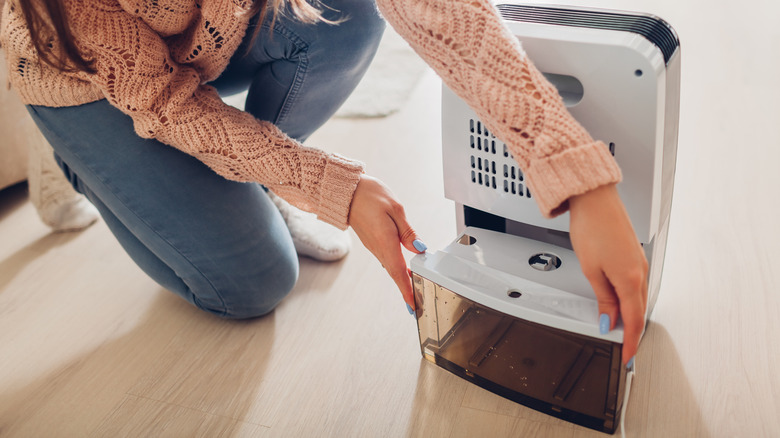
By placing a portable dehumidifier in the room you just painted, you have more control over the drying speed instead of just hoping the paint dries on its own. Dehumidifiers act like a vacuum for moisture in the air, creating the moderate humidity conditions that paint manufacturers recommend. The ideal humidity range for helping paint dry is between 40% and 50%. For the best results, place the unit away from walls. Placement matters, as there are flat-out bad spots to put your dehumidifier; keep it a few feet away from your still-wet walls so it doesn't blow dust onto them. Keep the windows and doors closed, too, while the machine runs. That helps create more of a sealed drying space that helps the dehumidifier work more efficiently.
Using a dehumidifier does more than save you time, though. When paint dries too slowly, it's far more prone to picking up dust and other gunk floating around in the air. A dehumidifier speeds up how long it takes for paint to dry, helping the surface reach a dust-dry point faster where it'll no longer be able to collect any dust. It also makes it so you'll be able to apply your second coat much sooner (and get that dried up faster, too), cutting your total project time significantly. Just remember to empty your dehumidifier's tank regularly so you can keep using it. Once the air is crisp and dry, you should notice your paint leveling out into a streak-free finish that looks like you hired a team of professionals to come paint it. Now that you've mastered this, you can stop hovering over your walls and start enjoying your beautiful new space!