

The Popular Flowering Tree With Stunning Bark That Lights Up Your Yard In Winter
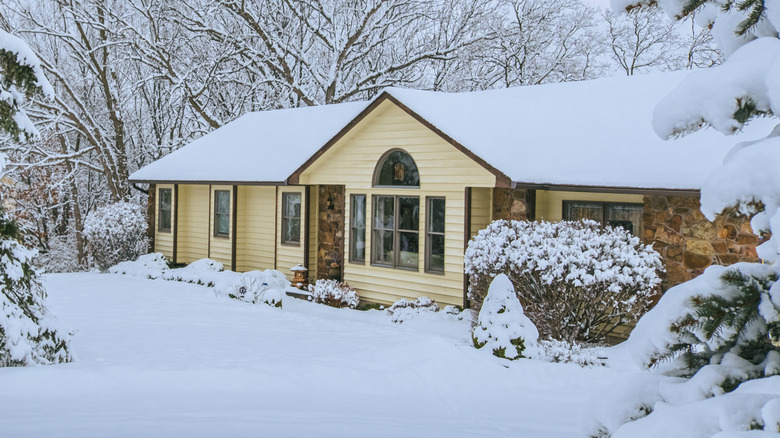
Winter can be a tough time for gardeners and lovers of beautiful foliage and flowers. With so much of nature lying dormant, often under layers of snow or ice, the colorful blossoms of spring and summer and brightly-hued leaves of fall are often something we miss and long for in our yards during the coldest, grayest months of the year. However, there is a plant that you can incorporate in your landscaping that yields colorful, vibrant beauty on its trunks year-round: the crepe myrtle (Lagerstroemia).
Crepe myrtles are a collection of trees and shrubs native to China that grow in USDA Hardiness Zones 6 to 9. They produce big, boisterous blooms in an assortment of shades from July to September, and a kaleidoscope of rich burgundies, reds, yellows, and purple foliage in the fall. Then, while many other trees and shrubs are mostly barren during the winter months, that's when crepe myrtles really start to show off. If the crepe myrtle tree is given what it needs to flourish in wintertime, healthy, fully-mature crepe myrtles exfoliate and shed their barks, revealing a gorgeous assortment of colors underneath. So if your yard is feeling low on color and a little dull during the shortest days of the year, incorporating a crepe myrtle or two can be a lovely way to give your garden a beauty boost.
How to get beautiful crepe myrtle bark in your backyard
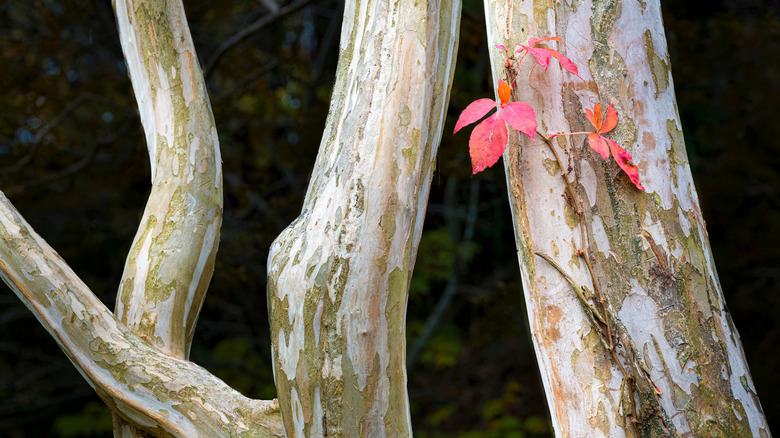
Certain cultivars of crepe myrtle trees are especially adept at showing off stunning winter bark colors. In fact, a series of crepe myrtles bred by the National Arboretum in Washington, D.C. has been specifically designed to display this particularly beautiful trait! For example, 'Natchez' crepe myrtles have bark that peels away in layers of lovely cinnamon, while 'Muskogee' crepe myrtles also exfoliate in winter, leaving an attractive light gray base. 'Pecos' crepe myrtles display multiple colors as they exfoliate their bark,and the 'Centennial Spirit' crepe myrtle sheds in strips of cream bark.
If you want your crepe myrtle tree's bark in tip-top shape, keep some care tips for a healthy and thriving crepe myrtle tree in mind. Be careful not to over-prune; trimming off too much, i.e. performing what's called "crepe murder," can result in weak growth and prevent all that lovely, colorful bark from forming. And to keep the bark healthy and strong, look out for unsightly infestations, such as crepe myrtle bark scale. While the scale won't kill your tree, it will certainly cover up all that beautiful, colorful bark we love and generally make the tree less appealing to look at, so be sure to take care of it early on. To get rid of scale on plants, scrub the branches and trunks with warm, soapy water, then cover the tree with a dormant oil, followed by a systemic insecticide. If any smaller branches are too far gone, simply remove them, seal them up in garbage bags so that the pests can't spread, and put them in the trash.