

The Basil Variety Believed To Bring Luck To Your Home

The aromatic herb called holy basil (Ocimum tenuiflorum) has a long history as a sacred plant in Indian culture. Its common name translates to Hindi as "the incomparable one" and in English it's also known as tulsi. These names point to the Hindu belief that this herb is a manifestation of the goddess Lakshmi and its role in Vastu Shastra, an Indian philosophy-driven way of designing spaces with an attention to the balance of elements and flow of energy. If you're using Vastu Shastra principles in your home and garden, or just hoping to surround yourself with positive plant energy, consider growing holy basil, which is thought to bring good luck and prosperity into the environment. Grow holy basil from seed, then either keep the revered plant indoors or transfer it to your warm-weather herb garden. Once you have your thriving holy basil, certain placements in the home are thought to enhance its good-luck properties.
Holy basil is related to the more familiar sweet basil (Ocimum basilicum) more commonly used cooking, but you can tell it apart by the purplish hue of its leaves, which are pointier than other varieties of basil and have more defined serrated edges. While it's an edible herb, holy basil has a stronger and spicier taste than sweet basil, with notes of mint, pepper, and lemon. Whether eaten raw, brewed into a tea, or ground into a powder, it's most often consumed for health reasons, especially according to the tenets of Ayurvedic medicine.
Starting seeds and proper placing for good luck
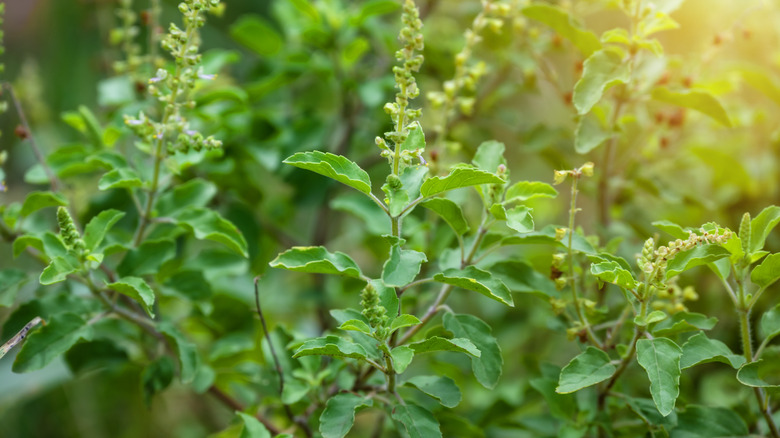
You can grow holy basil indoors, outside as an annual, or in a year-round garden in USDA Hardiness Zones 10 and 11. Like sweet culinary basil, you should grow this herb from seeds instead of a seedling, for more control over its growth. Sow the seeds into a thoroughly moistened peat moss and perlite mixture to give them the best chance of germinating. If your goal is to transfer the holy basil into the ground outside, start this process around four weeks before the final frost in your area.
The way you tend to holy basil, which is known to reach a height of 24 inches ore more, depends on how you want to use it. To admire its flowers, let it grow wild, but to harvest for cooking or tea, cut off the leaves to harvest them before flowers emerge. Picking the leaves often will result in even more of the foliage developing for an abundant harvest.
There are particular rules for where to place your holy basil plants if you're following Vastu Shastra. The practice holds that the holy basil should be placed in an east direction, while avoiding a southern spot. Since the plant is considered sacred, this design system also calls for literally elevating the plant rather than growing it at floor or ground level, and keeping it far from cleaning implements that get dirty. It's a good thing holy basil is an herb that thrives in hanging baskets. Finally, holy basil should be grown in odd numbers according to Vastu Shastra, so if you want to get more than one, add plants in increments of two!