

The Lesser-Known Liquid That Helps Indoor Spider Plant Thrive

Spider plants are often sold as being unkillable. The reputation isn't totally wrong, but it isn't completely true either. These grass-like houseplants are certainly resilient; they'll keep growing even in poor conditions and with little care. But surviving and thriving are not the same thing — especially when it comes to indoor greenery. In your home, spider plants rely completely on what's in their pot for food. So yes, houseplants really do need to be fertilized — even the ones marketed as low maintenance. Before you run to the store for any old houseplant fertilizer, take a pause to consider your options. One of the best additives for indoor spider plants is liquid fish food fertilizer.
This applies even if you choose the best spider plant variety for your houseplant collection. No matter the cultivar, they all need the right amount of light, water, and nutrients to thrive. Over time, the nutrients in that soil get used up, which leads to slow growth and discolored leaves. You may even notice that the spider plant stops putting out plantlets. All this tends to happen gradually, so many people don't notice their plant is struggling until it's in deep trouble. Of particular importance is nitrogen, which supports leaf growth and helps maintain a healthy green color. Spider plants are, after all, grown for foliage, not flowers, so a steady supply of nitrogen is vital. It just so happens that fish fertilizer has nitrogen in abundance.
How fish food supports spider plant growth — and one drawback
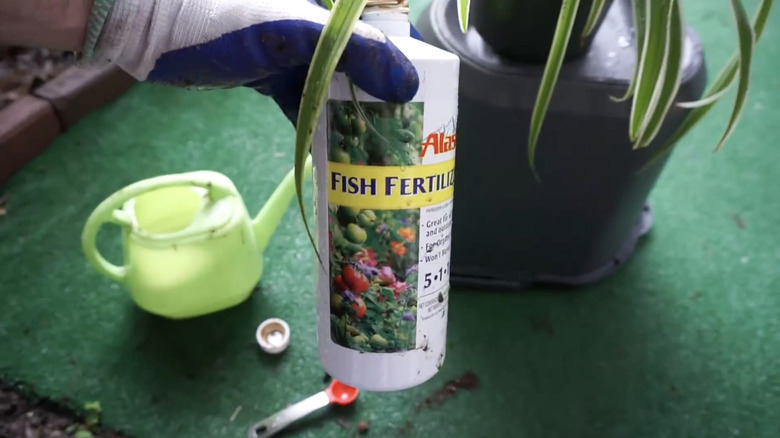
That's right, liquid fish food fertilizer, also known as fish emulsion, is a common household item that can be used as natural fertilizer. In fact, it works particularly well for spider plants. Just don't confuse it with liquid fish food for pets! The biggest advantage of fish emulsion is that it's gentle. Unlike with plants in garden beds, any excess fertilizer tends to get trapped in a houseplant's pot. Plus, spider plants don't respond well to heavy feeding. Using strong fertilizers or overfertilizing can burn their roots and cause leaf tips to brown. Mix liquid fish food fertilizer with water, which releases the nutrients slowly into the soil. As such, it really only needs to be applied once every two weeks during spring and summer. In winter, when growth typically slows, you don't need to feed your spider plant at all.
There is one drawback, and you may have already guessed what it is: the smell. Most commercial fish emulsion is made from fish by-products, so yes, it's probably going to have — and maybe even leave behind — a less-than-appealing odor when you apply it to your plant. That's even the case if you dilute it in water. There isn't too much you can do about the smell, so we say embrace it! You could try placing your potted spider plant near an open window when fertilizing it, but that may not be sufficient. If a spider plant has stalled but isn't visibly struggling, nutrients are often the missing piece, and liquid fish food might be just the natural input you — and your struggling plant — need.