

The Floating DIY Seat Arrangement That Works Perfectly In Small Spaces
We may receive a commission on purchases made from links.
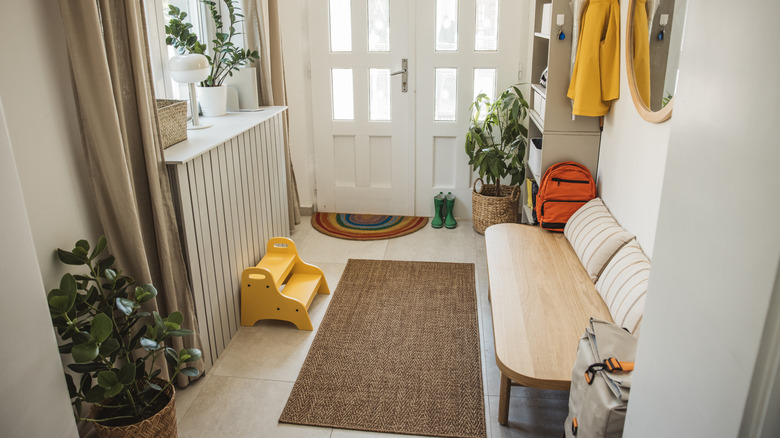
It can be challenging to fit enough seating into a small room or apartment. Even if you do, the place can look cluttered, and you're almost certainly giving up valuable storage space. One clever option is to DIY a floating seat arrangement. It's the same idea as DIYing a long floating shelf, but upscaled to support the weight of a couple of people. It can be an attractive, space-saving addition to a room and also allows for stylish containers to slide underneath yet remain easily accessible.
The construction of the floating bench requires that you cut into the existing drywall, so if you don't own the property, you'll need to check for permission. That aside, it's a DIY that should be within the skill set of anyone with modest experience. Most of the tools can be found in the kit of essential tools Mike Holmes says every homeowner should have. You can use a utility knife to cut through the drywall, but a pad saw (it looks a bit like a bread knife) is better.
To provide the required strength for the floating seat, we're going to use Fittes Heavy Duty Steel Brackets, which support up to 350 pounds each. They cost $92 a pair from Amazon, and you'll need two sets. Note that your wall studs need to be at least 2-by-4 to accept these.
Fit the supports for your floating seat and decide the style
Your floating seat will run across four wall studs. There are some simple tips to find a stud if you don't have a stud finder. Next, decide the height of your seating. It's entirely up to you, but a dining chair is a useful guide. Mark the wall, and then measure up and down 5 or 6 inches, and use a level to draw horizontal lines. This piece of drywall must be removed to fit the brackets. Be careful when cutting, as it needs to go back again.
Fittes provides a useful video showing how to attach its brackets, but before you do that, you need to decide the style of floating seat you want. There are two main options. One has a simple wooden frame made from ¾-inch plywood and 1-by-4-inch lumber found at most hardware stores. The other uses concrete for a modern industrial aesthetic. That decision will affect how much height you need to allow when fitting the brackets.
Once the brackets are in place, mark the positions of the extending arms on the drywall you cut out, and cut holes so you can slide the drywall back into its original position. Use tape and drywall compound to cover the edges. You'll need to paint over this, but that's best left until the floating seat is completed.
Install the DIY floating seat
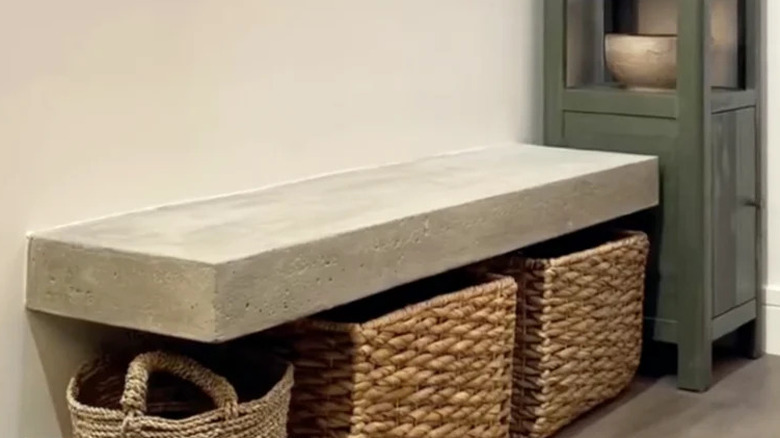
The wooden frame is made by screwing 1-by-4-inch lumber to three edges of a sheet of ¾-inch plywood of the desired size. Hide the screw holes with wood filler, and stain or paint the frame to match the room. The frame simply rests on the Fittes brackets. A couple of ordinary shelf brackets attached underneath and to the two middle wall studs stop it from moving around.
A similar frame can be used upside down to provide a form for the concrete. However, it will need wooden legs screwed to each corner to support the weight while the concrete sets. These are purely functional, so they don't have to be neat. You'll also want four lengths of rebar running horizontally across the supports for reinforcement. There are holes in the Fittes brackets to wire or zip-tie these in place.
Seal the edges of the form where they meet the wall with silicone before you pour the concrete. Using something like Quikrete Countertop Mix is a good idea, as it has an easy-flow formula designed for beginner use. It also saves you from buying separate products and mixing them yourself. Once the concrete has set, simply take the form apart and discard it. Smooth the top of the concrete using a random orbital sander with 150 to 220 grit, and then finish with concrete sealer to help prevent staining. Either style of floating seating could be topped with loose cushions, or you could make one to size with foam and the fabric of your choice.