

Can Severe Winter Weather Cause Trees To Explode? Here's What We Found
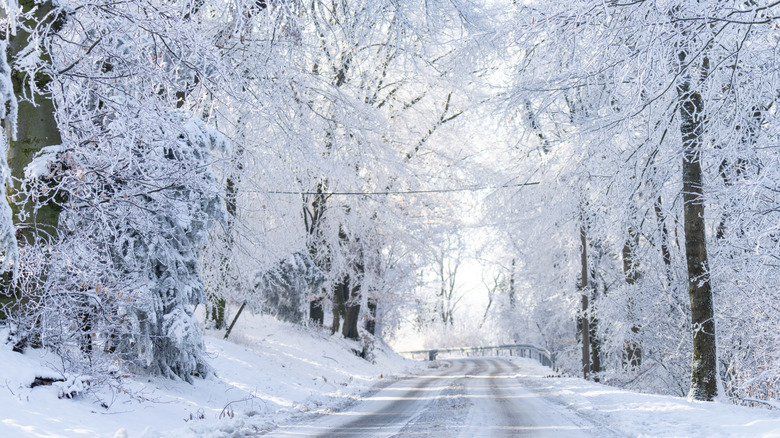
From frozen iguanas falling from the sky to spinning circles of ice on rivers, rare natural events related to the weather remind us that nature doesn't always behave as expected. Whether it's thundersnow or fire tornadoes, some of the stories related to extreme weather events sound more like fiction than fact. Case in point: Trees exploding in cold weather. If you've heard of this, you might have dismissed it as an urban legend or an internet myth, but what we found is that there's some truth behind the stories.
There are many historic references to exploding trees, but some meteorologists are hesitant to use the hyperbolic term "exploding." Instead of exaggerating, they prefer to use terms like "frost cracking" to describe what can happen to trees when temperatures plunge during a winter storm. Frost cracking, which isn't always noisy, happens because trees rely on sap to survive during the winter, and sap contains water. When temperatures plunge rapidly, the water in the sap expands as it freezes, and the resulting pressure can cause a tree to crack or split. The sound that accompanies frost cracking in trees can be quite loud, sounding like a gunshot, a car backfiring, or a loud clap. In other words, it sounds like an explosion.
However, saying that trees are exploding conjures visions of fully exploding trees splintering into a million pieces, and frost cracking isn't always so dramatic. It can cause significant damage to trees, but tree removal might not be the right decision, as many of them do heal.
Discover the truth about rare exploding trees
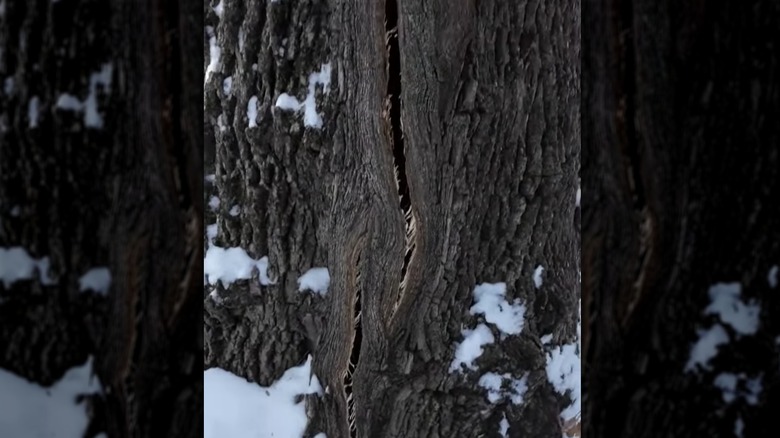
Not all frost cracking in trees creates an explosion, and you may have already seen the results of this in your own yard. Frost cracking is more common in some types of species, including maples, apples, horse chestnuts, walnuts, willows, green ash, box elder, chokecherry, and birch. It's also more likely to occur with young, non-native, or thin-barked trees. Certain types of weather patterns also lead to frost cracking, especially clear, cold days in the middle of winter. On these days, when sunlight warms and expands the tree's cells during the day and is followed by frigid temperatures at night, it makes trees even more susceptible to frost cracking.
According to Janet Laminack with Denton County, Texas A&M AgriLife Extension, large temperatures fluctuations are the most likely to blame. When people reported exploding trees in Texas in 2022, she explained via 5NBCDFW, "Our wide temperature swings mean that trees may not be completely dormant or prepared for the cold." She adds that, "Trees have several mechanisms they use to prevent freezing. Colder climates tend to get cold and stay cold and the tree takes cues to get acclimated and ready for the freeze." That's why wrapping vulnerable trees in the fall should be one of the things you should do in winter to prep your garden or yard. Another idea to reduce your tree's exposure to the elements is to plant in layers, a landscaping idea that will create privacy in your yard while protecting the base of your tree.