

Easily Remove Scuffs From Your Walls With The Help Of A Cleaning Essential
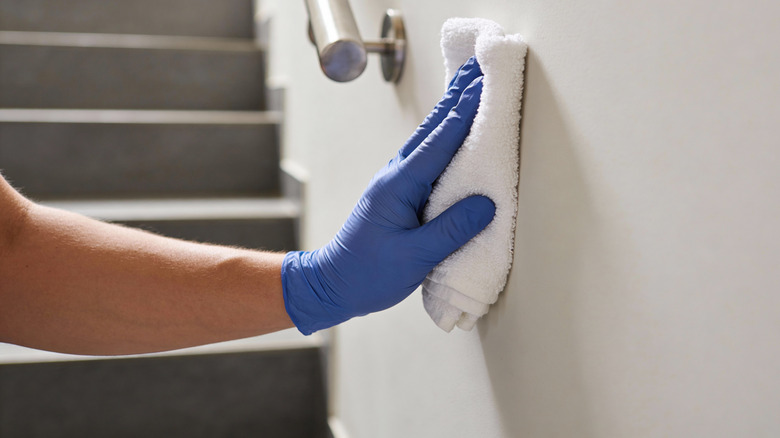
You may not think your walls get very dirty, but if you look closely, you may just start to notice scuff marks criss-crossing across them, particularly on the lower halves. These are superficial marks often caused by shoes or furniture. They're made when residue transfers from the object to the wall, and can be difficult to wipe off with a simple paper towel or sponge. Luckily, you don't have to resort to a specialty spray to help you remove those stubborn markings. Instead, all you need is a simple cleaning essential to easily clean your dirty walls: a microfiber cloth.
As you can probably guess from their name, microfiber cloths are made from millions of "micro" synthetic fibers, typically nylon and polyester. And they're truly micro — they're about 200 times thinner than human hair. This is important, because it increases the absorbency and surface area of the cloth. The tiny fibers glide over dirt and residue, "hook" onto the dirt particles, and trap them between the strands. It's why it feels like the cloth "catches" on your hand when you wipe it across your palm or fingers. It's with this technology that you're able to remove scuff marks from your walls.
How to get rid of wall scuff marks using a microfiber cloth
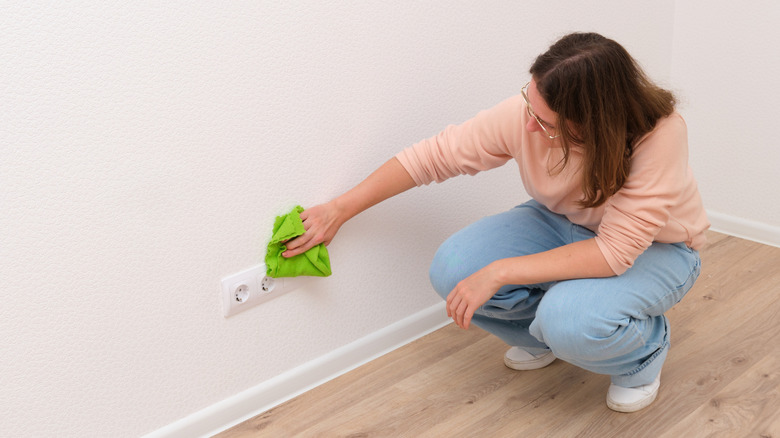
When using your microfiber cloth to remove scuff marks from your walls, you will want to slightly wet the cloth first, as this will help to scrub off the mark. Then, simply wipe the mark in a circular motion until it comes off. For an extra cleaning boost for super stubborn marks, you can add a sprinkle of baking soda onto the cloth as well, or make a water-and-baking-soda paste and rub it into the affected area with the cloth. Make sure to wipe the baking soda or pasta off with a damp, clean cloth to ensure there isn't any residue leftover. However, be careful using this method on flat or matte paint, as it can scrub some of it off.
To keep your microfiber cloths clean and durable, don't forget to try the simple layered folding trick, where you fold the cloth once, then over itself, and then over itself again, so you have eight usable sides. A lot of people make the mistake of exposing their microfiber cloths to high temperatures as well as not washing them regularly, both of which can decrease the product's overall lifespan. To wash your microfiber cloth after using it to clean your walls, separate from other fabrics and use the gentle cycle (avoid using fabric softener or dryer sheets), or hand wash in lukewarm water.